
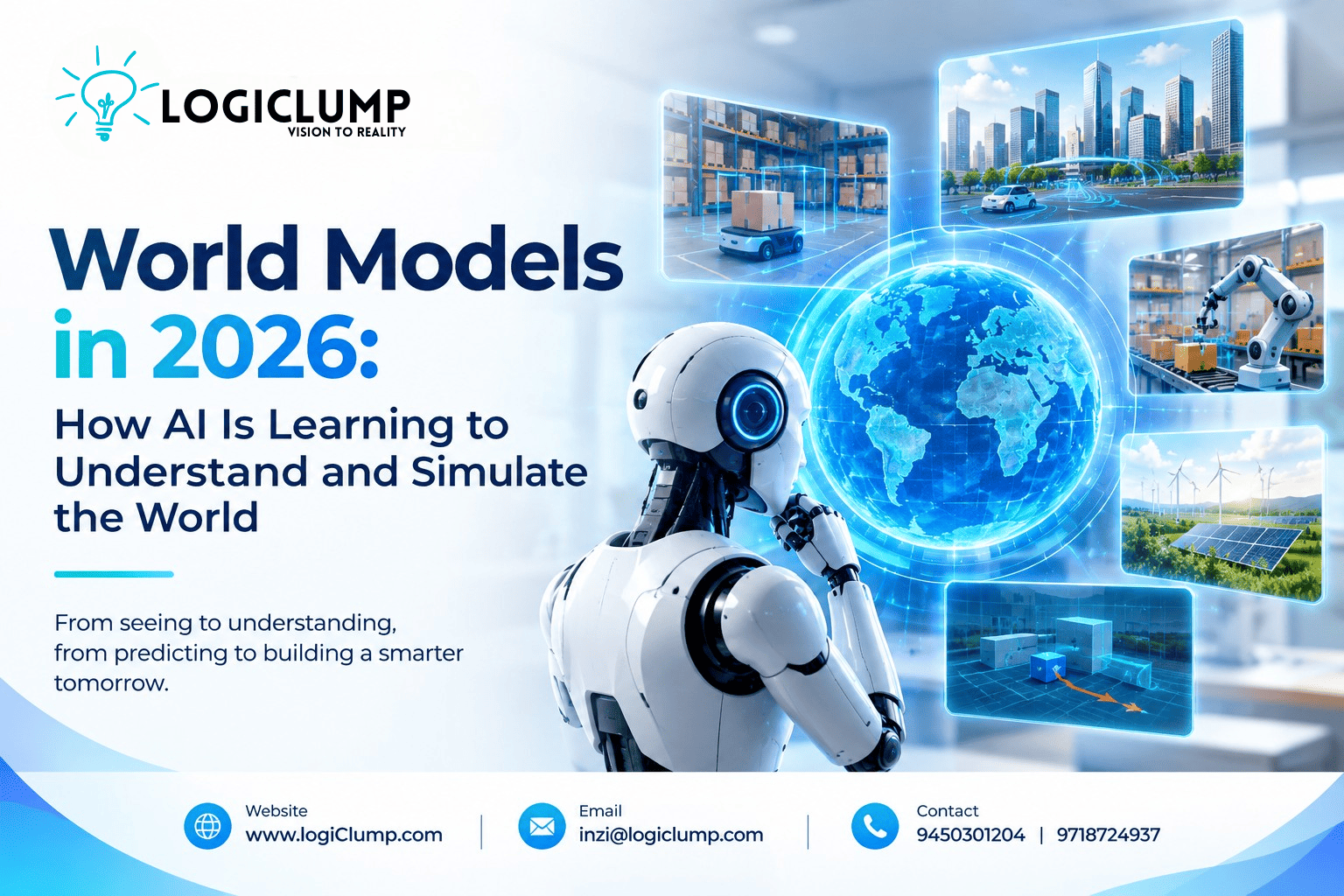
World Models in 2026: How AI Is Learning to Understand and Simulate the World
Generative AI has changed what software can create.
Today’s AI systems can write articles, generate images and videos, produce software code, summarize information, and communicate with users in increasingly natural ways.
But creating content is only one part of intelligence.
For many real-world applications, an AI system needs to understand how things behave, anticipate what might happen next, and evaluate the consequences of different actions.
A robot navigating a warehouse, for example, cannot simply recognize a box. It needs to understand where the box is, how it might move, whether another object is blocking its path, and what could happen if the robot reaches for it.
This is where world models are becoming increasingly important.
A world model attempts to create an internal representation of an environment so an AI system can reason about its current state, predict possible changes, and explore potential actions.
This emerging technology could become an important bridge between generative AI, autonomous agents, robotics, simulation, and physical AI.
What Exactly Is a World Model?
Think of a world model as a digital representation of how an environment behaves.
A conventional AI system may be able to identify an object in an image.
A more advanced system using a world model could potentially reason about what happens when that object is moved, dropped, pushed, or placed somewhere else.
The distinction is important.
A world model is not simply trying to answer:
“What am I looking at?”
It is also trying to answer:
“What is likely to happen if something changes?”
Depending on the system, a world model can represent elements such as:
- Objects
- Locations
- Movement
- Time
- Physical relationships
- Environmental conditions
- Actions
- Possible outcomes
The exact architecture varies between research projects, but the broader objective is to give AI systems a better understanding of environments and their dynamics.
Why World Models Matter After Generative AI
Generative AI has primarily focused on producing outputs.
A language model produces text.
An image model produces pictures.
A video model produces moving scenes.
A coding model produces software.
World models introduce another dimension: prediction and simulation.
Consider an AI system controlling a warehouse robot.
Instead of immediately choosing an action, the system could potentially evaluate several possibilities:
Move left → obstacle detected
Move right → longer route
Move forward → clear path
The system could then select an action based on its prediction of what may happen.
This creates a different AI workflow:
Understand → Predict → Evaluate → Act → Observe → Update
That approach is particularly relevant when AI interacts with dynamic environments.
From Generating Content to Generating Environments
One of the most interesting developments is the movement from AI-generated content toward AI-generated environments.
A generated video is normally something the viewer watches.
An interactive environment is different.
The user or AI can move through it, interact with objects, change conditions, and observe how the environment responds.
Google DeepMind's Genie research is an example of this direction. Its newer work explores interactive environments generated by AI rather than static media alone.
This concept could eventually allow developers to create environments for:
- Training
- Games
- Robotics
- Education
- Simulation
- Research
- AI-agent testing
The important change is that AI-generated worlds can potentially become interactive spaces rather than passive content.
World Models and AI Agents
AI agents are designed to perform tasks by using tools, information, and multi-step workflows.
But an agent operating in a complex environment needs some way to estimate the consequences of its decisions.
This is where a world model could become useful.
Imagine an AI agent responsible for organizing warehouse operations.
It could potentially use a world model to test:
- Different delivery routes
- Warehouse layouts
- Robot movements
- Scheduling changes
- Possible bottlenecks
Instead of immediately applying every decision to the real environment, the agent could first explore alternatives inside a simulation.
This creates an interesting combination:
AI Agent = Decides what to do
World Model = Estimates what could happen
Real System = Executes the approved action
Such an architecture could become increasingly important as AI systems gain more autonomy.
Robotics May Be a Major Use Case
Robots have to operate in environments that are unpredictable.
A human can look at a room and quickly understand that a chair is blocking a doorway or that a glass object may break if it falls.
For robots, these relationships need to be learned and represented computationally.
World models could help robots understand:
- Spatial relationships
- Object movement
- Navigation
- Interaction
- Environmental changes
- Action consequences
A robot could potentially simulate an action before performing it.
For example, before picking up an unfamiliar object, it could estimate its position, orientation, weight, and likely movement.
This doesn't mean world models will automatically make robots capable of human-level reasoning. Real-world robotics remains difficult.
However, better environmental prediction could provide an important component for more capable machines.
Autonomous Vehicles and Predictive Driving
Autonomous vehicles are another area where prediction matters enormously.
A vehicle needs to respond to an environment containing many independent elements.
These can include:
- Cars
- Pedestrians
- Cyclists
- Traffic signals
- Road construction
- Weather
- Lane changes
- Unexpected obstacles
Simply recognizing these objects is not enough.
The vehicle also needs to estimate how they may behave over the next few seconds.
For example:
If another vehicle changes lanes, what happens?
If a pedestrian approaches the road, what could happen next?
If traffic suddenly slows, which route is safer?
A world-model approach could potentially help an autonomous system evaluate multiple possible future scenarios before selecting an action.
The Connection With Physical AI
Physical AI refers to intelligent systems that can perceive and interact with physical environments.
This includes:
- Robots
- Drones
- Autonomous vehicles
- Industrial machines
- Smart equipment
- Intelligent sensors
These systems need more than language or image generation.
They need a relationship between perception, prediction, decision-making, and physical action.
A simplified architecture could look like:
Sensors
↓
Environment Understanding
↓
World Model
↓
Prediction
↓
AI Agent / Planner
↓
Physical Action
↓
New Sensor Data
The cycle then repeats.
This feedback loop could allow intelligent machines to continually update their understanding of their surroundings.
Simulation Could Become a Major AI Training Tool
Training AI in the physical world can be expensive.
A robot that makes a mistake in a simulation may simply restart.
A robot that makes the same mistake in a factory could damage equipment or interrupt production.
Simulation therefore provides an attractive training environment.
AI systems could potentially practice:
- Navigation
- Manipulation
- Industrial operations
- Autonomous driving
- Drone flight
- Warehouse tasks
before interacting with real equipment.
This is especially useful for situations where physical testing is costly, dangerous, or difficult to repeat.
World Models and Digital Twins
Digital twins already allow businesses to create virtual representations of physical assets and processes.
Factories, buildings, machines, energy systems, and infrastructure can be represented digitally to support monitoring and analysis.
World models could potentially make these environments more predictive.
Instead of asking:
“What is the current condition of this machine?”
a business could eventually ask:
“What is likely to happen if we increase production by 20%?”
or:
“What could happen if this component begins operating outside its normal temperature range?”
The system could simulate different scenarios and provide information for planning.
This could be useful for:
- Predictive maintenance
- Factory optimization
- Energy management
- Infrastructure planning
- Production scheduling
- Risk analysis
Gaming Could Enter a New Era
The gaming industry may also benefit from world-model technology.
Most modern games rely on environments created using predefined assets, rules, physics, and programmed interactions.
AI-generated environments could introduce a different approach.
Imagine describing:
“Create a futuristic city after a massive storm.”
An AI system could potentially generate the environment and allow the player to explore it.
The environment might dynamically change as the player interacts with it.
This could lead to games with:
- Dynamically generated worlds
- AI-created environments
- Adaptive characters
- Interactive scenarios
- Personalized gameplay
- Procedurally generated missions
The technology is still developing, but world models could eventually change how digital environments are created.
Education Could Become More Immersive
World models may also have applications outside entertainment.
Education could become more interactive when students can explore simulated environments instead of relying only on text, images, and conventional videos.
For example, students studying physics could experiment with simulated systems.
Engineering students could test machines virtually.
Architecture students could explore different building designs.
History students could interact with reconstructed environments.
Medical students could practice simulated scenarios.
This could make learning more experiential while reducing the cost and risk of physical experimentation.
Enterprise Applications Could Be Significant
The business potential of world models extends beyond robots and autonomous vehicles.
Organizations could use simulated environments to investigate different scenarios before making expensive real-world changes.
Possible applications include:
Manufacturing
Simulate production-line changes before modifying factory equipment.
Logistics
Test warehouse layouts and transportation routes.
Retail
Model customer movement and store layouts.
Energy
Simulate consumption patterns and infrastructure changes.
Construction
Explore different project configurations before implementation.
Training
Create realistic environments for employee training.
Infrastructure
Model potential changes to large physical systems.
The common theme is simple:
Test digitally before changing the real world.
World Models Need Reliable Predictions
There is an important limitation that businesses should understand.
A realistic simulation is not necessarily an accurate simulation.
An AI-generated environment can look convincing while still behaving incorrectly.
A world model might misunderstand:
- Physics
- Object behavior
- Long-term changes
- Rare events
- Multiple-agent interactions
- Real-world locations
This creates a critical distinction between visual realism and predictive reliability.
A simulation that looks realistic is useful for some purposes.
A simulation used to control an industrial robot or safety-critical system needs much stronger validation.
Real-world testing therefore remains essential.
The Data Challenge
World models also depend heavily on data.
A system attempting to understand an environment may require information from:
- Cameras
- Video
- Sensors
- Simulations
- Robot movements
- Historical observations
- 3D environments
- Action-and-result data
The model needs enough examples to understand how different situations evolve.
Poor or narrow training data can lead to poor predictions.
For example, a system trained mostly in clean indoor environments may struggle with unusual outdoor conditions.
This makes data quality, diversity, and representation extremely important.
Computing Infrastructure Will Matter
World models can require significant computing resources.
An AI system may need to process visual information, understand spatial relationships, simulate future states, and evaluate multiple possibilities.
This can create demand for:
- GPUs
- AI accelerators
- High-speed memory
- Cloud computing
- Edge computing
- High-bandwidth networks
- Real-time inference systems
As world models become more sophisticated, the supporting infrastructure will become increasingly important.
This connects world-model development with the broader growth of AI data centers and specialized AI hardware.
A New Software Architecture Is Emerging
Traditional applications generally execute predefined instructions.
AI applications introduced models capable of generating or interpreting information.
World-model applications could add another layer of prediction and simulation.
A simplified architecture might look like:
User / AI Agent
↓
Planning System
↓
World Model
↓
Simulation Engine
↓
Possible Outcomes
↓
Action
↓
Real Environment
↓
Sensor Feedback
↓
Updated Model State
This architecture can combine conventional software with AI models, simulation engines, APIs, sensors, and physical devices.
For developers, this represents a much broader technology stack.
Security Risks Will Increase With Autonomy
The more closely an AI system interacts with the real world, the more important security becomes.
A chatbot producing an incorrect paragraph may create a quality problem.
An autonomous system making an incorrect physical decision could create a much more serious situation.
World-model-based applications therefore need strong controls around:
- AI model access
- Device identity
- API permissions
- Sensor data
- Software updates
- Simulation environments
- Human approval
- Audit trails
- System monitoring
Security should be built into the architecture rather than added after deployment.
Human Oversight Will Still Matter
World models could help machines evaluate possible outcomes, but businesses should not assume that every decision needs to become autonomous.
Different actions can have different levels of risk.
For example:
Low risk:
Simulating alternative warehouse layouts.
Medium risk:
Recommending a robot route.
High risk:
Controlling machinery in a hazardous environment.
The appropriate level of human involvement can therefore depend on the consequences of failure.
The goal should not necessarily be maximum autonomy.
It should be appropriate autonomy.
World Models Are Part of a Larger AI Evolution
World models should not be viewed as an isolated replacement for generative AI.
They are part of a broader technology progression.
One possible way to visualize the evolution is:
Generative AI
Creates and transforms information.
↓
AI Agents
Use information and tools to complete tasks.
↓
World Models
Represent environments and predict possible outcomes.
↓
Physical AI
Uses perception, intelligence, and action to interact with the real world.
These technologies can work together.
A future robot could use a generative model for communication, an AI agent for task planning, a world model for prediction, and specialized software for physical control.
What Businesses Should Do Now
Most businesses do not need to immediately implement a world model.
The technology is still developing, and many applications remain experimental.
Instead, organizations can start by identifying situations where simulation could provide measurable value.
Good candidates include processes that are:
- Expensive to test physically
- Difficult to reproduce
- Risky to experiment with
- Highly data-driven
- Dependent on complex environments
- Suitable for digital simulation
Businesses can begin with digital twins, predictive analytics, simulation platforms, or AI-assisted decision systems before moving toward more advanced world-model applications.
What World Models Could Mean for Software Companies
The emergence of world models could create new opportunities for software developers.
Future projects may require combinations of:
- AI models
- Cloud platforms
- APIs
- IoT systems
- Real-time applications
- Simulation engines
- Data platforms
- Computer vision
- Analytics
- Mobile applications
- Robotics integrations
This means software companies may increasingly work across the boundaries of traditional application development and intelligent systems.
For technology providers such as LogiClump, this creates an opportunity to build software foundations that can connect AI models, business systems, data, APIs, automation, and intelligent devices.
The important objective is not to add a world model simply because it is a new technology.
The objective is to determine whether simulation, prediction, or intelligent decision-making can solve a genuine business problem.
The Future May Be About Simulating Before Acting
Generative AI made it easier for machines to create.
World models could make it easier for machines to predict.
That difference could become increasingly important.
Instead of an AI system simply responding to a request, future systems could potentially:
Understand the environment
→ Generate possible scenarios
→ Evaluate outcomes
→ Select an action
→ Execute it
→ Observe the result
→ Adapt
This approach could eventually support intelligent systems operating in both digital and physical environments.
Conclusion
World models represent an emerging direction in artificial intelligence that goes beyond simply generating text, images, videos, or code.
Their goal is to give AI systems a better representation of environments and enable them to reason about how those environments might change.
The technology could influence robotics, autonomous vehicles, gaming, industrial automation, digital twins, education, logistics, AI-agent training, and physical AI.
There are still significant challenges.
World models need better data, reliable predictions, efficient computing, realistic simulations, strong safety controls, and extensive validation before they can be trusted in high-stakes environments.
But their potential is significant.
The evolution of AI may therefore look increasingly like:
Generate → Understand → Predict → Plan → Act
Generative AI taught machines how to create.
AI agents are teaching them how to perform tasks.
World models could help teach them how to anticipate the consequences of those tasks.
And that could be one of the important steps toward AI systems that do not merely understand the digital world—but can increasingly simulate, navigate, and interact with the world around us.
Contact Us:
🌐 Website: www.logiClump.com
📧 Email: inzi@logiclump.com
📞 Contact: 9450301204 | 9718724937
Explore how world models could take AI beyond content generation through simulation, prediction, robotics, digital twins, autonomous systems, and physical AI.
Tom Cruise