
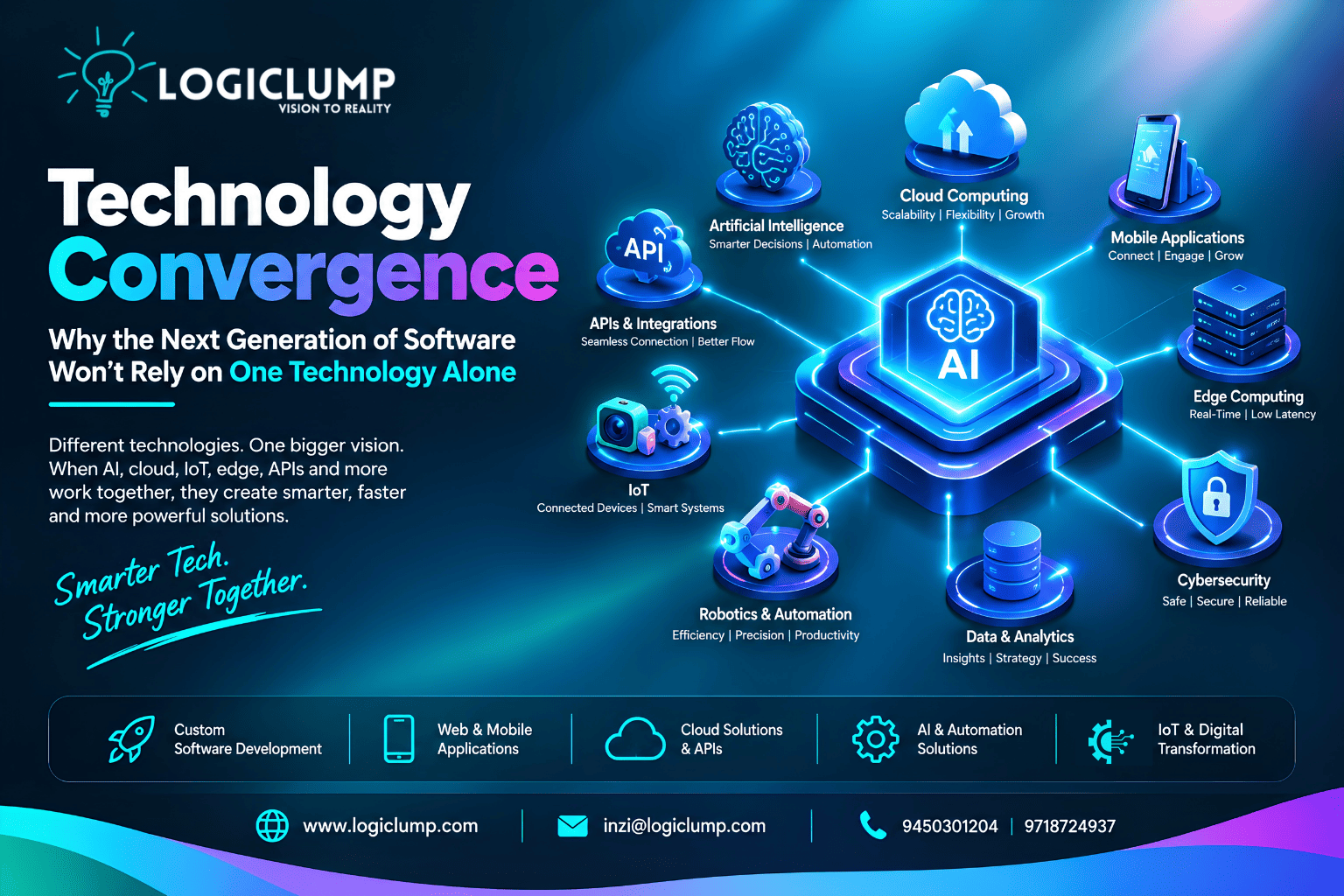
Technology Convergence
Software development is entering a new phase.
For years, technology discussions often focused on individual innovations—cloud computing, artificial intelligence, mobile applications, IoT, cybersecurity, or automation. Each technology was usually considered as a separate category.
That approach is changing.
Modern digital solutions increasingly combine several technologies to solve a single business problem. An application may use AI for decision-making, cloud infrastructure for scalability, APIs for integration, IoT devices for collecting information, and edge computing for real-time processing.
This growing interaction between different technologies is known as technology convergence.
The future of software may therefore depend less on choosing one "best" technology and more on understanding how multiple technologies can work together effectively.
What Does Technology Convergence Mean?
Technology convergence happens when different technologies are integrated to create a solution with capabilities that would be difficult to achieve using just one technology.
Consider a smart industrial system.
Sensors can collect information from machines. IoT technology transfers that information. Edge computing can process time-sensitive data locally. AI can identify patterns, while cloud platforms store and analyze larger datasets.
The result is a connected system rather than a standalone application.
Some common examples include:
AI + IoT → Intelligent connected devices
AI + Robotics → Automated decision-making systems
IoT + Digital Twins → Real-time virtual representations
AI + Edge Computing → Low-latency intelligent applications
Spatial Computing + AI → Context-aware digital experiences
The real value comes from the interaction between these technologies.
Why Modern Software Is Becoming More Connected
A traditional application might have consisted primarily of a frontend, backend and database.
Modern software can involve considerably more components:
Web/Mobile App → APIs → Business Logic → AI Services → Cloud → Database → External Platforms → Connected Devices
Each component performs a different job.
A mobile application might collect user information. An API can transfer that information securely. An AI service can analyze it, while cloud infrastructure provides storage and computing resources.
In other situations, the application may also communicate with physical devices or third-party platforms.
This means developers increasingly have to think about systems and ecosystems, rather than individual applications.
AI Is Helping Connect Different Technologies
Artificial intelligence is becoming an important component of technology convergence.
AI can analyze large amounts of information, identify patterns, generate predictions and automate decisions. When it is connected with other technologies, its capabilities can extend beyond a traditional software application.
For example, imagine a manufacturing environment containing connected machines.
Sensors collect operational information.
IoT transports the data.
Edge computing handles information that requires an immediate response.
AI analyzes machine behavior.
Cloud infrastructure stores historical information.
Analytics software presents the results to management.
Here, AI is not working independently. It is part of a larger technology ecosystem.
AI + IoT: Turning Data Into Action
IoT has made it possible to connect machines, sensors and devices to digital platforms.
But collecting information is only the first step.
AI can analyze the information generated by those devices and identify unusual patterns or potential problems.
For example, sensors attached to industrial equipment could monitor:
- Temperature
- Vibration
- Energy consumption
- Operating speed
- Machine activity
- Equipment health
An AI system can analyze these signals and identify patterns that may indicate a developing problem.
This can support predictive maintenance, helping organizations identify potential equipment issues before they cause major disruption.
The combination therefore moves IoT from simple connectivity toward intelligent automation and decision support.
Digital Twins, AI and Real-Time Information
Another powerful example of technology convergence is the combination of digital twins, AI and connected data.
A digital twin is a virtual representation of a physical object, system or environment.
When real-world data continuously updates the digital model, businesses can obtain a more current view of what is happening.
AI can then analyze that information and help explore possible scenarios.
For example:
Sensors → Live Data → Digital Twin → AI Analysis → Business Decision
This approach can be useful in manufacturing, logistics, infrastructure, energy and other industries where understanding real-world operations is important.
Instead of simply observing what happened in the past, businesses can use connected digital systems to explore what may happen under different conditions.
AI and Robotics: When Software Influences the Physical World
Software traditionally operates within digital environments.
Robotics creates a bridge between digital decisions and physical actions.
When AI is integrated into robotic systems, machines can potentially interpret information from their surroundings and respond accordingly.
A robotic system may need to:
- Detect objects
- Understand its environment
- Process sensor information
- Make decisions
- Perform physical actions
- Respond to changing conditions
This creates opportunities across manufacturing, warehouses, healthcare, logistics and other industries.
For developers, this also introduces new challenges because software must interact with physical environments, sensors and machines, not just screens and databases.
Edge Computing and AI: Processing Information Closer to the Source
Cloud computing has transformed modern software infrastructure, but sending every piece of information to a remote cloud server is not always ideal.
Some applications require extremely fast responses.
Examples include:
- Connected vehicles
- Industrial equipment
- Smart surveillance
- Wearable devices
- Robotics
- Real-time monitoring systems
Edge computing allows certain workloads to be handled closer to the device generating the data.
When AI processing is also moved closer to the edge, systems can potentially respond faster and reduce unnecessary data transmission.
This creates a powerful combination:
IoT + Edge Computing + AI
The result can be an intelligent system capable of making decisions closer to where events actually occur.
Spatial Computing and AI
Another emerging area of convergence is spatial computing.
Traditional software generally presents information through screens, menus and two-dimensional interfaces.
Spatial computing introduces a stronger understanding of three-dimensional environments and physical surroundings.
When combined with AI, it can enable applications that understand context, location, objects and movement.
Potential applications include:
- Product visualization
- Engineering
- Architecture
- Industrial training
- Healthcare
- Retail
- Remote assistance
- Digital twins
For example, instead of viewing information on a conventional dashboard, an engineer could potentially interact with digital information positioned within a representation of a physical environment.
How Technology Convergence Is Changing Software Architecture
As applications incorporate more technologies, software architecture becomes increasingly important.
A modern platform might look like this:
Web & Mobile Applications
↓
API Layer
↓
Application Services
↓
AI & Analytics
↓
Cloud Infrastructure
↓
Databases
↓
IoT & Edge Devices
Each layer needs to communicate reliably with the others.
Developers must therefore consider:
- API design
- Data flow
- Scalability
- Security
- Integration
- Fault tolerance
- Performance
- Monitoring
- System maintenance
The challenge is no longer simply writing application code.
It is designing a system where different technologies can operate together efficiently.
Integration Is Becoming a Business Priority
Having multiple technologies does not automatically create a better digital product.
A business might invest in AI, cloud platforms, IoT devices and analytics tools, but if those systems operate independently, their combined value may remain limited.
Successful convergence requires integration.
For example:
Customer App → API → AI Engine → Database → Analytics Dashboard
Each component contributes to the overall workflow.
Businesses therefore need to consider technology architecture from a broader perspective.
Instead of asking:
“Which technology should we purchase?”
A better starting point is:
“What problem are we trying to solve, and which technologies can work together to solve it?”
APIs Are Becoming More Important
APIs play a critical role in connected software environments.
Different applications and platforms often need to exchange information even when they are built using different technologies.
A business may use:
- A mobile application
- A web platform
- CRM software
- AI services
- Payment gateways
- Cloud infrastructure
- Analytics platforms
- IoT devices
- Third-party services
APIs can act as the communication layer between these systems.
For example:
Mobile App → API → AI Service → Database
Or:
IoT Device → API → Cloud → Analytics Dashboard
As technology ecosystems become more complex, reliable and secure APIs become increasingly important.
Security Gets More Challenging
Technology convergence also creates additional security considerations.
Connecting more systems means creating more communication points, interfaces and data flows that need protection.
A modern ecosystem may include cloud services, APIs, AI models, mobile applications, databases, connected devices and third-party platforms.
Each component can introduce different security requirements.
Businesses should consider areas such as:
Identity Management
Only authorized users and systems should be able to access resources.
API Security
Communication between applications needs to be protected against unauthorized access and misuse.
Device Security
Connected devices should be properly authenticated and maintained.
Data Protection
Sensitive information needs appropriate protection throughout its lifecycle.
AI Security
AI systems should also be protected against malicious inputs, unauthorized access and inappropriate use.
Monitoring
Organizations need visibility into system activity so unusual behavior can be investigated quickly.
Security should therefore be part of the architecture from the beginning.
Technology Convergence Does Not Mean Using Everything
There is an important distinction between technology convergence and simply adding more technology.
A business does not need AI, robotics, IoT, edge computing and digital twins just because these technologies are popular.
For a simple corporate website, such an architecture would add unnecessary complexity.
For an industrial monitoring platform, however, combining IoT, cloud infrastructure, analytics and AI might provide meaningful value.
The objective should always be:
Use the right technology for the right problem.
More technology does not automatically mean a better solution.
How Businesses Can Prepare for the Convergence Era
Businesses can take several practical steps to prepare for increasingly connected technology environments.
1. Define the Problem First
Technology selection should begin with a business requirement.
For example:
Challenge: Frequent equipment failures.
Potential technology combination:
IoT + AI + Analytics + Cloud
2. Build Modular Systems
A modular architecture makes it easier to add or replace individual components as business requirements change.
This can also reduce the need to rebuild an entire platform when a new technology becomes available.
3. Strengthen Data Infrastructure
Many emerging technologies depend on reliable data.
Businesses should establish strong practices around:
- Data storage
- Data quality
- Data governance
- Data integration
- Access control
- Data security
Poor-quality data can limit the effectiveness of even advanced technologies.
4. Focus on Interoperability
Different technologies should be able to communicate effectively.
Well-designed APIs, standardized interfaces and modular architectures can make integration easier.
5. Include Security From the Start
Security should not be treated as an afterthought.
Every new device, API, platform and integration should be evaluated for potential security risks.
6. Introduce New Technologies Gradually
Businesses do not have to transform their entire technology environment at once.
Starting with a focused use case allows organizations to evaluate results before expanding the solution.
What Technology Convergence Means for Developers
Technology convergence is also changing the skills required in modern development teams.
Developers will continue to need strong programming fundamentals, but understanding how different technologies interact is becoming increasingly valuable.
Depending on the project, developers may encounter:
- APIs
- Cloud platforms
- AI services
- Databases
- Distributed systems
- IoT
- Edge computing
- Cybersecurity
- DevOps
- Data engineering
Nobody needs to become an expert in every technology.
However, developers who understand how different components fit into a complete system can contribute more effectively to complex projects.
This broader perspective is often called systems thinking.
The Future of Software Is an Ecosystem
The next generation of digital products may increasingly operate as interconnected ecosystems rather than isolated applications.
Imagine a business platform where:
A mobile app interacts with
an AI service, which connects through
secure APIs to a cloud platform, which processes information from
IoT devices, while a digital twin represents the physical environment and analytics systems help businesses understand the results.
Every component has a different purpose.
The overall capability comes from connecting them.
That is where technology convergence becomes meaningful.
How LogiClump Approaches Modern Software Development
At LogiClump, we believe technology should be selected according to the requirements of the product and the business.
A modern digital project may involve website development, mobile application development, custom software, API integration, cloud services, analytics or AI capabilities.
Instead of forcing every project into the same technology stack, the architecture should be designed around factors such as:
- Business objectives
- Performance
- Security
- Scalability
- Integration requirements
- Development cost
- Long-term maintenance
The goal is to create a digital solution that can work effectively today while remaining flexible enough to adapt tomorrow.
Final Thoughts
The future of software is unlikely to belong to one technology.
AI, cloud computing, IoT, edge computing, robotics, spatial computing, analytics and other technologies will continue to develop independently—but their greatest impact may come from how they interact with one another.
AI can make connected devices smarter.
IoT can provide real-world information.
Digital twins can represent complex environments.
Robotics can transform digital decisions into physical actions.
Edge computing can bring processing closer to the source.
APIs can connect these technologies into unified digital ecosystems.
Technology convergence is therefore not about using the maximum number of technologies.
It is about combining the right technologies to solve the right problems.
For businesses and software developers, this shift creates both challenges and opportunities.
The organizations that understand integration, architecture, security and scalability will be better positioned to build digital products that can evolve alongside technology.
Connect Technologies. Create Possibilities. Build the Future.
Contact Us:
🌐 Website: www.logiClump.com
📧 Email: inzi@logiclump.com
📞 Contact: 9450301204 | 9718724937
Explore how technology convergence is shaping modern software by combining AI, IoT, cloud, APIs, robotics, edge computing, and other technologies to build smarter, scalable digital solutions with LogiClump.
Tom Cruise