
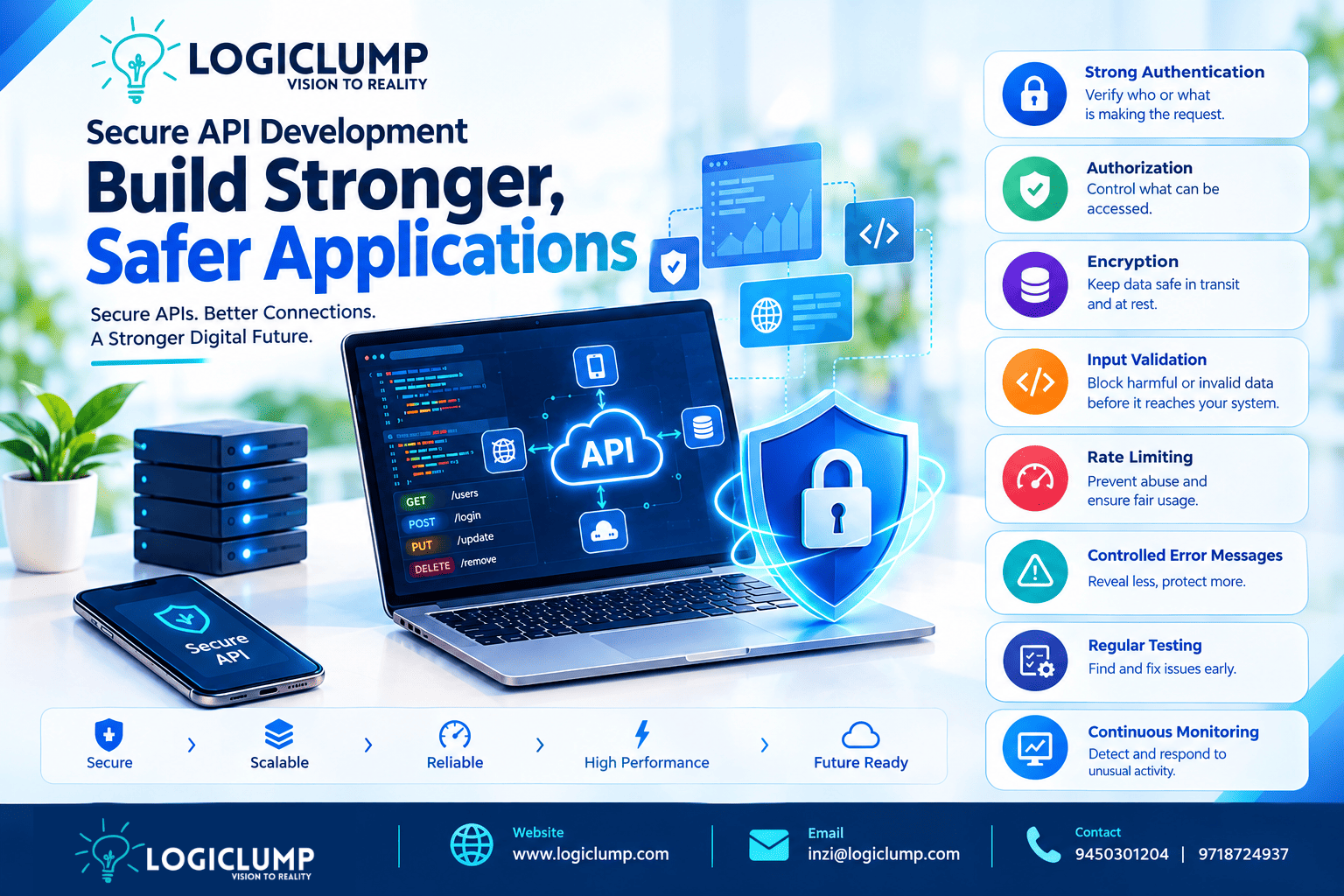
Secure API Development: Building a Safer Digital Future
Modern digital products depend on communication between different software systems. A mobile application may need to communicate with a backend server, a website may connect to a payment gateway, and a cloud platform may exchange information with several external services.
Much of this communication happens through APIs (Application Programming Interfaces).
APIs make modern software ecosystems possible, but they also create important security responsibilities. Since APIs can provide access to user information, business data, transactions, and application functionality, weak API security can expose an entire digital platform to unnecessary risks.
For this reason, security should be considered throughout the API development process—not added only after an application has been completed.
What Exactly Is an API?
An API acts as a communication layer between different software applications.
Whenever you perform actions such as:
- Signing into an application
- Making a digital payment
- Viewing live financial information
- Connecting a website to an external platform
- Retrieving information from a cloud service
there is a good chance that one or more APIs are involved.
APIs allow systems to exchange information in a structured way. Because they often sit between users, applications, databases, and third-party services, protecting them is an important part of overall application security.
Why API Security Is Important
Businesses are increasingly building interconnected digital ecosystems. A single application may communicate with databases, mobile clients, cloud infrastructure, payment services, analytics platforms, and external APIs.
If an API contains security weaknesses, attackers may attempt to exploit them to:
- View information they should not access
- Compromise account credentials
- Change application data
- Perform unauthorized operations
- Send excessive requests to a service
- Abuse weaknesses in access controls
A successful attack can have consequences beyond the software itself. Data exposure, service interruptions, financial losses, and reduced customer confidence can all affect a business.
That makes API security a business consideration as well as a technical one.
1. Build Strong Authentication
Authentication is the process of establishing who or what is making an API request.
Depending on the application, developers may use technologies such as:
- API keys
- OAuth 2.0
- JSON Web Tokens (JWT)
- Multi-factor authentication
- Secure session mechanisms
The authentication method should match the application's security requirements.
Credentials and tokens also need careful handling. They should not be hard-coded into public repositories, unnecessarily exposed to clients, or stored in insecure locations.
Authentication provides the first layer of protection, but it should always work together with appropriate authorization controls.
2. Control Access With Authorization
Authentication and authorization serve different purposes.
Authentication:
“Who is making this request?”
Authorization:
“What is this user or application permitted to access?”
For example, a normal customer might be allowed to view their own account information but should not be able to access another customer's records or administrative functions.
APIs should therefore verify permissions for individual resources and actions rather than assuming that a successfully authenticated user can access everything.
Proper access controls are particularly important for applications containing financial information, customer records, administrative functions, or other sensitive resources.
3. Protect Information With Encryption
Sensitive information should be protected while it travels between systems.
Using HTTPS with modern TLS configurations helps protect API communication against interception and unauthorized modification.
Businesses should also consider appropriate protection for sensitive information stored on servers and databases.
Encryption and secure data handling become especially important when an API processes:
- Payment information
- Personal information
- Authentication credentials
- Customer records
- Transaction data
- Confidential business information
Security requirements should be considered according to the type and sensitivity of the data being processed.
4. Validate API Inputs
An API should never assume that incoming information is trustworthy.
Every request should be checked against the application's expected rules before the data is processed.
Validation can include checking:
- Data types
- Input formats
- Character limits
- Required parameters
- Accepted values
- Request structure
For example, if an API expects a numerical account identifier, it should not blindly accept arbitrary input and pass it directly to internal systems.
Strong validation helps reduce unexpected application behavior and can protect against several categories of input-based attacks.
5. Use Rate Limiting
APIs can receive large numbers of requests within a short period.
Without appropriate controls, excessive requests may consume server resources or be used to automate abusive activity.
Rate limiting places reasonable restrictions on how frequently a client can make requests.
It can help reduce risks associated with:
- Brute-force attempts
- Automated abuse
- Excessive API traffic
- Resource exhaustion
- Repeated unauthorized requests
Rate limits should be designed according to the application's normal traffic patterns so legitimate users can continue using the service effectively.
6. Keep Error Messages Under Control
Error responses are useful for developers, but excessive technical information can create security risks in production environments.
An API error should generally provide enough information for the client to understand that a request failed without revealing unnecessary internal details.
Avoid exposing information such as:
- Database structures
- Internal server paths
- Framework details
- Configuration information
- Stack traces
- Sensitive system information
Detailed debugging information can be useful during development, but production environments should use controlled error responses.
7. Test and Maintain APIs Regularly
API security isn't something developers complete once and forget.
Applications evolve, dependencies change, new vulnerabilities are discovered, and new functionality is introduced. Security practices therefore need to continue throughout the application's lifecycle.
A regular API security program may include:
- Code reviews
- Security testing
- Dependency updates
- Vulnerability assessments
- Penetration testing
- Automated security checks
- API configuration reviews
Regular testing helps development teams discover weaknesses before they become larger problems.
8. Monitor API Traffic
Security doesn't stop when an API is deployed.
Monitoring API activity can help teams understand how their systems are being used and identify unusual behavior.
For example, monitoring systems may detect:
- Repeated authentication failures
- Unexpected request volumes
- Unusual access patterns
- Attempts to access restricted resources
- Sudden changes in traffic
Centralized logging and appropriate alerting can give development and security teams greater visibility into potential incidents.
Early detection can also help organizations respond more quickly when suspicious activity occurs.
API Security in Modern Software Architecture
Today's applications rarely operate as isolated systems.
A typical digital ecosystem might look like:
Mobile App → API Layer → Backend Services → Database → Cloud Infrastructure → Third-Party Services
Each connection needs appropriate security controls.
As the number of integrations increases, API security becomes increasingly important because a weakness in one component may affect other connected services.
This is why security should be integrated into the development lifecycle from architecture and design through deployment and maintenance.
Security Should Be Part of the Development Process
A common mistake is treating security as a final testing stage.
Instead, development teams can incorporate security considerations from the beginning by thinking about:
Architecture → Authentication → Authorization → Data Protection → Validation → Testing → Monitoring
This approach helps identify security requirements before implementation rather than trying to repair weaknesses after the product has already been deployed.
How LogiClump Builds Secure Digital Solutions
At LogiClump, modern software development goes beyond creating attractive interfaces and useful features.
Digital products also need a strong technical foundation that supports security, performance, scalability, and reliability.
Whether the requirement involves a website, mobile application, custom software, trading platform, business application, or integrated digital solution, APIs can play an important role in connecting different parts of the system.
A carefully designed API architecture can help create applications that are:
- Secure
- Scalable
- Reliable
- High-Performance
- Maintainable
- Ready for Future Growth
The right combination of architecture, development practices, testing, and monitoring can provide a stronger foundation for long-term digital products.
Final Thoughts
APIs are essential to modern software. They connect applications, enable integrations, transfer information, and support many of the digital experiences businesses rely on every day.
However, increased connectivity also increases the importance of security.
Strong authentication, effective authorization, encrypted communication, input validation, rate limiting, controlled error handling, regular testing, and continuous monitoring are all important elements of a responsible API security strategy.
As businesses continue to expand their digital ecosystems, secure API development should remain an integral part of software architecture—not an afterthought.
At LogiClump, we believe successful digital products begin with a strong technical foundation.
Build Secure. Build Smart. Build for the Future.
About LogiClump Technologies
LogiClump Technologies provides web development, mobile app development, and custom software solutions designed around business requirements. From modern websites and applications to complex digital platforms, the focus is on building technology that is scalable, reliable, and prepared for long-term growth.
CONTACT
📞 9450301204 | 9718724937
🌐 www.logiclump.com
📧 inzi@logiclump.com
Discover how LogiClump uses secure API development practices—including authentication, authorization, encryption, validation, rate limiting, testing, and monitoring—to build safer, scalable digital applications.
Tom Cruise