
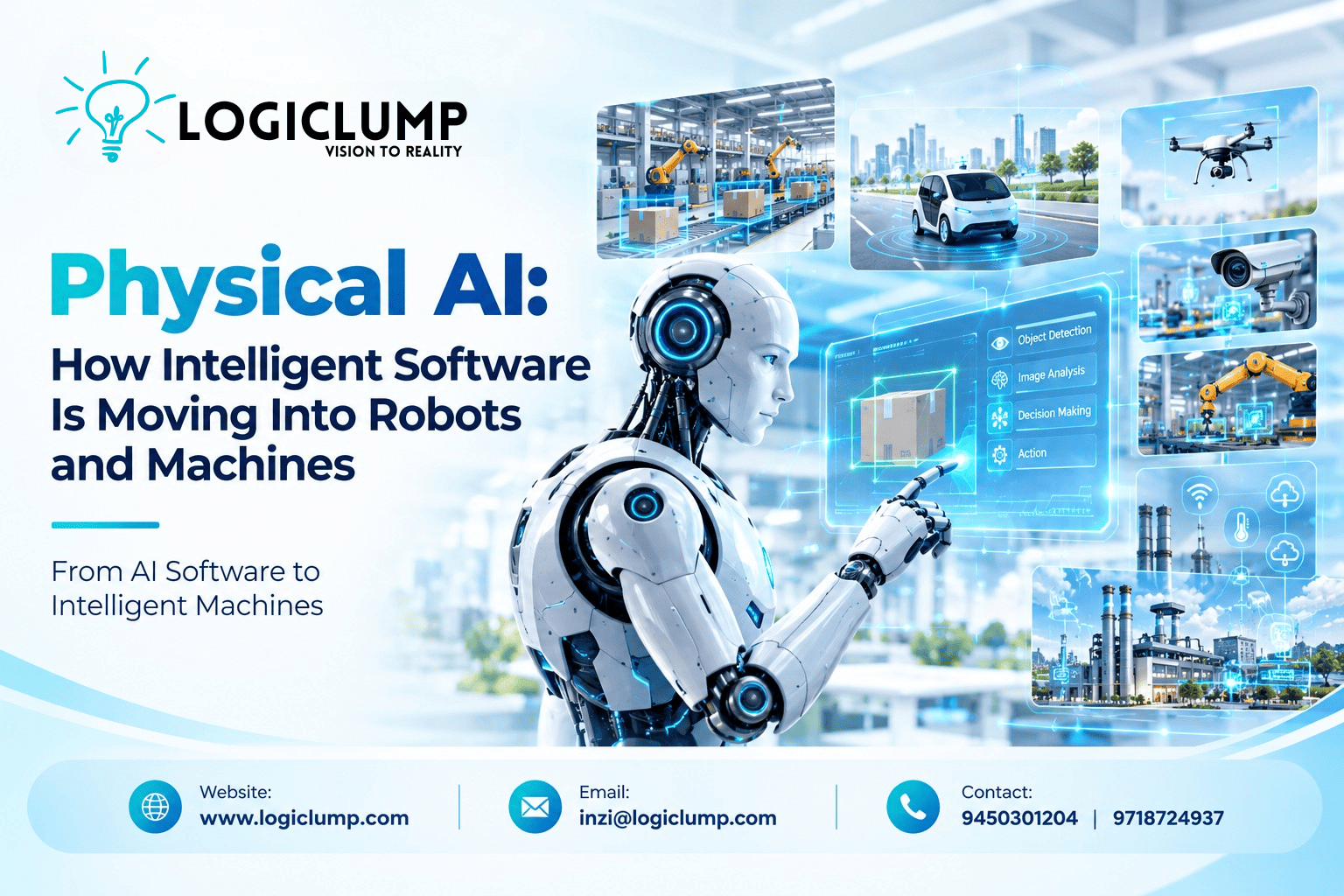
Physical AI: Bringing Intelligence Into the Real World
Artificial intelligence has spent much of the last decade living inside screens.
AI can write software, analyze documents, generate images, answer questions, detect patterns, and automate digital workflows.
But a new phase of artificial intelligence is emerging.
Instead of keeping intelligence inside computers and cloud applications, developers are increasingly connecting AI with robots, vehicles, drones, industrial equipment, cameras, sensors, and other physical machines.
This shift is often described as Physical AI.
Physical AI combines software intelligence with machines that can perceive their surroundings, make decisions, and perform actions in the real world.
It represents an important change in the role of AI.
Instead of simply generating an answer, an AI system may eventually be able to see a situation, understand it, decide what to do, and physically act on that decision.
What Is Physical AI?
Physical AI refers to AI systems designed to interact with the physical environment.
Traditional software usually operates in a digital environment.
For example, a business application may:
- Process information
- Generate reports
- Manage customer records
- Send notifications
- Analyze data
Physical AI adds another dimension.
An intelligent machine may:
- Observe its surroundings
- Identify objects
- Understand spatial relationships
- Predict what may happen
- Choose an action
- Move or manipulate objects
- Learn from the resulting feedback
A simple Physical AI system can therefore be understood as:
Sense → Understand → Decide → Act → Learn
The technology combines AI models with sensors, robotics, control systems, software, and hardware.
Why Physical AI Is Becoming Important
Generative AI has demonstrated how powerful software can become at working with information.
The next challenge is much harder:
Can AI operate reliably in the real world?
Physical environments are unpredictable.
Objects can move.
People can change direction.
Lighting can change.
Machines can malfunction.
Weather can affect sensors.
Unexpected obstacles can appear.
A physical AI system therefore needs to continuously interpret new information and respond to changing circumstances.
This makes Physical AI considerably different from a conventional software application.
The Technology Behind Physical AI
Physical AI is not based on one technology.
It is a combination of multiple systems working together.
Artificial Intelligence
AI models interpret information and help make decisions.
Computer Vision
Cameras and vision systems allow machines to understand images and video.
Sensors
Machines can use cameras, lidar, radar, microphones, pressure sensors, temperature sensors, and other devices to gather information.
Robotics
Robotic systems provide the physical mechanisms needed to perform actions.
Edge Computing
Some AI processing needs to happen close to the machine to reduce latency.
Cloud Computing
Cloud platforms can provide additional computing power, storage, analytics, and centralized management.
Control Systems
Control software converts decisions into physical movements or machine operations.
Together, these technologies form the foundation of Physical AI.
Robots Are Becoming More Intelligent
Robots have existed for decades, particularly in manufacturing.
However, traditional industrial robots generally operate according to carefully programmed instructions.
They may perform the same movement thousands of times with extremely high precision.
Physical AI introduces a different possibility.
Instead of programming every possible situation manually, AI can help a robot interpret its environment and adjust its behavior.
For example, a warehouse robot could identify:
- Different package sizes
- Obstacles
- Available routes
- Human workers
- Changing warehouse conditions
It could then use that information to determine how to complete a task.
This does not mean robots can operate without constraints.
They still require carefully designed hardware, software, safety systems, and operating boundaries.
But AI can make machines considerably more adaptable.
Computer Vision Gives Machines Eyes
One of the most important technologies behind Physical AI is computer vision.
A camera provides an enormous amount of visual information.
AI models can process that information to identify:
- People
- Objects
- Vehicles
- Equipment
- Road markings
- Product defects
- Machine conditions
- Environmental changes
Consider a manufacturing facility.
A conventional camera may simply capture an image.
An AI-powered vision system can potentially determine whether a component is correctly assembled or whether a product contains a visible defect.
This can transform cameras from passive recording devices into intelligent sensors.
Sensors Give Machines Environmental Awareness
Vision alone is not enough for many applications.
Physical AI systems can combine multiple sensor types.
For example, an autonomous machine may use:
Camera → Visual information
Lidar → Distance and spatial information
Radar → Object detection and movement
Temperature sensor → Environmental conditions
Pressure sensor → Physical interaction
Combining these inputs is known as sensor fusion.
The AI system can use multiple sources of information to build a more complete understanding of its environment.
Physical AI and AI Agents
AI agents are becoming capable of performing multi-step digital tasks.
Physical AI extends this idea into the real world.
A digital agent might:
Read an email → Update CRM → Create a task
A physical AI agent could potentially:
Observe environment → Plan movement → Operate machine → Check result
This creates a connection between agentic AI and robotics.
An AI agent can determine what needs to be accomplished, while robotics and control systems determine how the physical action is performed.
This combination could become increasingly important in future autonomous systems.
Manufacturing Could Change Significantly
Manufacturing is one of the most natural environments for Physical AI.
Factories already use automation extensively.
The next step is to make automated systems more adaptable.
Physical AI could assist with:
- Quality inspection
- Assembly
- Sorting
- Packaging
- Inventory movement
- Predictive maintenance
- Machine monitoring
- Production optimization
For example, an AI-powered inspection system could continuously examine products and identify unusual patterns that traditional rule-based inspection might miss.
Robotic systems could also adjust their behavior based on object position, production conditions, or changes in the environment.
Warehouses Could Become More Autonomous
Modern warehouses contain thousands or millions of products.
Managing these environments requires coordination between people, software, machines, and inventory systems.
Physical AI could connect these elements.
An intelligent warehouse system could potentially coordinate:
- Autonomous mobile robots
- Inventory systems
- Cameras
- Picking systems
- Conveyor systems
- Human workers
- Delivery schedules
Instead of each component operating independently, AI could help coordinate the overall workflow.
This could make warehouses more responsive to changing demand.
Autonomous Vehicles
Vehicles are another major area for Physical AI.
An autonomous vehicle must continuously understand its environment.
It may need to recognize:
- Traffic signals
- Cars
- Pedestrians
- Cyclists
- Road markings
- Construction zones
- Weather conditions
It then needs to determine what action should happen next.
This creates a continuous loop:
Perception → Prediction → Planning → Control
The system must perform these operations quickly because decisions can have immediate physical consequences.
Drones and Aerial Systems
Drones provide another interesting application.
A traditional remotely controlled drone depends heavily on a human operator.
An AI-enabled drone can potentially perform more tasks independently.
Applications could include:
- Infrastructure inspection
- Agriculture
- Mapping
- Disaster assessment
- Delivery
- Industrial monitoring
- Security operations
A drone equipped with cameras, sensors, navigation systems, and AI can potentially identify objects and environmental conditions while adjusting its flight path.
Physical AI in Healthcare
Healthcare could also benefit from intelligent machines.
Potential applications include:
- Surgical robotics
- Rehabilitation systems
- Medical equipment
- Hospital logistics
- Patient monitoring
- Assistive robotics
For example, robots could help transport supplies through hospitals while AI systems coordinate routes and schedules.
Medical robotics, however, requires particularly strict safety and regulatory controls.
In healthcare, AI should assist within carefully defined boundaries rather than being treated as an unrestricted autonomous decision-maker.
Agriculture Could Become More Intelligent
Agriculture involves large physical environments and repetitive tasks.
Physical AI could support:
- Crop monitoring
- Weed detection
- Automated harvesting
- Soil analysis
- Irrigation management
- Agricultural drones
- Precision spraying
AI-powered cameras and sensors can gather information about crop conditions.
Machines can then use that information to perform targeted actions.
This can potentially reduce unnecessary resource use while improving operational efficiency.
Physical AI and Smart Infrastructure
Cities and infrastructure are also becoming more connected.
AI-enabled systems can potentially monitor:
- Roads
- Bridges
- Energy systems
- Water infrastructure
- Traffic
- Public transportation
- Buildings
For example, intelligent sensors could detect unusual structural patterns in infrastructure and notify maintenance teams.
This creates a combination of:
Sensors + AI + Connectivity + Physical Infrastructure
which could make infrastructure management more predictive.
Digital Twins Can Help Physical AI Learn
One of the biggest challenges with physical machines is training.
You cannot always allow a robot to repeatedly fail in a real factory.
This is where digital twins and simulation become valuable.
A digital twin creates a virtual representation of a physical environment.
A robot can potentially practice tasks inside the simulated environment before attempting them in the real world.
For example:
Virtual warehouse → Robot training → Simulation testing → Real warehouse deployment
This approach can reduce the cost and risk of physical experimentation.
World Models and Physical AI
Another emerging technology closely connected to Physical AI is the world model.
A world model attempts to represent how an environment behaves and what might happen when an action is performed.
For a robot, this could mean estimating:
“If I move this object, where will it go?”
For an autonomous vehicle:
“If that vehicle changes lanes, what could happen next?”
For a manufacturing system:
“If production speed increases, what effect could it have on the process?”
World models can therefore provide a predictive layer between perception and action.
This could become an important part of more advanced Physical AI systems.
Edge AI Is Critical
Physical machines often cannot depend entirely on a remote cloud server.
Imagine a robot that needs to stop immediately when an obstacle appears.
Waiting for a distant server to process the image could introduce unacceptable delay.
This is why edge AI is important.
Edge computing allows AI inference to happen close to the device.
Benefits can include:
- Lower latency
- Faster decisions
- Reduced network dependency
- Improved privacy
- Greater operational resilience
Cloud computing can still provide large-scale analytics and centralized management, while edge systems handle time-sensitive decisions locally.
Physical AI Needs Powerful Hardware
Intelligent machines require increasingly capable hardware.
Modern Physical AI systems may rely on:
- GPUs
- AI accelerators
- Embedded processors
- High-speed memory
- Cameras
- Lidar
- Radar
- Specialized sensors
The development of semiconductor technology is therefore closely connected to Physical AI.
Better processors can allow machines to run more sophisticated AI models while consuming less power.
This creates an ecosystem connecting:
Semiconductors → AI Models → Edge Computing → Robotics → Physical Applications
Security Becomes More Serious
A software vulnerability can be serious.
A vulnerability in a system controlling a physical machine can be even more consequential.
Physical AI systems therefore need strong security controls.
Important areas include:
- Device authentication
- Secure communication
- API security
- Firmware protection
- Access control
- Encryption
- Software updates
- Network segmentation
- Audit logging
- AI model security
Organizations should also carefully control what actions an AI system is authorized to perform.
An AI-powered warehouse robot may be allowed to move packages.
It should not automatically have permission to modify critical business systems without appropriate controls.
Safety Must Be Built Into the System
Physical AI requires another layer that ordinary software applications often do not need to the same extent: physical safety.
A machine must not only produce a technically valid decision.
It must produce an action that is safe.
Safety mechanisms may include:
- Emergency stops
- Restricted operating zones
- Collision detection
- Human override
- Fail-safe modes
- Redundant sensors
- Operational limits
- Continuous monitoring
AI should operate inside clearly defined safety boundaries.
Human + Machine Collaboration
Physical AI does not necessarily mean replacing people with robots.
In many environments, the more practical model may be human-machine collaboration.
A human can provide:
- Judgment
- Context
- Strategy
- Approval
- Exception handling
The machine can provide:
- Speed
- Precision
- Continuous monitoring
- Repetitive execution
- Data processing
This combination can be particularly valuable in manufacturing, logistics, healthcare, construction, and other industries.
What Makes Physical AI Difficult?
Physical environments are much harder than digital environments.
Software can often be restarted when something goes wrong.
A physical machine may damage equipment or injure someone.
Physical AI must therefore deal with:
Unpredictable Environments
Real-world conditions constantly change.
Limited Sensor Accuracy
Sensors can produce incomplete or noisy information.
Hardware Constraints
Machines have limits related to power, speed, weight, and movement.
Real-Time Requirements
Some decisions must happen within milliseconds.
Safety Requirements
Failures can have physical consequences.
High Development Costs
Building and testing intelligent machines can require expensive hardware and specialized facilities.
These challenges mean Physical AI will likely develop gradually across different industries rather than appearing as one universal technology.
How Businesses Can Prepare for Physical AI
Companies do not need to immediately purchase advanced humanoid robots.
A more practical starting point is to identify processes where physical intelligence could create measurable value.
Look for tasks that are:
- Repetitive
- Physically demanding
- Highly measurable
- Time-sensitive
- Data-rich
- Difficult to monitor manually
A gradual roadmap could look like:
Step 1: Identify the Problem
Find a specific physical process that needs improvement.
Step 2: Collect Data
Use cameras, sensors, machine logs, and existing business data.
Step 3: Build a Digital Model
Create a simulation or digital twin where appropriate.
Step 4: Introduce AI
Start with monitoring, prediction, classification, or recommendations.
Step 5: Add Controlled Automation
Allow the system to perform selected physical actions.
Step 6: Add Safety Controls
Define operating limits, human overrides, and emergency procedures.
Step 7: Monitor and Improve
Measure performance and continuously improve the system.
Physical AI Will Create New Software Opportunities
The growth of intelligent machines does not mean software becomes less important.
It means software becomes even more deeply connected to physical systems.
Businesses may need software for:
- Robot management
- Device monitoring
- IoT platforms
- AI analytics
- Digital twins
- Cloud dashboards
- Mobile control applications
- API integrations
- Fleet management
- Predictive maintenance
- Security systems
The software layer becomes the bridge between intelligent machines and business operations.
How LogiClump Can Help
Physical AI requires an ecosystem rather than a single application.
Businesses exploring intelligent machines may need to connect:
AI + APIs + Cloud + IoT + Data + Applications + Automation
At LogiClump, we develop custom software, AI-powered applications, mobile and web platforms, APIs, cloud solutions, dashboards, and technology systems designed around specific business requirements.
As businesses begin connecting intelligent software with machines and connected devices, a strong software foundation can become an important part of the overall architecture.
The objective should not be to use AI simply because it is new.
The objective should be to identify where intelligent automation can solve a real operational problem.
What the Future Could Look Like
The future of Physical AI may not be defined by one type of robot.
Instead, intelligence could become embedded across many types of machines.
Factories could contain adaptive robots.
Warehouses could use autonomous fleets.
Drones could inspect infrastructure.
Vehicles could make increasingly complex decisions.
Agricultural machines could respond to crop conditions.
Buildings could automatically adjust their systems.
Machines could communicate with cloud platforms and with one another.
This could create a world where software intelligence becomes a normal component of physical infrastructure.
Conclusion
Physical AI represents a significant evolution in the way artificial intelligence interacts with the world.
Generative AI made it possible for machines to create text, images, video, and code.
Physical AI takes the concept further by connecting intelligence with sensors, machines, robots, vehicles, and real-world environments.
The technology combines AI models, computer vision, robotics, edge computing, cloud platforms, sensors, simulation, and secure software architectures.
Its development will not be without challenges.
Safety, reliability, cybersecurity, cost, hardware limitations, and real-world testing remain critical concerns.
But the long-term direction is compelling.
AI is moving from:
Generate → Understand → Predict → Decide → Act
As this evolution continues, intelligent software may no longer live primarily inside applications and data centers.
It may increasingly become part of the machines that build, transport, inspect, manufacture, navigate, and operate in the physical world.
That is the promise of Physical AI: not simply smarter software, but software intelligence that can interact with reality.
Contact Us:
🌐 Website: www.logiClump.com
📧 Email: inzi@logiclump.com
📞 Contact: 9450301204 | 9718724937
Discover how Physical AI is connecting intelligent software with robots, drones, autonomous vehicles, smart factories, and machines in 2026.
Tom Cruise