
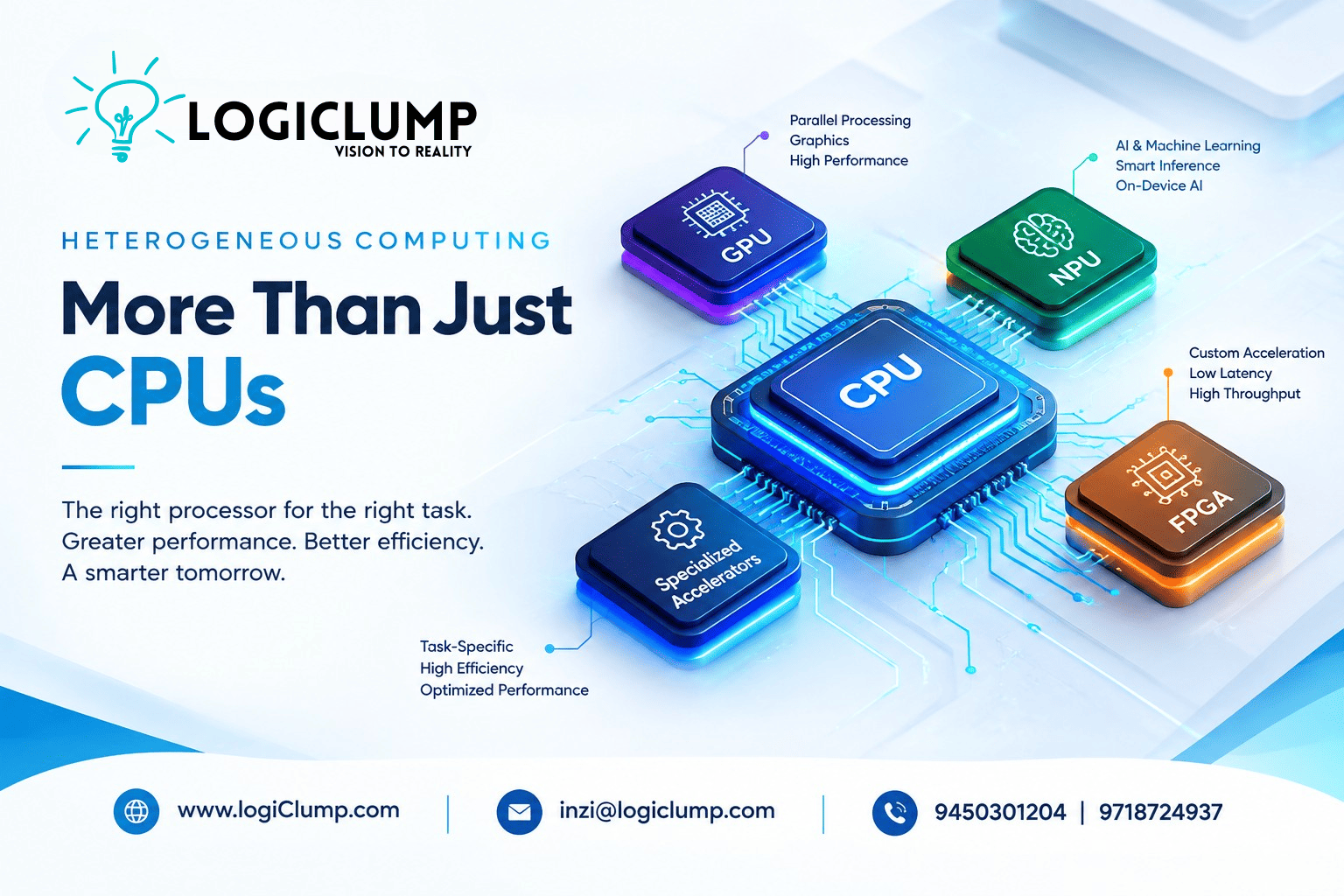
Heterogeneous Computing More Than CPUs
For many years, the CPU has been the primary engine behind software applications. Websites, enterprise platforms, operating systems, and business tools have traditionally depended on CPUs to execute most of their workloads.
That model is changing.
Modern applications increasingly involve artificial intelligence, real-time analytics, advanced graphics, large-scale simulations, video processing, and other computationally intensive tasks. Handling all of these workloads with CPUs alone can be inefficient.
This has led to the growing importance of heterogeneous computing—an approach that combines different types of processors and accelerators so each workload can be handled by the hardware best suited to it.
Instead of asking one processor to do everything, heterogeneous computing focuses on a simpler idea:
Use the right computing resource for the right task.
What Is Heterogeneous Computing?
Heterogeneous computing refers to a system that combines multiple kinds of processing units.
Depending on the application, a computing platform may include:
- CPU – General-purpose computing and system management
- GPU – Parallel processing, graphics, and intensive calculations
- NPU – AI and machine-learning workloads
- FPGA – Configurable hardware acceleration
- Specialized accelerators – Processing designed for specific tasks
Each component has its own strengths. The CPU can manage general application logic, while another processor can take over workloads that benefit from parallel or specialized processing.
This division can help applications achieve better performance and efficiency.
Why CPUs Alone May Not Be Enough
CPUs are designed to handle a broad range of instructions, making them highly flexible.
However, some modern workloads involve performing huge numbers of similar calculations simultaneously.
AI models are a good example. They can require large quantities of mathematical operations that are well suited to parallel hardware.
Other examples include:
- 3D rendering
- Video processing
- Scientific simulations
- Image analysis
- Large-scale data processing
- Machine learning
In these situations, specialized processors can complement the CPU and take over tasks for which they are better suited.
The computing model therefore moves from:
CPU-Centric → Multi-Processor Computing
The CPU Still Has an Important Role
The rise of specialized processors does not make CPUs irrelevant.
CPUs remain responsible for many essential operations, including:
- Running operating systems
- Executing application logic
- Managing system resources
- Coordinating workloads
- Handling sequential operations
- Managing communication between system components
In a heterogeneous architecture, the CPU can act as a coordinator.
Rather than performing every intensive calculation itself, it can direct suitable workloads toward GPUs, NPUs, or other accelerators.
GPUs: Powerful Parallel Processors
GPUs became popular through computer graphics and gaming, but their capabilities extend well beyond visual rendering.
Their architecture is particularly effective when the same type of operation needs to be performed across large amounts of data.
This makes GPUs useful for:
- Artificial intelligence
- Machine learning
- Computer vision
- 3D graphics
- Scientific computing
- Video processing
- Data analytics
For highly parallel workloads, distributing calculations across many GPU processing units can significantly change how an application handles computational demands.
NPUs and the Growth of AI
Artificial intelligence has created demand for another type of processor: the Neural Processing Unit, or NPU.
NPUs are designed to accelerate certain AI and machine-learning operations.
They can support features such as:
- Image recognition
- Voice processing
- Object detection
- AI assistants
- Generative AI features
- On-device machine learning
One important advantage of local AI processing is that certain tasks can be completed directly on a device rather than always relying on remote servers.
This can support faster responses and reduce the amount of data that needs to travel to the cloud, depending on the application.
FPGAs: Programmable Hardware for Specialized Workloads
FPGAs, or Field-Programmable Gate Arrays, offer another form of acceleration.
They can be configured for particular computational requirements, allowing organizations to build specialized processing pipelines without designing an entirely new chip.
FPGAs can be useful when applications require:
- Low latency
- High throughput
- Real-time processing
- Specialized computation
- Hardware-level customization
They have applications across areas such as telecommunications, networking, industrial systems, financial technology, and data processing.
How Heterogeneous Computing Works
A heterogeneous system divides work according to the strengths of its available processing resources.
For example:
Application → CPU → GPU → AI Accelerator → Storage
The CPU may manage application logic and coordinate operations.
A GPU could process large parallel calculations, while an AI accelerator handles specific machine-learning operations.
The storage and memory systems then provide the data required by these processing units.
The architecture varies depending on the software and hardware involved, but the principle remains the same: different workloads can be assigned to different processing resources.
Heterogeneous Computing and AI
Artificial intelligence is one of the major areas driving heterogeneous computing.
Large AI workloads can require substantial computational resources, particularly during model training and inference.
A modern AI platform may therefore distribute responsibilities across multiple components:
CPU: Application control and orchestration
GPU: Parallel mathematical workloads
NPU/AI Accelerator: Specialized AI inference
Memory: Fast access to model and application data
Networking: Communication between computing resources
This type of architecture can help organizations match computing resources to the requirements of their AI workloads.
Key Benefits of Heterogeneous Computing
1. Improved Performance
Specialized hardware can process certain workloads more efficiently than a general-purpose processor.
This can reduce the time required for computationally demanding operations.
2. Greater Efficiency
When a task runs on hardware specifically designed for it, the system may use computing resources more efficiently.
This can be particularly important for mobile devices, edge systems, and large data centers.
3. Flexible Architecture
Businesses can combine different processing technologies based on their application requirements instead of relying on one processing model for every workload.
4. Better Application Experiences
Faster computation can support responsive experiences in areas such as:
- AI applications
- Gaming
- Video processing
- Financial platforms
- Real-time analytics
- Augmented and virtual reality
5. Workload Specialization
Different processors can focus on the operations they are designed to handle efficiently, allowing the overall system to distribute computational responsibilities more effectively.
Challenges Developers Need to Consider
Heterogeneous computing also introduces new engineering challenges.
More Complex Development
Developers may need specialized frameworks, libraries, APIs, and programming models to take advantage of different processors.
Data Transfer
Moving information between processors can introduce delays. Efficient data movement and memory management therefore become important.
Hardware Differences
Applications may need to work across different hardware architectures and acceleration technologies.
Testing and Debugging
When workloads are distributed across several processing units, identifying performance bottlenecks or software issues can become more complicated.
Higher Development Requirements
Specialized hardware and development tools can increase infrastructure and engineering requirements.
For these reasons, heterogeneous computing should be adopted when its benefits justify the additional complexity.
What Heterogeneous Computing Means for Developers
Software optimization is no longer limited to improving CPU performance.
Developers increasingly need to understand concepts such as:
- Parallel computing
- GPU acceleration
- AI hardware
- Memory bandwidth
- Data transfer
- Hardware-aware algorithms
- Power efficiency
This does not mean every software developer needs to become a hardware specialist.
However, understanding how different computing resources behave can help teams make better architectural and performance decisions.
Heterogeneous Computing in Cloud and Edge Computing
Heterogeneous architectures are also becoming important beyond traditional computers.
Cloud environments can provide different types of computing resources, allowing organizations to select infrastructure based on their workloads.
For example, an application might use conventional CPU resources for its backend while using GPU resources for AI or data-processing workloads.
Edge computing introduces another possibility.
An edge device could combine:
CPU + GPU + NPU + Sensors
and process information closer to where it is generated.
This can be useful when applications require fast responses, continuous processing, or reduced dependence on remote infrastructure.
Where the Technology Is Heading
As applications become more computationally intensive, heterogeneous computing is likely to become an increasingly common architectural approach.
AI systems, robotics, autonomous technologies, scientific applications, cloud infrastructure, and advanced enterprise platforms can all require different forms of processing.
The important development is not simply adding more processors.
The bigger challenge is coordinating them effectively.
Software needs to determine:
- Which workload should run on which processor?
- How should data move between processing units?
- How can computing resources be used efficiently?
- How can performance be improved without unnecessary complexity?
These questions are becoming increasingly important in modern software architecture.
Should Every Business Adopt Heterogeneous Computing?
Not necessarily.
The technology should be considered based on actual application requirements.
Businesses can evaluate questions such as:
- Does the application require heavy computation?
- Does it use AI or machine learning?
- Are low response times important?
- Is energy efficiency a priority?
- Could acceleration reduce processing time?
- Does the existing infrastructure support specialized hardware?
- Will the performance improvement justify additional development complexity?
For some applications, a CPU-based architecture may remain perfectly suitable.
For computationally demanding systems, combining CPUs with GPUs, NPUs, FPGAs, or other accelerators may provide useful advantages.
How LogiClump Approaches Modern Software Development
At LogiClump, we believe technology decisions should be based on the requirements of the product and the business.
From website and mobile app development to custom software, cloud solutions, AI-powered applications, and enterprise platforms, architecture can influence performance, scalability, security, and long-term maintenance.
Choosing the appropriate technologies and processing approach can help businesses build digital products that are prepared for changing workloads and future requirements.
Final Thoughts
Heterogeneous computing represents a shift away from the idea that one processor should handle every task.
CPUs remain the foundation of general-purpose computing, while GPUs, NPUs, FPGAs, and other accelerators can take on specialized workloads.
The result is a more flexible computing model where different types of hardware work together according to their strengths.
As AI, cloud computing, edge systems, and data-intensive applications continue to evolve, understanding heterogeneous computing can help developers and businesses make more informed technology decisions.
The future of computing isn't about choosing one processor for everything. It's about using the right processing technology for each job.
About LogiClump Technologies
At LogiClump Technologies, we develop digital solutions around business requirements, combining modern technologies with scalable and performance-focused architectures.
Build smarter. Choose the right technology. Prepare for the future.
Contact Us:
🌐 Website: www.logiClump.com
📧 Email: inzi@logiclump.com
📞 Contact: 9450301204 | 9718724937
Explore how heterogeneous computing combines CPUs, GPUs, NPUs, and accelerators to improve software performance, efficiency, scalability, and AI capabilities with LogiClump.
Tom Cruise