
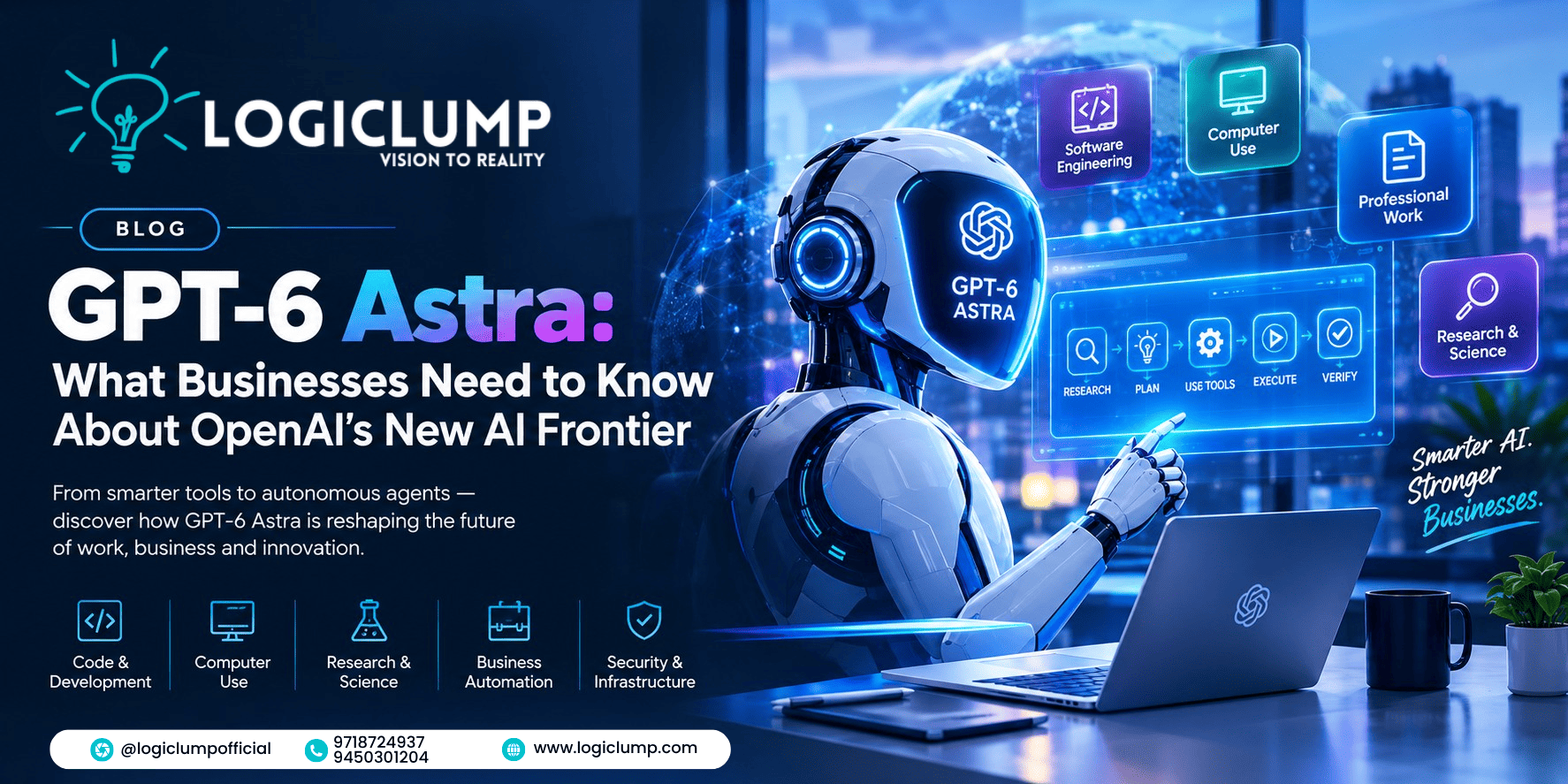
GPT-6 Astra: From AI Assistance to AI Execution
Artificial intelligence is moving beyond the era of simply answering questions. The next generation of AI is increasingly focused on understanding goals, using digital tools, completing multi-step workflows, and producing finished work.
OpenAI’s GPT-6 Astra represents this shift. Introduced on September 3, 2026, Astra is positioned as OpenAI’s most capable model yet, with major advances in computer use, software engineering, research, cybersecurity, science, and professional work.
For businesses building websites, applications, automation systems, enterprise software, and AI-powered products, Astra is an important development to watch.
What Is GPT-6 Astra?
GPT-6 Astra is OpenAI’s latest frontier AI model, designed for more complex end-to-end work rather than just generating individual responses.
Traditional AI workflows often look like:
Ask → Get Answer → Human Executes
Astra is designed to move toward:
Give a Goal → AI Reasons → AI Uses Tools → AI Completes Work → Human Reviews
OpenAI says Astra can work with computers, browse the web, write and test software, analyze information, create documents and presentations, and handle complex professional workflows.
This makes Astra particularly interesting for businesses looking to incorporate AI directly into their operations.
What Makes Astra Different?
1. Advanced Computer Use
One of Astra's most significant capabilities is its ability to interact with computer environments.
Instead of merely explaining how to perform a task, an AI agent can potentially navigate software, work with online forms, update CRM records, research information, and perform other digital operations.
OpenAI specifically highlights tasks such as updating customer records, organizing calendars, conducting research, creating websites, and performing frontend quality checks.
For businesses, this could mean fewer repetitive manual processes.
2. Stronger Software Engineering
Software development is another major area where Astra is designed to make an impact.
It can assist with:
- Writing and reviewing code
- Debugging applications
- Testing software
- Working with development tools
- Building websites and applications
- Performing frontend QA
- Troubleshooting technical problems
For development companies, AI like Astra can become an additional engineering assistant rather than simply a coding chatbot.
This could help teams spend more time on architecture, product decisions, security, and innovation while AI handles more repetitive development tasks.
3. Better Handling of Complex Work
A major change is Astra's ability to work through multiple stages of a task.
A business project might involve:
Research → Analysis → Development → Testing → Documentation → Final Delivery
Instead of requiring a separate AI interaction for every step, advanced agentic systems are increasingly designed to maintain context and work through connected stages.
OpenAI says Astra can adapt when requirements change and remain oriented toward the broader objective while handling additional instructions.
That capability could become particularly valuable for enterprise workflows.
4. AI for Professional Work
Astra isn't positioned only as a developer tool.
OpenAI reports capabilities across professional workflows, including the creation of documents, spreadsheets, presentations, and analyses while following existing templates and instructions.
This opens possibilities for:
- Business reporting
- Data analysis
- Presentations
- Research
- Documentation
- Customer operations
- Internal automation
- Project management
The bigger opportunity is connecting these capabilities to the software businesses already use.
5. A Major Step for AI-Powered Research
Astra's development also highlights how AI is increasingly being used for scientific and mathematical research.
Before the public GPT-6 Astra launch, OpenAI reported that an internal version of Astra contributed to results across ten mathematics and theoretical computer-science problems. The resulting arguments were subsequently prepared by humans and formalized with Lean certificates.
This demonstrates a broader direction for AI: AI systems assisting researchers with difficult, open-ended problems rather than simply retrieving existing information.
What Does GPT-6 Astra Mean for Businesses?
The most important question isn't simply "How powerful is Astra?"
The better question is:
"How can businesses use increasingly capable AI to improve their products and operations?"
Here are some potential areas.
AI-Powered Customer Support
AI agents could help businesses manage customer questions, search internal knowledge, summarize conversations, and assist support teams.
Intelligent CRM Automation
Instead of employees manually updating customer records, AI agents could potentially perform routine CRM operations based on approved instructions and workflows.
Software Development
Development teams can use advanced AI to accelerate coding, testing, debugging, documentation, and application maintenance.
Business Research
AI can assist with market research, competitor analysis, data interpretation, and report preparation.
Workflow Automation
Businesses can connect AI with APIs, databases, CRM systems, cloud services, and internal applications to automate repetitive processes.
Why APIs Will Become Even More Important
As AI becomes capable of performing actions, secure APIs become the bridge between AI and business systems.
Consider a simple workflow:
AI Agent → Secure API → CRM → Database → Payment System → Reporting Dashboard
The AI may provide the intelligence, but APIs provide the controlled communication layer.
This means businesses need to think carefully about:
- API authentication
- Authorization
- Data protection
- Rate limiting
- Audit logs
- Access permissions
- Error handling
- Monitoring
For companies developing AI-powered products, AI capability and secure software architecture need to evolve together.
Security Becomes Even More Important
Greater AI capability also introduces greater responsibility.
OpenAI says GPT-6 Astra reached its Critical cybersecurity capability threshold under its Preparedness Framework. The company reports that, with appropriate tools and access, Astra can identify previously unknown security vulnerabilities and develop exploits, which is why additional safeguards and monitoring were implemented.
For businesses, this reinforces an important principle:
Powerful AI should always operate within carefully designed security boundaries.
Organizations should consider:
- Least-privilege access
- Secure authentication
- Human approval for sensitive actions
- API access controls
- Continuous monitoring
- Data isolation
- Activity logging
- Regular security testing
AI automation should increase productivity without creating uncontrolled access to critical business systems.
How LogiClump Can Help Businesses Prepare for the AI Era
At LogiClump, we see AI as part of a broader digital transformation—not as a standalone technology.
Businesses preparing for advanced AI systems need a strong technical foundation.
That can include:
- AI-powered applications
- Custom software development
- Secure API development
- Web and mobile applications
- CRM and business automation
- Cloud-ready architecture
- Third-party integrations
- Scalable backend systems
The goal is not simply to add an AI chatbot to an existing product.
The bigger opportunity is to build AI-ready digital infrastructure where intelligent systems can securely interact with business applications and data.
The Future: From AI Assistants to AI Agents
The evolution is becoming clearer.
Yesterday's AI:
Answer questions.
Today's AI:
Reason and create.
Tomorrow's AI:
Reason → Plan → Use tools → Execute → Verify.
GPT-6 Astra is an important example of this transition.
For businesses, this could eventually mean AI systems that don't just recommend what employees should do—but actively complete approved parts of the workflow.
However, successful implementation will depend on more than AI models. Businesses will also need secure APIs, reliable infrastructure, thoughtful architecture, human oversight, and strong data governance.
Final Thoughts
GPT-6 Astra represents a significant step toward AI systems that can participate in real-world digital work.
Its capabilities across computer use, coding, research, professional workflows, and scientific tasks show how quickly AI is moving from conversation toward execution.
For businesses, the opportunity is enormous—but the foundation matters.
The companies best positioned to benefit from advanced AI will be those that start building scalable, secure, API-driven and AI-ready digital systems today.
LogiClump — Turning Digital Ideas Into Scalable Solutions.
Discover GPT-6 Astra and how its advanced AI capabilities are transforming business, software development, automation, research, computer use, and secure digital workflows.
Tom Cruise