
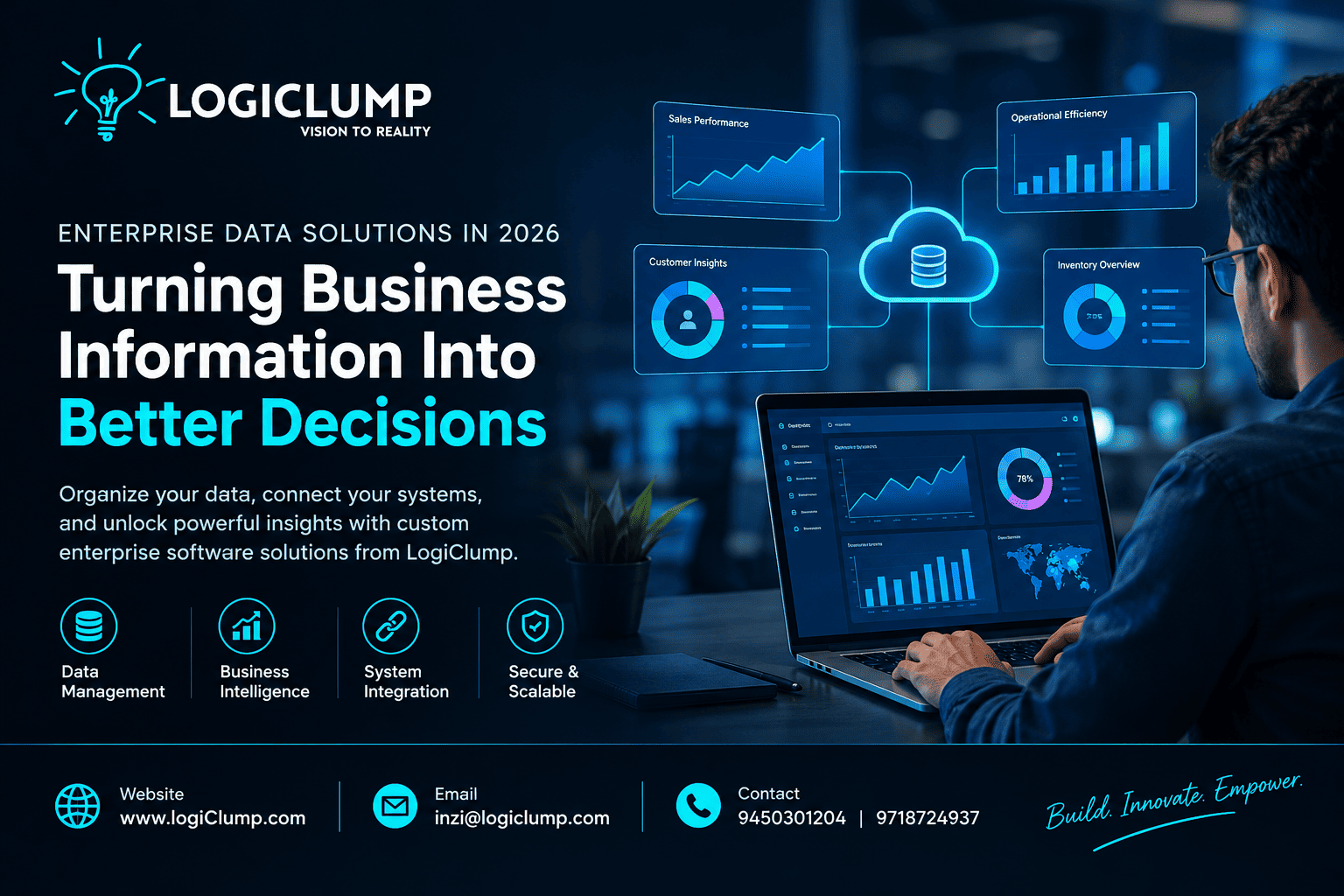
Enterprise data solutions in 2026
Businesses make decisions every day about sales, customers, expenses, inventory, performance, and future growth. The quality of those decisions often depends on how easily employees can access and understand the information available to them.
However, many organizations still manage important information across separate applications, spreadsheets, and departmental reports. Although each system may serve a useful purpose, bringing everything together can be time-consuming and complicated.
This creates a challenge for growing enterprises: how can a business turn the information it already collects into insights that support better decisions?
Enterprise data solutions address this challenge by helping organizations organize business information, connect relevant systems, and present important findings through useful reports and dashboards.
For companies seeking greater control over their operations, these capabilities can provide a stronger foundation for planning, performance monitoring, and long-term growth.
As an enterprise software development company, LogiClump Technologies develops custom software solutions that help businesses connect their systems, organize information, and improve access to business insights.
Why Having Business Data Is Not Enough
Modern businesses collect information from many sources. Customer interactions, financial transactions, product sales, employee activities, and operational records can all generate useful data.
The difficulty is making that information consistent and accessible.
Disconnected Systems Create Information Gaps
A company may store customer details in a CRM, financial records in accounting software, and stock information in an inventory application.
When these systems operate independently, employees may need to switch between applications or manually combine records to answer a simple business question.
Manual Reporting Takes Time
Preparing reports can involve downloading files, combining spreadsheets, checking calculations, and formatting results.
When this process happens repeatedly, employees have less time to investigate the meaning behind the numbers.
Inconsistent Records Affect Confidence
Different departments may maintain duplicate customer entries, use different definitions for business metrics, or rely on outdated information.
These inconsistencies can make reports harder to compare and reduce confidence in the results.
Important Changes May Go Unnoticed
Without appropriate reporting, a business may struggle to recognize changes in customer activity, operating costs, product demand, or service performance.
The information might already exist, but employees may not have an effective way to identify what deserves attention.
The solution is not necessarily to collect more data. It is to improve how existing information is managed and used.
What Are Enterprise Data Solutions?
Enterprise data solutions are systems and practices that help organizations manage information throughout its business lifecycle.
Depending on the company's needs, they may include data integration, reporting tools, dashboards, data-quality processes, access controls, and analytics applications.
Their purpose is to make business information more reliable, accessible, and useful.
A solution might help a company:
-
Bring selected information from different systems into a common reporting environment
-
Identify incomplete or duplicated records
-
Standardize important business measurements
-
Create dashboards for management and department leaders
-
Restrict access to confidential information
-
Track changes to important records
-
Reduce repetitive reporting tasks
-
Support analysis of historical performance
The appropriate combination depends on the organization's size, existing software, data requirements, and business objectives.
How Business Intelligence Turns Information Into Insights
Business intelligence, or BI, helps people interpret business information through reports, visualizations, comparisons, and performance indicators.
Rather than reviewing large collections of raw records, decision-makers can examine information organized around their responsibilities.
For example, a company might use business intelligence to understand:
Sales performance: Which products, regions, or channels contribute most to revenue?
Customer activity: How are enquiries, repeat purchases, or customer retention changing?
Financial performance: How are expenses and revenue progressing against business targets?
Operational efficiency: Where are delays, backlogs, or recurring issues appearing?
Inventory management: Which products may require closer attention because of changing demand?
These insights help people ask better questions and investigate potential problems.
Business intelligence does not guarantee that every conclusion will be correct. The quality of the analysis depends on reliable data, suitable measurements, and informed interpretation.
Enterprise Data Management and Business Intelligence Work Together
Managing data and analyzing it are related but different activities.
Enterprise data management focuses on the quality, organization, protection, and governance of information.
Business intelligence focuses on presenting that information in ways that help people understand performance and make decisions.
Consider a business that wants to compare sales across several branches.
The data management process helps establish that sales records are complete, the reporting periods are consistent, and the same revenue definitions are being used.
The BI environment then presents the results in a dashboard so managers can compare branches and investigate differences.
Without reliable information, even a well-designed dashboard can be misleading. Without useful reporting, well-maintained data may remain difficult for decision-makers to interpret.
Effective enterprise analytics requires both dependable information and a practical way to use it.
Where Custom Enterprise Data Software Can Help
Standard reporting products can be effective for many organizations. However, some businesses need reporting experiences that reflect their own processes, information sources, and management priorities.
Custom enterprise software can help address those requirements.
Management Dashboards
A tailored dashboard can present selected performance indicators in one place.
For example, executives might review sales trends, outstanding orders, customer-service activity, and operational performance without requesting separate reports from every department.
Department-Level Reporting
Different teams need different information.
Finance may focus on expenses and receivables, while sales managers may need visibility into leads and conversions.
Custom reporting can provide relevant views while respecting each user's permissions.
Connected Business Information
When appropriate, enterprise applications can integrate selected data from CRM, accounting, inventory, and other systems.
This can reduce repeated manual transfers and help employees work with more consistent information.
Scheduled Reporting
Businesses that prepare recurring reports can automate suitable parts of the process, such as gathering information, updating dashboards, or distributing approved summaries.
The goal is to reduce repetitive work while maintaining the checks required for accurate reporting.
Historical Comparisons
Organizations can use consistent historical records to examine how performance changes over time.
This may help managers identify trends, investigate unusual results, and evaluate whether business initiatives are producing the intended outcomes.
A Business Example: Understanding Profitability Across Multiple Locations
Imagine a company operating several retail outlets.
Each outlet records sales and returns, while the finance department maintains expense records separately. Management wants to understand why some locations perform better than others.
Preparing the comparison manually requires employees to collect information from multiple sources and check whether the figures use consistent definitions.
A custom reporting solution could bring the relevant information into a shared analytics environment.
Managers could then compare selected indicators across locations, review historical performance, and investigate differences that require further attention.
The solution might also connect to existing business applications rather than replacing them.
The result would not automatically explain every performance difference. Managers would still need to consider factors such as local demand, operating costs, product availability, and business strategy.
However, better-organized information could make that investigation faster and more systematic.
Data Quality: The Foundation of Reliable Reporting
A reporting system is only as dependable as the information it uses.
If records contain missing values, outdated details, inconsistent categories, or duplicate entries, the results may not reflect actual business performance.
Organizations can improve data quality by establishing clear practices for maintaining important records.
These may include:
-
Defining common terms and business metrics
-
Identifying responsible data owners
-
Checking records for errors and duplication
-
Updating outdated information
-
Maintaining consistent reporting periods
-
Validating information received from connected systems
-
Reviewing data quality regularly
For example, if different departments define an active customer differently, their reports may produce conflicting totals.
Agreeing on a shared definition can make comparisons more meaningful.
Data quality should be treated as an ongoing responsibility rather than a one-time preparation task.
Protecting Enterprise Information
Business analytics may involve confidential financial figures, customer information, employee records, and commercially sensitive data.
Organizations must make sure that better visibility does not lead to inappropriate access.
A well-designed enterprise data solution should consider:
Access permissions: Users should see information relevant to their responsibilities.
Authentication: Access should be protected by suitable identity controls.
Data protection: Sensitive information should be handled using appropriate security measures.
Auditability: Important changes and access-related events should be traceable where required.
Backup and recovery: Critical information should be protected against accidental loss and system failures.
Secure integrations: Data exchanged between applications should be protected and handled according to defined permissions.
The security model should reflect the sensitivity of the data and the risks associated with the business.
Can Artificial Intelligence Improve Business Analytics?
AI can make selected analytics tasks easier, particularly when employees need to explore information or summarize complex reports.
Depending on the system and its capabilities, AI-assisted features may help users:
-
Summarize business performance
-
Search approved internal information
-
Ask questions about selected datasets
-
Identify unusual changes for investigation
-
Generate preliminary explanations of reported trends
-
Prepare draft summaries for management review
These features should be introduced with realistic expectations.
An AI-generated explanation may overlook important context or misinterpret a result. Important conclusions should therefore be checked against the underlying records and appropriate business knowledge.
Organizations should also evaluate data access, privacy, operational costs, and the reliability of AI outputs before introducing these features into enterprise reporting.
Choosing the Right Data and Analytics Approach
A business does not necessarily need a completely new data platform to improve its reporting.
The right approach depends on its current systems and the problems it needs to solve.
Before selecting a solution, decision-makers should consider:
-
Which decisions currently lack reliable information?
-
Where are the relevant records stored?
-
How accurate and consistent are those records?
-
Which applications need to exchange information?
-
What reports are most important to employees?
-
How frequently must the information be updated?
-
What security restrictions apply?
-
Who will maintain the system after implementation?
Some organizations may need better reporting from their existing applications. Others may benefit from integration, a custom dashboard, or a more comprehensive enterprise data environment.
The objective should be to improve a specific business outcome rather than introduce technology without a clear purpose.
Measuring the Results of an Enterprise Data Project
Businesses should define how they will evaluate the project before implementation begins.
Useful indicators may include:
-
Time spent preparing recurring reports
-
Frequency of duplicate or inconsistent records
-
Delays in making important information available
-
Time required to investigate performance changes
-
Accuracy of selected business measurements
-
Employee adoption of reporting tools
-
Reduction in manual data handling
For example, a business aiming to simplify management reporting can compare the time required to produce its key reports before and after the new solution is introduced.
A company focusing on data quality might measure the frequency of duplicate customer records or missing fields.
These measurements help establish whether the solution is delivering practical value and where further improvements may be needed.
Common Mistakes in Enterprise Data Projects
Focusing on Technology Before the Business Problem
A platform should be selected because it addresses a meaningful requirement, not simply because it offers an extensive list of features.
Ignoring Inconsistent Data
Building reports before checking the underlying information can produce results that look convincing but are unreliable.
Making Every Dashboard Too Complicated
Users need clear, relevant information. Excessive metrics and unnecessary visual elements can make reports harder to understand.
Connecting Systems Without Clear Data Ownership
When multiple applications maintain the same information, organizations need rules for deciding which source is authoritative and how updates should be handled.
Neglecting Ongoing Maintenance
Data sources, business definitions, permissions, and reporting requirements change over time. The solution needs regular review to remain useful.
How LogiClump Helps Businesses Build Enterprise Data Solutions
LogiClump Technologies develops custom enterprise software designed around business requirements, operational needs, and long-term objectives.
Our capabilities include:
-
Custom enterprise application development
-
Business dashboards and reporting interfaces
-
CRM and business management systems
-
API development and integration
-
Web and mobile application development
-
AI-powered business applications
-
E-commerce platforms
-
Specialized FinTech and trading software
For organizations seeking better access to business information, a project may involve improving existing applications, connecting selected data sources, developing a custom reporting interface, or introducing analytics capabilities into a larger enterprise system.
The right scope depends on the organization's existing technology, information requirements, security needs, and desired outcomes.
Our focus is on developing practical software that helps businesses solve real problems and adapt as their requirements evolve.
Conclusion: Turn Business Information Into a Useful Resource
Collecting information is only the beginning. Businesses also need reliable ways to organize it, protect it, understand it, and use it in everyday decisions.
Enterprise data management helps establish consistent and dependable information practices. Business intelligence helps transform that information into reports and insights that support planning and performance evaluation.
When these capabilities are supported by suitable enterprise software, organizations can improve reporting, reduce manual effort, and gain a clearer view of their operations.
Success begins with a clear business objective, reliable information, appropriate security, and tools designed around the people who will use them.
LogiClump Technologies helps businesses develop enterprise software solutions that connect information, improve visibility, and support more informed decision-making.
Build Your Enterprise Data Solution With LogiClump
Looking to develop a business dashboard, improve management reporting, connect enterprise applications, or create custom software for your organization's needs?
Contact LogiClump Technologies to discuss your project.
🌐 Website: https://www.logiclump.com/
📧 Email: inzi@logiclump.com
📞 Contact: 9450301204 | 9718724937
Build. Innovate. Empower.
Discover how enterprise data solutions and custom business intelligence software help companies improve reporting, connect information, and make informed decisions.
Tom Cruise