
Authentication vs Authorization: Secure Access Explained
Every modern digital application needs to answer two basic security questions:
Who is trying to access the system?
What is that person allowed to access or change?
These questions are handled through authentication and authorization. They are closely connected, but they perform different jobs.
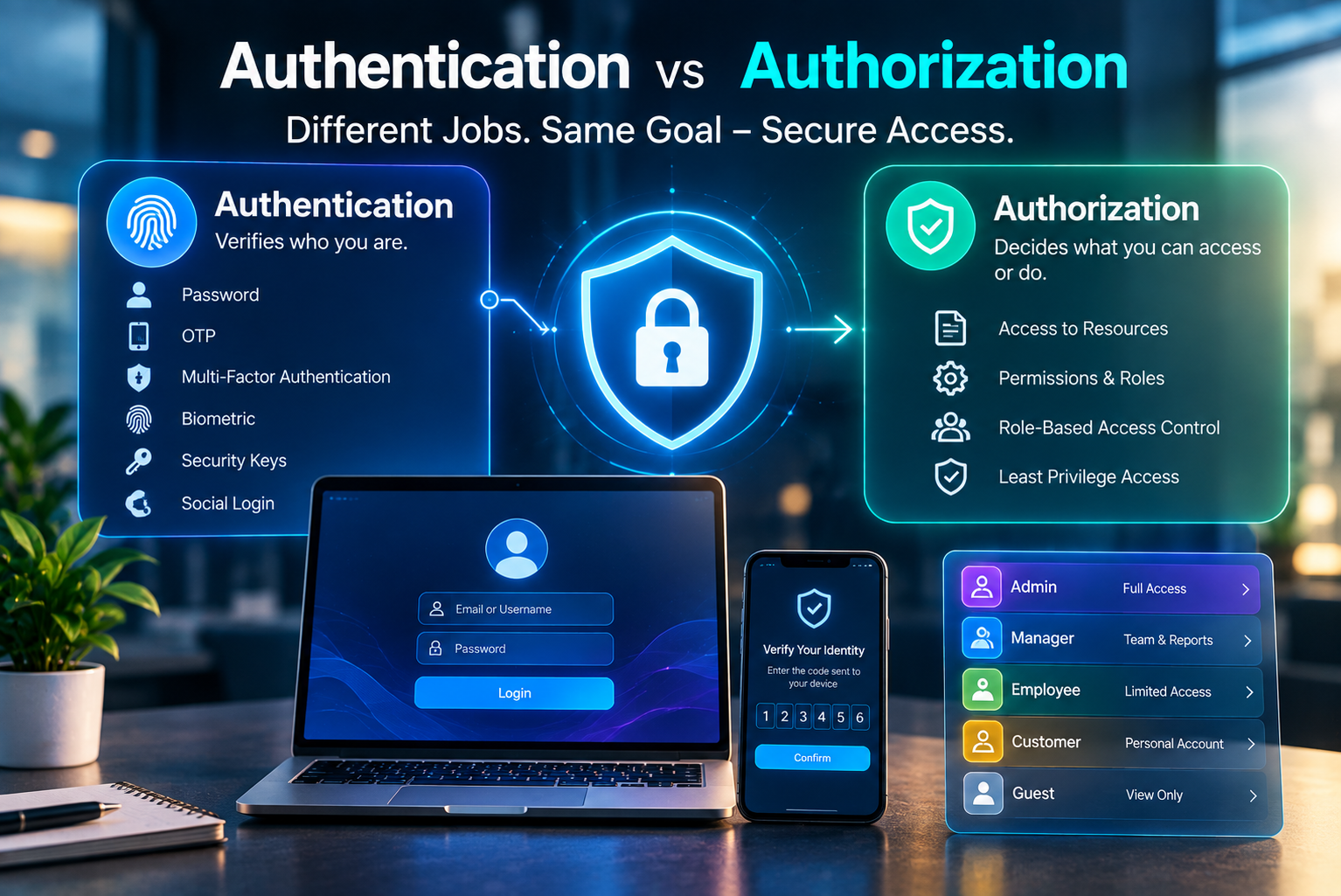
Authentication establishes a user's identity, while authorization decides which resources and actions are available to that authenticated user.
For websites, mobile applications, APIs, SaaS products, CRM platforms, financial systems, and enterprise software, getting both processes right is an important part of building a secure application.
What Does Authentication Mean?
Authentication is the identity verification stage of an application.
When a person enters login credentials, the system checks whether those credentials belong to a valid account. Depending on the application, identity can be verified in several ways.
Common authentication methods include:
- Email and password
- Mobile OTP
- Multi-factor authentication
- Authenticator applications
- Biometric verification
- Security keys
- Social or enterprise login
- Token-based authentication
The purpose is to establish confidence that the person or service making a request is associated with the claimed identity.
A Simple Authentication Example
Consider an employee logging into an internal company portal.
The employee enters their registered email address and password. The application verifies the credentials and, if they are valid, creates an authenticated session.
At this point, the system knows which employee has logged in.
It still needs to determine what that employee can access.
That decision belongs to authorization.
What Is Authorization?
Authorization is the process of deciding what an authenticated identity can access or perform.
Once a user has been identified, the application checks their assigned permissions, role, ownership, or other access rules.
For example, an administrator may have permission to manage employees and system settings, while a normal employee may only have access to their own account and assigned business tools.
Authorization can control access to:
- Customer information
- Financial records
- Administrative dashboards
- Reports
- Databases
- Business documents
- API endpoints
- Account settings
- Specific application features
In short, authorization answers:
“What is this user permitted to do?”
Authentication and Authorization: What Is the Difference?
The distinction becomes easier when you look at their roles separately.
Authentication verifies identity.
Authorization determines permissions.
Imagine entering an office building.
Your employee ID proves that you work for the company. That is similar to authentication.
Your ID may also determine whether you can enter the server room, finance department, or management area. That is authorization.
Both layers are required because knowing someone's identity does not automatically mean they should have unrestricted access.
Why Strong Authentication Matters
User accounts are frequent targets for cyberattacks. Stolen passwords, phishing, credential reuse, and automated login attempts can all put accounts at risk.
A well-designed authentication system adds appropriate protection around the identity-verification process.
Secure Password Handling
Applications should never treat passwords as ordinary database values.
Passwords should be processed using suitable password-hashing techniques and should not be stored in readable form.
Applications should also encourage users to maintain strong, unique passwords.
Multi-Factor Authentication
Multi-factor authentication adds another verification requirement after or alongside the password.
For example:
Password + OTP
or
Password + Authenticator App
This creates an additional security barrier when a password has been exposed.
Secure Session Management
Authentication does not end when the login succeeds.
Applications also need to protect authenticated sessions. Tokens and session identifiers should be handled securely, have appropriate lifetimes, and be invalidated when necessary.
Poor session management can turn a valid login into an opportunity for account takeover.
Why Authorization Is Equally Important
A correctly authenticated user should not automatically have access to every part of an application.
Imagine a CRM containing thousands of customer records. A sales employee may need access to their assigned customers, while a system administrator may need broader access.
If the application does not enforce these differences, sensitive information can be exposed.
Authorization helps ensure that users receive only the permissions appropriate to their responsibilities.
This becomes especially important for:
- Financial applications
- Healthcare systems
- E-commerce platforms
- CRM software
- SaaS applications
- Enterprise portals
- Trading systems
- Business management platforms
Role-Based Access Control
One popular authorization model is Role-Based Access Control (RBAC).
With RBAC, permissions are associated with roles rather than being manually configured for every individual user.
A business application might have roles such as:
| Role | Example Permissions |
|---|---|
| Administrator | Manage users, settings, and system configuration |
| Manager | Access team data and business reports |
| Employee | Use assigned business functions |
| Customer | Manage personal account information |
| Guest | Access limited public resources |
This approach can make permission management easier as an organization grows.
However, complex applications may require additional rules based on resources, departments, ownership, location, account type, or other attributes.
Authentication and Authorization in APIs
APIs allow different applications and services to communicate with one another. Because they often provide access to sensitive resources, identity and permission checks are particularly important.
An API request should not automatically be trusted simply because it comes from another application.
Depending on the architecture, APIs may use technologies and mechanisms such as:
- Access tokens
- OAuth-based authentication
- API keys
- Signed requests
- Service identities
- Permission scopes
A secure API should verify both the identity behind a request and whether that identity has permission to access the requested resource.
For sensitive operations, authorization should be enforced at the backend rather than relying on what the frontend displays.
Authentication in Mobile Applications
Mobile applications face many of the same identity challenges as websites, but they also have device-specific considerations.
A secure mobile application should carefully manage:
- Login credentials
- Authentication tokens
- User sessions
- Backend communication
- Account recovery
- Permission checks
One important rule is that hiding a feature in the mobile interface is not the same as protecting it.
For example, an application may hide an administrative button from ordinary users. A malicious user could still attempt to call the corresponding API directly.
The server must therefore verify authorization for sensitive operations independently of the mobile interface.
Common Authentication and Authorization Mistakes
Security problems can occur when identity and permission controls are treated as simple login functionality.
Weak Credential Protection
Poor password storage or weak login controls can expose user accounts.
Trusting the Frontend
Security decisions should not depend solely on buttons, menus, or restrictions implemented in the client application.
Excessive Permissions
Giving every employee or customer more access than necessary increases the potential impact of a compromised account.
Insecure Sessions
Long-lived or poorly protected sessions can increase the risk of unauthorized account access.
Missing Resource-Level Checks
An application may confirm that a user is logged in but fail to check whether that user owns or is permitted to access a particular resource.
Poor Error Handling
Security-related responses should avoid revealing unnecessary information about accounts, credentials, tokens, databases, or internal application behavior.
The Principle of Least Privilege
A strong authorization strategy generally follows the principle of least privilege.
The idea is straightforward:
Give each user, service, or application only the permissions required to perform its intended job.
For example, a reporting service that only needs to read specific data should not receive permission to modify or delete the entire database.
Limiting permissions can reduce the potential damage caused by compromised accounts or services.
Authentication and Authorization in Modern Software
Today's applications are increasingly interconnected.
A single business platform might include:
Website → Mobile App → API → CRM → Database → Cloud Services → Third-Party Systems
Every connection introduces another point where identity and permissions may need to be considered.
This is why authentication and authorization should be included during application architecture and development rather than added as an afterthought.
How to Build a Strong Access-Control Strategy
Businesses developing a new application can consider several practices from the beginning:
- Clearly define user types and responsibilities
- Select appropriate authentication methods
- Use MFA where it provides meaningful protection
- Secure passwords and authentication tokens
- Protect user sessions
- Establish clear authorization rules
- Apply least-privilege principles
- Enforce permission checks on backend services
- Protect API endpoints
- Monitor unusual access behavior
- Maintain appropriate audit records
- Review permissions regularly
The exact implementation should depend on the application's users, data, integrations, business requirements, and security risks.
Authentication and Authorization for APIs, SaaS, and Enterprise Platforms
The importance of access control increases as software becomes more connected.
A SaaS platform may serve thousands of customers. A CRM may contain confidential business information. A financial application may process sensitive transactions. An enterprise system may have different departments with completely different responsibilities.
In these environments, simply having a username and password is not enough.
Applications need an access-control architecture that determines who can access which resources and under what conditions.
Why Security Should Be Part of Software Architecture
Authentication and authorization affect much more than the login screen.
They influence application databases, APIs, frontend interfaces, backend services, user roles, session management, cloud infrastructure, logging, and third-party integrations.
Designing these components together can make an application easier to maintain and safer to expand.
Security should therefore be considered during the planning and architecture stages of software development.
How a Professional Development Team Can Help
Implementing secure authentication and authorization requires careful consideration of application architecture and business requirements.
A development team needs to understand:
- Who the application's users are
- Which resources they can access
- Which operations require additional permissions
- How different services communicate
- How sessions and tokens are managed
- Which activities should be logged
- How permissions will evolve as the product grows
This becomes even more important when authentication and authorization need to work across websites, mobile apps, APIs, CRM systems, cloud services, and other business tools.
Conclusion
Authentication and authorization are two essential parts of application security, but they solve different problems.
Authentication establishes identity. Authorization controls permissions.
A user successfully signing in does not mean that the user should have unrestricted access to the application.
By combining secure identity verification with carefully designed access controls, businesses can build software that better protects sensitive information while giving users the functionality they actually need.
As websites, mobile applications, APIs, SaaS platforms, and connected business systems continue to grow, authentication and authorization will remain fundamental components of secure software development.
Talk to Our Team
Looking to develop a secure website, mobile application, API, CRM, SaaS platform, or custom business software?
LogiClump Technologies can help turn your technology requirements into scalable and practical software solutions.
🌐 Website: www.logiclump.com
📧 Email: inzi@logiclump.com
📞 Contact: 9450301204 | 9718724937
Build. Innovate. Empower.
Understand authentication and authorization, how they differ, and why secure identity and access control are essential for modern applications and APIs.
Tom Cruise