
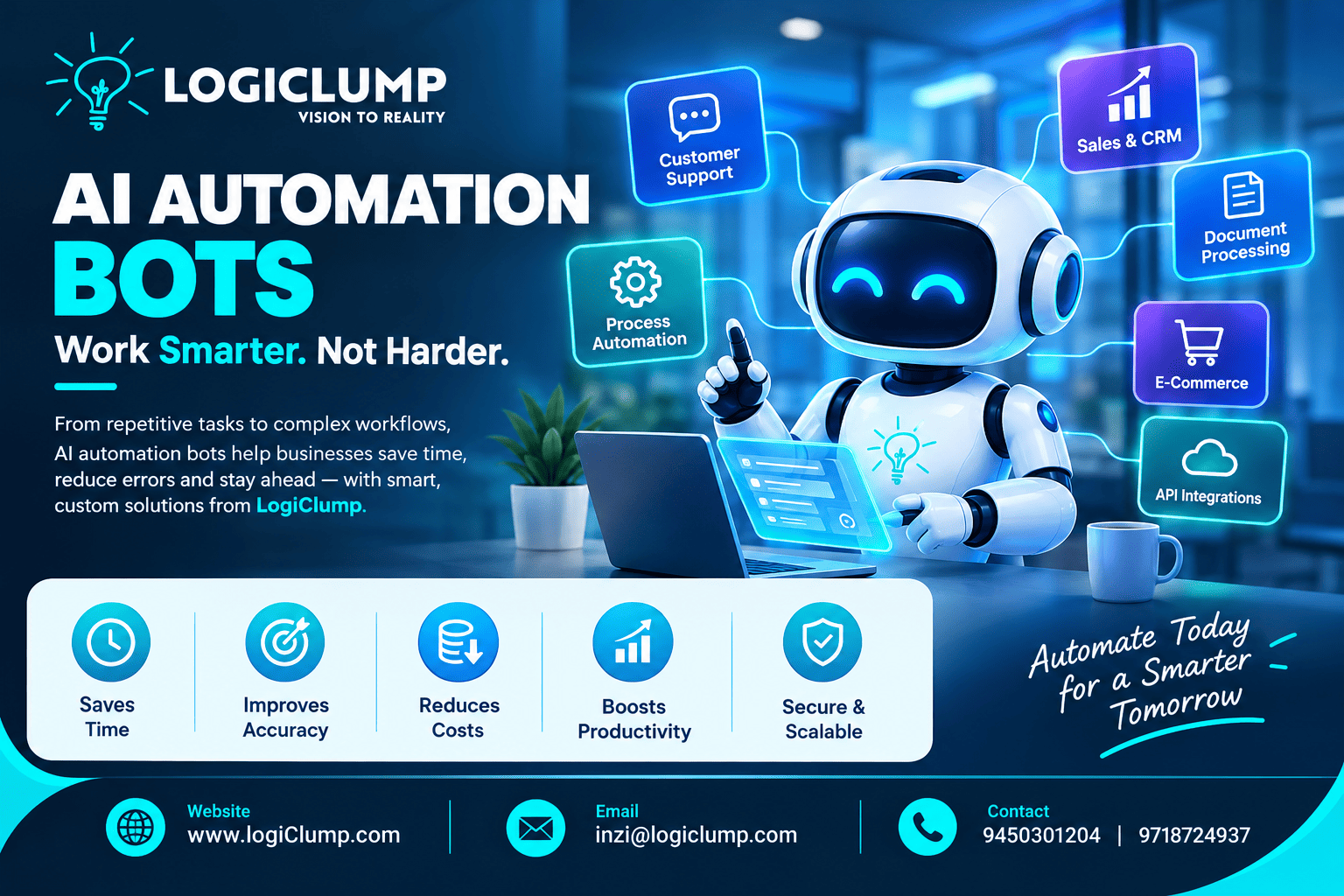
AI Automation Bots for Businesses
Running a business involves more than serving customers and generating revenue. Behind every successful organization are dozens of everyday activities: managing inquiries, updating customer records, reviewing documents, coordinating employees, tracking orders, and keeping different software systems in sync.
When these activities depend heavily on manual effort, teams can spend hours handling routine work instead of focusing on growth.
AI automation bots offer a way to make everyday business operations more efficient. By combining artificial intelligence with workflow automation, these systems can help businesses interpret information, organize tasks, and carry out selected actions across their existing software.
For companies seeking practical digital transformation, the opportunity is not simply to automate individual tasks. It is to build connected workflows that reduce unnecessary effort and help employees make better use of their time.
At LogiClump, we develop custom software, AI-powered applications, and business integrations that can help organizations turn operational challenges into practical digital solutions.
Understanding AI Automation Bots
An AI automation bot is a software system that uses artificial intelligence to assist with tasks that would otherwise require manual work or repetitive decision-making.
Unlike a basic script that follows a fixed sequence, an AI-enabled bot can interpret certain types of information, recognize patterns, categorize requests, and generate responses. When connected to authorized business systems, it can also initiate specific actions.
Imagine a company receiving hundreds of customer inquiries every week. Employees may need to read each message, identify the customer's problem, locate the relevant account, and forward the inquiry to the appropriate department.
An AI automation bot could assist by classifying incoming messages, retrieving relevant information, preparing a response, and creating a support ticket.
The exact level of automation depends on the system's design, permissions, and reliability.
AI automation bots may combine technologies such as:
-
Natural language processing
-
Generative AI
-
Machine learning
-
Business workflow engines
-
Database integrations
-
Application programming interfaces (APIs)
-
Rules-based automation
The goal is to select the technologies that suit the business problem rather than adding unnecessary complexity.
How AI Automation Differs From Basic Business Automation
Traditional automation is excellent at handling predictable tasks. For example, a system can automatically send an order confirmation after a purchase or notify a manager when a form is submitted.
AI becomes useful when the process involves information that requires interpretation.
Consider a company that receives customer emails. A conventional workflow may send every email to the same inbox. An AI-enabled workflow could identify whether a message concerns billing, technical support, a sales inquiry, or a delivery issue, then route it accordingly.
The two approaches can work together:
Business rules provide control. AI helps interpret information. Automation carries out approved actions.
This combination can be more dependable than relying on an AI model to make every decision independently.
Business Problems AI Automation Can Help Solve
The most valuable automation projects usually begin with a specific operational problem.
1. Too Much Time Spent on Repetitive Tasks
Employees may repeatedly copy information between applications, prepare similar reports, send reminders, or update records.
An AI automation bot can help organize these activities and reduce manual handling.
For example, when a prospect submits a website inquiry, a workflow could extract the relevant details, create a CRM record, assign the lead to a salesperson, and prepare a follow-up reminder.
Employees can then focus on engaging with the prospect rather than entering the same information into several systems.
2. Slow Customer Service
Customers often contact businesses with similar questions about products, services, orders, or account procedures.
An AI bot connected to an approved knowledge base can help answer routine questions and direct more complicated requests to a human representative.
This can improve the handling of common inquiries while preserving human support for situations that require judgment, empathy, or special authorization.
3. Information Scattered Across Applications
A business might store customer details in a CRM, invoices in accounting software, orders in an e-commerce platform, and internal procedures in a separate document system.
Employees may need to open several applications to complete one task.
With suitable integrations, an AI automation bot can retrieve information from authorized sources and coordinate selected steps within a single workflow.
This can reduce application switching and make information easier to use.
4. Inconsistent Business Processes
When employees perform the same task in different ways, errors and delays can become more common.
Automation can standardize routine steps, such as checking required fields, assigning tasks, sending notifications, and recording outcomes.
AI can help handle variations in incoming information, while predefined business rules establish the boundaries of the process.
Types of AI Automation Bots Businesses Can Use
Different departments can benefit from different automation solutions.
Customer Support Bots
A customer support bot can help answer frequently asked questions, search product documentation, categorize tickets, and collect information before a support representative takes over.
When connected to the relevant business systems, it may also assist with order-status inquiries or service requests.
For more complicated problems, the bot should be able to transfer the conversation to a human without losing important context.
CRM and Sales Bots
Sales teams need accurate customer information and timely follow-ups.
A CRM automation bot can help:
-
Organize incoming leads
-
Classify sales inquiries
-
Summarize customer conversations
-
Prepare follow-up messages
-
Identify missing information
-
Create reminders and tasks
-
Update approved CRM fields
For example, a business could use automation to assign incoming leads based on their inquiry type and notify the appropriate salesperson.
The bot should follow the company's qualification rules and avoid making unsupported assumptions about a customer's suitability.
E-Commerce Bots
Online retailers handle product questions, order inquiries, customer feedback, returns, and inventory changes.
AI automation can assist with these activities by categorizing customer requests, retrieving product information, preparing support responses, and notifying employees when an issue requires attention.
A retailer could also use a bot to summarize recurring complaints about a product, helping the team identify issues that deserve further investigation.
Document Processing Bots
Many organizations receive information through invoices, application forms, purchase orders, contracts, and other documents.
An AI-enabled document workflow can extract relevant fields, classify the document, identify missing information, and send it to the correct team.
For instance, an invoice-processing system could capture the supplier name, invoice number, and amount before checking the information against company records.
Financial approvals and payments should still follow appropriate validation and authorization procedures.
HR Automation Bots
Human resources departments handle employee questions, onboarding activities, scheduling, and internal documentation.
An HR bot can help employees locate approved policies, answer routine procedural questions, and initiate standard requests.
It may also help coordinate onboarding checklists or remind employees about outstanding documentation.
Because HR information can be sensitive, access must be restricted according to employee roles and business requirements.
IT Operations Bots
IT teams manage service requests, technical incidents, application alerts, and internal support questions.
An AI automation bot can summarize incident information, classify incoming requests, search technical documentation, and prepare tickets for the relevant team.
For example, repeated reports of the same application error could be grouped into a single incident summary.
Changes to production systems or security permissions should remain subject to appropriate safeguards.
How an AI Automation Bot Fits Into a Business Workflow
A useful automation system is designed around a clear process, not just an AI interface.
A typical workflow includes the following stages:
Step 1: Receive an event
The process begins with a customer message, form submission, document upload, scheduled activity, or another defined trigger.
Step 2: Interpret the information
The AI identifies the likely request, document type, or task.
Step 3: Retrieve relevant data
The system accesses approved records, business documents, or connected applications.
Step 4: Apply business rules
The workflow checks whether the proposed next step is permitted and whether additional information is needed.
Step 5: Perform an authorized action
The bot may create a ticket, prepare a message, update a permitted field, or assign a task.
Step 6: Verify and record the result
The system checks available evidence of completion and records important events.
Step 7: Involve a human when needed
Unclear requests, failed operations, and high-impact actions can be routed for human review.
This structure helps businesses introduce AI without surrendering control of their operations.
Why APIs Matter for AI Automation
An AI bot cannot reliably coordinate business systems unless it has a suitable way to communicate with them.
APIs allow applications to exchange information and perform authorized operations.
For example, a custom automation solution might connect:
-
A website inquiry form to a CRM
-
A CRM to an email notification service
-
An order-management system to customer support
-
An internal database to a reporting dashboard
-
A document-processing workflow to an approval system
These integrations allow a bot to participate in an existing process rather than operating as an isolated tool.
A secure implementation should include authentication, access restrictions, input validation, rate limits, credential protection, and activity logging.
Each integration should expose only the information and actions required for the bot's assigned role.
When Businesses Need Custom AI Automation Software
Ready-made automation platforms can be effective for common workflows. However, some businesses have requirements that do not fit neatly into standard products.
A company may use an internally developed CRM, a specialized inventory database, a custom customer portal, or a collection of applications that need to work together.
In such cases, a tailored solution may be more suitable.
Custom AI automation software can be designed around:
-
Existing applications and databases
-
Company-specific procedures
-
Internal approval structures
-
User permissions
-
Industry requirements
-
Reporting and analytics needs
-
Third-party integrations
-
Future business expansion
For example, a logistics business might need a workflow that receives shipment updates, checks delivery records, flags potential delays, and prepares notifications for customers and operations staff.
A custom system can coordinate these steps according to the company's actual process.
Security and Reliability Should Be Built In
AI automation bots may interact with confidential records and important business applications. Their permissions and actions must therefore be carefully managed.
A reliable solution should consider the following safeguards:
Limited access: Each bot should have only the permissions needed for its work.
Data privacy: Sensitive information should be protected and made available only to authorized users and systems.
Human approval: High-value transactions, destructive actions, and important permission changes may require explicit confirmation.
Input validation: Information should be checked before it is used to trigger important operations.
Activity records: Important actions, system calls, approvals, and failures should be recorded.
Protection against malicious instructions: Emails, documents, and external content should be treated as untrusted input, not as authority to override the system's approved instructions.
Ongoing monitoring: Teams should review errors, unexpected behavior, and workflow performance after deployment.
These controls help businesses make automation useful without giving AI unrestricted access to critical systems.
Common Mistakes to Avoid
AI automation projects can fail when organizations focus on technology before understanding the process.
Automating an Unclear Workflow
If employees cannot clearly explain how a process should work, automating it may simply make existing problems harder to detect.
Document the current process and agree on the desired outcome first.
Expecting AI to Be Correct Every Time
AI can misinterpret information or generate inaccurate responses. Important outputs should be validated, and uncertain situations should have a clear escalation path.
Ignoring Existing Software
A bot that cannot access the right business information may have limited value. Identify the necessary integrations before development begins.
Giving the Bot Too Much Authority
A bot that can read records may not need permission to delete them or approve transactions. Separate access to information from permission to execute sensitive actions.
Measuring Activity Instead of Results
The number of automated tasks is not enough to prove success. Businesses should measure time saved, error reduction, customer experience, and total operating costs.
How to Measure the Business Value of AI Automation
Before launching an AI automation bot, establish a baseline for the existing process.
Useful measures include:
-
Average task-completion time
-
Manual steps required per task
-
Error and rework rates
-
Customer response times
-
Successful workflow completion
-
Frequency of human escalation
-
Employee time spent on administration
-
Cost per completed task
Suppose a business receives a large volume of support requests. It could measure how much time employees spend categorizing tickets before automation, then compare the results after introducing the bot.
The evaluation should also consider incorrect classifications, integration failures, monitoring costs, and the time employees spend correcting errors.
This provides a more realistic picture of whether automation is improving the business.
A Practical Roadmap for Getting Started
Businesses can introduce AI automation gradually instead of attempting to transform every department at once.
1. Choose One Suitable Process
Look for a repetitive task with a clear outcome and measurable workload.
2. Define the Desired Result
Specify what successful completion means and which situations require human involvement.
3. Identify the Required Information
Determine which records, documents, and applications the bot needs to access.
4. Select the Right Technology
Evaluate whether the process needs AI, conventional automation, a ready-made platform, or a custom application combining these approaches.
5. Establish Permissions and Controls
Decide what the bot can read, create, modify, or send, and which actions need approval.
6. Test With Realistic Scenarios
Test normal cases, incomplete information, unusual requests, failed integrations, and potentially malicious inputs.
7. Launch a Controlled Pilot
Start with a limited workflow and monitor its performance before expanding its responsibilities.
8. Improve Based on Evidence
Use operational metrics and employee feedback to identify what needs improvement.
Once the workflow performs reliably, the business can consider applying the same approach to other suitable processes.
The Future of AI Automation in Business
AI automation is moving beyond simple automated replies toward systems that can assist with several connected stages of a business process.
A customer request may involve retrieving account information, creating a task, preparing a response, and updating a record. A document workflow may involve classification, data extraction, validation, and approval.
Some solutions may use specialized AI agents for different responsibilities, coordinated through a controlled workflow.
However, not every business needs a complex multi-agent system. In many cases, a single AI component combined with conventional automation can solve the problem more simply.
The direction is clear: successful business automation will depend on selecting the right level of intelligence and autonomy for each task.
How LogiClump Helps Businesses Build AI Automation Solutions
Every organization has its own processes, applications, and operational challenges. Effective automation should fit those requirements rather than forcing the business into an unsuitable workflow.
LogiClump Technologies develops custom digital solutions that can bring together AI capabilities, business applications, APIs, and workflow automation.
Our software development services include:
-
AI-powered business applications
-
Custom AI automation bots
-
CRM development and integration
-
Web and mobile application development
-
API development and third-party integrations
-
Business workflow automation
-
Reporting dashboards
-
SaaS platforms
-
Custom backend systems
Whether your objective is to improve customer support, simplify CRM operations, process documents, or connect separate business applications, the first step is understanding the process you want to improve.
We focus on building practical software around real business requirements, with attention to integration, scalability, security, and maintainability.
Conclusion
AI automation bots can help businesses reduce repetitive work, organize information, and coordinate activities across their software systems.
Their value extends beyond answering questions. When connected to suitable applications and controlled workflows, they can assist with customer service, CRM management, document handling, e-commerce operations, and internal business processes.
However, effective automation depends on more than AI alone. Clear workflows, reliable data, secure integrations, appropriate permissions, testing, and human oversight are all essential.
For businesses planning to modernize their operations, AI automation can provide a practical starting point: identify one time-consuming process, improve it with the right technology, measure the outcome, and expand when the results justify it.
Ready to make your business workflows smarter?
Connect with LogiClump Technologies to explore custom AI automation bots, intelligent applications, API integrations, and business software tailored to your needs.
🌐 Website: www.logiclump.com
📧 Email: inzi@logiclump.com
📞 Contact: 9450301204 | 9718724937
LogiClump — Build. Innovate. Empower.
Learn how AI automation bots help businesses reduce repetitive work, streamline workflows, connect applications, and improve operational efficiency.
Tom Cruise