
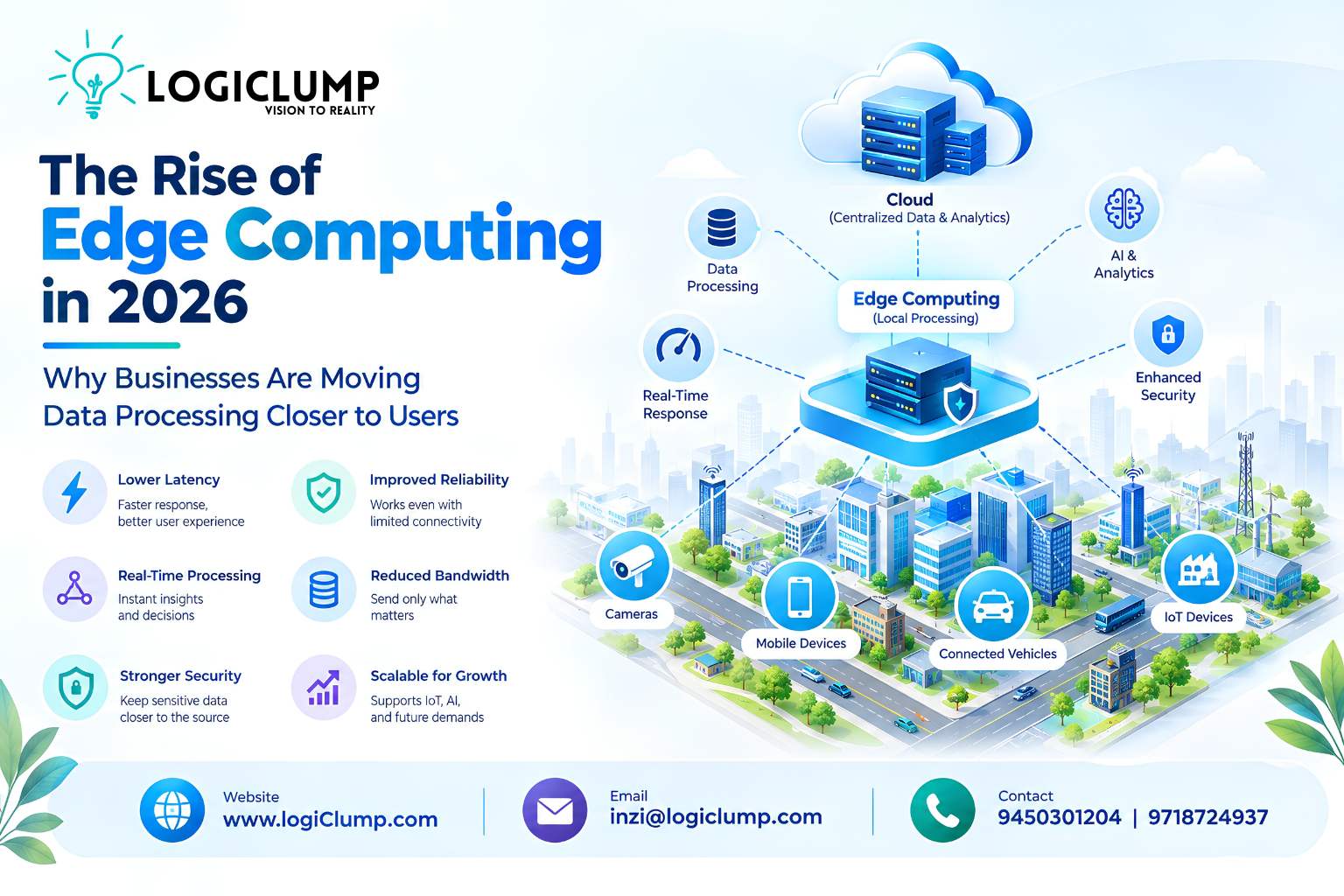
The Rise of Edge Computing in 2026
Businesses are generating and processing more data than ever before. From mobile applications and connected devices to AI systems, online platforms, industrial equipment, and real-time analytics, modern digital services increasingly depend on fast access to data and computing resources.
Traditionally, much of this processing has taken place in centralized cloud data centers. Cloud computing remains an important foundation for modern applications, but as workloads become more sensitive to latency, connectivity, responsiveness, and real-time decision-making, businesses are increasingly exploring another approach: edge computing.
Edge computing moves some data processing and computing capabilities closer to the location where data is generated or consumed.
In 2026, this approach is becoming increasingly relevant for applications that need fast responses, continuous connectivity, and efficient handling of large volumes of distributed data.
What Is Edge Computing?
Edge computing is a distributed computing approach in which data processing occurs closer to users, devices, applications, or data sources instead of sending every request to a centralized cloud environment.
A traditional architecture may look like:
User / Device → Internet → Cloud Data Center → Processing → Response
An edge-enabled architecture can instead look like:
User / Device → Edge Location → Processing → Response
Only the data that requires centralized processing may then be sent to the cloud or a central data center.
Edge locations can include:
- Local servers
- Branch-office infrastructure
- Telecom edge locations
- Content delivery networks
- Industrial gateways
- Retail systems
- On-premises computing devices
- Connected IoT gateways
The exact architecture depends on the application's requirements.
Why Edge Computing Is Becoming Important in 2026
The growth of digital services is creating new requirements for application performance.
Users expect websites, applications, and digital services to respond quickly.
At the same time, businesses are deploying more connected devices and generating larger amounts of information from:
- Smartphones
- Cameras
- Sensors
- Vehicles
- Industrial equipment
- Retail systems
- Healthcare devices
- Smart buildings
- IoT platforms
Sending all of this information to a centralized location can create additional network traffic and latency.
Edge computing provides another architectural option by processing suitable workloads closer to where the information originates.
Edge Computing vs. Cloud Computing
Edge computing does not necessarily replace cloud computing.
Instead, the two approaches can work together.
Cloud platforms are useful for centralized workloads such as:
- Large-scale data storage
- Enterprise applications
- Central analytics
- Machine-learning training
- Application management
- Long-term data processing
Edge infrastructure can handle workloads where local processing or faster response times are important.
A hybrid architecture could look like:
Devices → Edge Processing → Cloud Platform → Central Analytics
This allows businesses to use edge computing for immediate operations while keeping centralized cloud infrastructure for broader processing and management.
Reducing Latency
One of the main reasons businesses consider edge computing is latency.
When a request travels to a distant data center and back, network distance and intermediate infrastructure can add delay.
Processing information closer to the user or device can reduce the amount of distance that data needs to travel.
This can be useful for applications where fast responses matter, such as:
- Real-time monitoring
- Interactive applications
- Industrial systems
- Gaming
- Video processing
- Connected vehicles
- Augmented reality
- Remote operations
Even small improvements in responsiveness can influence how users experience digital services.
Edge Computing and Real-Time Applications
Some applications cannot rely entirely on centralized processing because they need decisions to happen quickly.
Consider an industrial machine equipped with sensors.
The system may need to detect an abnormal condition and trigger an action immediately.
Instead of sending every sensor reading to a remote cloud service and waiting for a response, an edge system can analyze relevant information locally.
The workflow could be:
Sensor → Edge Device → Real-Time Analysis → Immediate Action
The cloud can still receive selected information for reporting, historical analysis, or long-term optimization.
Edge Computing and IoT
The Internet of Things is one of the major areas where edge computing can be useful.
IoT devices can generate large volumes of data continuously.
For example, a smart factory may have thousands of sensors monitoring:
- Temperature
- Pressure
- Equipment performance
- Energy consumption
- Production activity
- Machine vibration
Sending every piece of raw information to a central cloud environment may not always be necessary.
Edge systems can filter and process data locally.
For example:
Sensors → Edge Gateway → Relevant Data → Cloud
This approach can reduce unnecessary data transmission while allowing important information to reach centralized systems.
Edge Computing for Retail
Retail businesses are also exploring distributed computing architectures.
A modern retail environment can contain:
- Point-of-sale systems
- Security cameras
- Inventory scanners
- Customer applications
- Digital displays
- Smart shelves
- Payment systems
Edge computing can allow certain processing tasks to occur within or near the store.
For example, local systems could process inventory information or analyze operational data without depending entirely on a distant cloud service.
The central cloud platform can then aggregate information from multiple locations.
Edge Computing in Healthcare
Healthcare applications can involve large amounts of sensitive information and systems that require reliable access.
Depending on the application, edge computing can support local processing for:
- Medical devices
- Patient monitoring
- Imaging workflows
- Hospital systems
- Connected equipment
- Real-time alerts
Local processing can potentially reduce network dependency for certain workloads.
However, healthcare applications also require careful attention to privacy, security, regulatory requirements, and system reliability.
Edge architecture should therefore be designed around the specific requirements of the healthcare environment.
Edge Computing for Smart Cities
Smart-city infrastructure can generate information from many distributed locations.
Examples include:
- Traffic cameras
- Road sensors
- Parking systems
- Public transportation
- Environmental sensors
- Street infrastructure
- Energy systems
Edge computing can process certain information locally rather than sending every data point to a central platform.
For example, traffic systems could process local sensor information to identify changing road conditions and provide relevant information to centralized systems.
This can support faster responses while reducing unnecessary data movement.
Edge Computing and AI
The combination of AI and edge computing is becoming increasingly important.
AI applications often require significant computing resources, but not every AI workload needs to be processed in a centralized cloud environment.
Smaller AI models can potentially run directly on:
- Edge servers
- Smartphones
- Industrial devices
- Cameras
- Vehicles
- IoT gateways
This approach is often referred to as edge AI.
A camera system, for example, could analyze video locally and send only relevant events to the cloud rather than continuously transmitting raw video.
The architecture might look like:
Camera → Edge AI → Event Detection → Cloud Storage / Analytics
This can reduce data transmission and support faster responses.
Edge Computing and Data Privacy
Data privacy is another consideration when processing information close to its source.
In some applications, businesses may not need to send all raw information to centralized infrastructure.
Local processing can allow systems to analyze information and transmit only the required results.
For example:
Raw Data → Local Processing → Relevant Result → Central System
However, edge computing does not automatically guarantee privacy.
Businesses still need appropriate:
- Authentication
- Encryption
- Access controls
- Device security
- Network protection
- Data governance
- Monitoring
- Software updates
Distributed infrastructure can actually create additional security considerations because there may be more devices and locations to manage.
Edge Computing Can Improve Resilience
Dependence on a centralized cloud service or internet connection can create operational challenges for certain applications.
If connectivity becomes unavailable, an application that requires continuous communication with a remote service may be affected.
Edge systems can allow some functionality to continue locally.
For example:
Internet Available → Edge + Cloud
Internet Disrupted → Edge Continues Essential Processing
Once connectivity is restored, relevant information can synchronize with centralized systems.
This can be particularly useful for industrial, retail, transportation, and remote environments.
Reducing Bandwidth Requirements
As businesses collect more video, sensor, and application data, network bandwidth can become an important consideration.
Edge computing can reduce the amount of information that needs to travel to centralized infrastructure.
For example, instead of sending continuous high-resolution video:
Camera → Edge Processing → Detect Event → Send Event Data
Only relevant information may be transmitted.
This can potentially reduce network traffic and associated infrastructure requirements.
Edge Computing and Content Delivery
Edge computing is closely related to the broader concept of distributed infrastructure.
Content delivery networks already place cached content closer to users to improve delivery performance.
Modern edge platforms can extend this concept by supporting additional application logic closer to users.
This can allow businesses to run selected workloads at geographically distributed locations rather than relying entirely on centralized servers.
Examples can include:
- API processing
- Authentication logic
- Personalization
- Content transformation
- Request routing
- Lightweight application functions
Edge Computing for Gaming
Online gaming is highly sensitive to latency.
Players expect fast responses between their actions and the application's reaction.
Edge infrastructure can place computing resources closer to groups of users, potentially reducing network distance.
Edge environments can support workloads such as:
- Game session processing
- Real-time interactions
- Content delivery
- Matchmaking-related services
- Data processing
However, the appropriate architecture depends on the game's technical requirements and user distribution.
Edge Computing and Connected Vehicles
Connected vehicles generate information from sensors, cameras, navigation systems, and other onboard technologies.
Some decisions need to happen close to the vehicle itself.
Edge processing can support local analysis while cloud infrastructure handles larger-scale operations such as:
- Fleet analytics
- Software management
- Historical data
- Centralized reporting
- Model training
This creates a distributed architecture:
Vehicle → Local Processing → Edge Infrastructure → Cloud
Such architectures can help separate real-time operations from centralized workloads.
Edge Computing and 5G
The expansion of high-speed mobile networks is another factor supporting edge computing.
5G can provide high-speed connectivity and lower-latency communication for suitable applications.
When combined with edge infrastructure, it can create opportunities for distributed applications that require fast communication between devices and nearby computing resources.
Potential applications include:
- Smart factories
- Connected vehicles
- Remote operations
- AR/VR
- Industrial IoT
- Real-time monitoring
The actual benefits depend on network availability, application architecture, and workload requirements.
Edge Computing Architecture
A modern edge architecture can contain several layers.
Device Layer
This includes sensors, smartphones, cameras, vehicles, and IoT devices.
Edge Layer
Local servers, gateways, or distributed computing resources process information close to the source.
Cloud Layer
Centralized cloud infrastructure handles storage, large-scale analytics, machine-learning training, and enterprise services.
Management Layer
Centralized systems manage:
- Devices
- Software updates
- Security policies
- Monitoring
- Configuration
- Data synchronization
A simplified architecture is:
Devices → Edge → Cloud → Central Applications
The Security Challenges of Edge Computing
Distributed infrastructure introduces additional security considerations.
Traditional cloud environments may concentrate infrastructure within professionally managed data centers.
Edge deployments can involve infrastructure distributed across:
- Stores
- Factories
- Vehicles
- Offices
- Telecom locations
- Remote facilities
This increases the number of systems that need protection.
Businesses should consider:
Device Security
Edge devices should use secure configurations and controlled access.
Authentication
Only authorized systems and users should be able to interact with edge infrastructure.
Encryption
Sensitive information should be protected both during transmission and storage.
Software Updates
Edge devices need reliable mechanisms for security patches and software updates.
Monitoring
Businesses need visibility into distributed systems to detect unusual activity and operational problems.
Edge Computing Can Increase Technical Complexity
Although edge computing provides potential benefits, it also introduces engineering challenges.
Businesses may need to manage:
- Distributed infrastructure
- Multiple locations
- Device lifecycle management
- Network connectivity
- Software updates
- Monitoring
- Security
- Data synchronization
- Hardware requirements
- Failure handling
Managing hundreds or thousands of distributed systems can be significantly more complex than managing a smaller centralized environment.
For this reason, edge computing should be introduced where its benefits justify the additional operational complexity.
Edge vs. Cloud: Which Approach Should Businesses Use?
The choice does not always have to be either edge or cloud.
Many modern applications can use both.
| Requirement | Edge | Cloud |
|---|---|---|
| Low-latency processing | Useful | May involve additional network delay |
| Centralized storage | Limited | Strong |
| Large-scale analytics | Limited | Strong |
| Local processing | Strong | Less suitable |
| Distributed workloads | Strong | Strong |
| Massive centralized compute | Limited | Strong |
| Offline or intermittent connectivity | Can support local operation | Usually more dependent on connectivity |
The right architecture depends on the application's workload, data requirements, geographical distribution, security needs, and operational model.
How Businesses Can Prepare for Edge Computing
Organizations considering edge computing can begin with a structured approach.
1. Identify Latency-Sensitive Workloads
Determine which applications require fast local responses.
2. Analyze Data Sources
Identify where information is generated and how much data is being produced.
3. Evaluate Network Requirements
Understand connectivity, bandwidth, reliability, and geographic distribution.
4. Select Suitable Edge Infrastructure
Determine whether the workload requires gateways, local servers, telecom edge infrastructure, or another architecture.
5. Design Security From the Beginning
Distributed systems should include authentication, encryption, monitoring, and controlled access.
6. Integrate With Cloud Systems
Edge infrastructure should work with centralized applications, databases, analytics, and management platforms where required.
7. Automate Management
Automation can help with deployment, updates, monitoring, configuration, and infrastructure management.
The Role of APIs in Edge Computing
APIs provide an important connection between edge systems and centralized applications.
An edge device may need to communicate with:
- Cloud platforms
- Enterprise applications
- Databases
- Analytics systems
- AI services
- Authentication systems
- Monitoring platforms
Well-designed APIs can help connect these components.
For example:
Edge Device → Secure API → Cloud Platform → Analytics
API design should consider authentication, data validation, performance, reliability, and failure handling.
Observability Becomes More Important
With infrastructure distributed across many locations, businesses need strong observability.
Teams should be able to monitor:
- Device health
- Application performance
- Network connectivity
- Resource utilization
- Errors
- Security events
- Data synchronization
- Software versions
Centralized monitoring can provide an overview of distributed systems while allowing teams to investigate individual edge locations when problems occur.
The Future of Edge Computing in 2026 and Beyond
Edge computing is becoming part of a broader shift toward distributed digital infrastructure.
The architecture of many applications may increasingly combine:
Cloud + Edge + AI + IoT + 5G + APIs + Automation
Cloud infrastructure can provide centralized scale and management.
Edge infrastructure can provide local processing and responsiveness.
AI can provide intelligent analysis.
IoT devices can generate information.
APIs can connect systems.
Automation can simplify management.
Together, these technologies can support more distributed digital services.
How LogiClump Can Help Build Edge-Ready Software
Edge computing requires careful coordination between application architecture, APIs, databases, cloud infrastructure, security, and distributed systems.
LogiClump can help businesses develop customized software solutions designed around their specific technology and operational requirements.
Development can incorporate considerations such as:
- Cloud-ready architecture
- API development
- Scalable backend systems
- IoT integration
- Real-time applications
- AI integration
- Data processing
- Secure communication
- Monitoring
- Automation
- Performance optimization
The objective is to create software architecture that can support distributed workloads while maintaining security, reliability, scalability, and maintainability.
Final Thoughts
The rise of edge computing reflects a broader change in how businesses approach digital infrastructure.
As applications become more dependent on real-time data, connected devices, AI, and geographically distributed users, processing every request through a centralized cloud environment may not always be the most suitable architecture.
Edge computing provides another option by bringing selected processing capabilities closer to users and data sources.
The future is unlikely to be about choosing edge instead of cloud.
Instead, many businesses will combine both approaches.
Cloud provides centralized scale. Edge provides proximity. AI provides intelligence. APIs provide connectivity.
Together, these technologies can create digital systems that are faster, more responsive, resilient, and better suited to the increasingly distributed nature of modern applications.
For businesses, the key is to identify where edge computing can solve a genuine technical or operational requirement and then design the architecture around measurable needs rather than adopting the technology simply because it is new.
Contact LogiClump
🌐 Website: www.logiclump.com
📧 Email: inzi@logiclump.com
📞 Contact: 9450301204 | 9718724937
Build. Innovate. Empower.
Explore how edge computing in 2026 helps businesses reduce latency, improve reliability, strengthen security, and process data closer to users.
Tom Cruise