
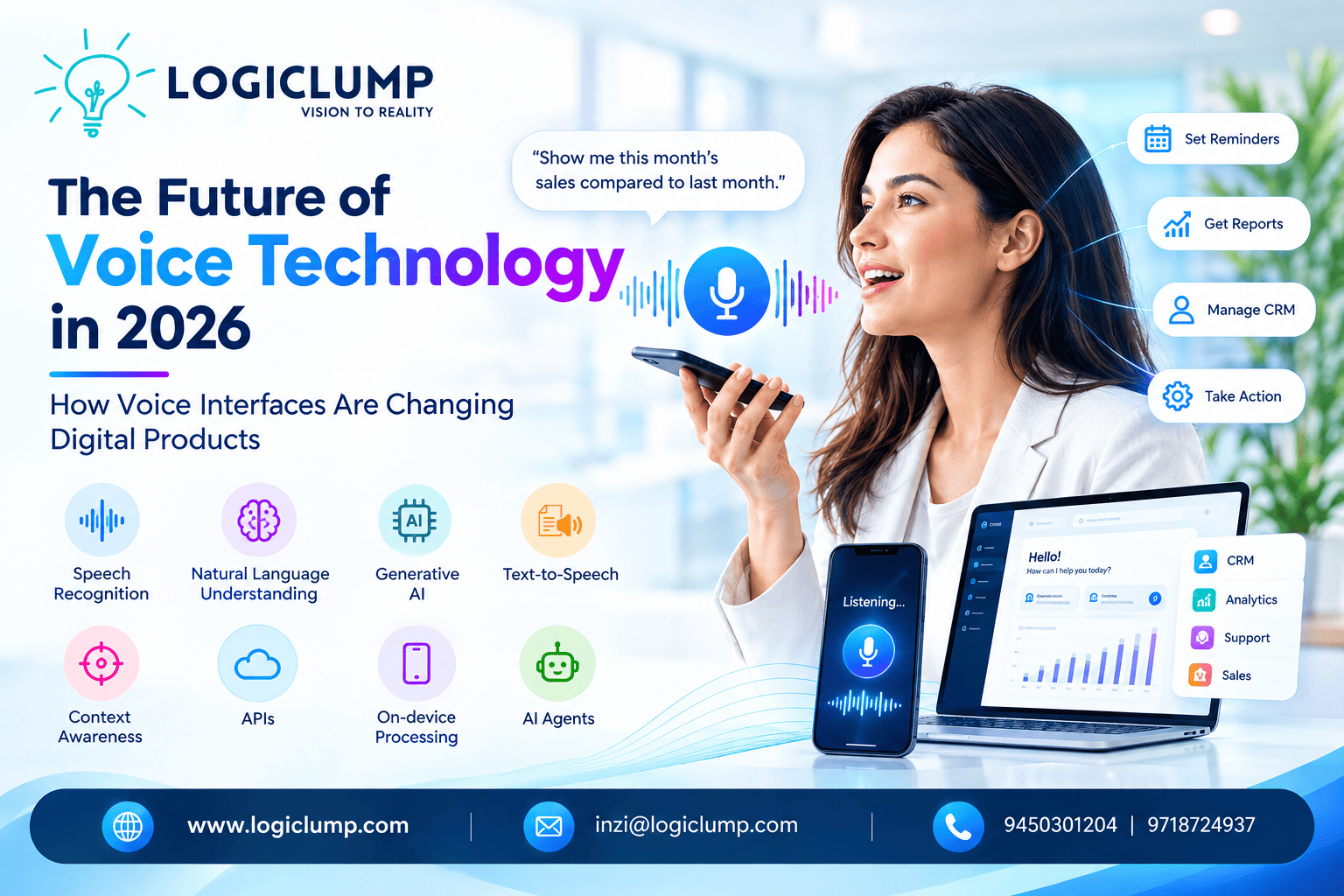
The Future of Voice Technology in 2026
The way people interact with technology is changing.
For decades, digital products have primarily depended on screens, keyboards, touch controls, buttons, and menus. Voice was added later as a convenient feature for tasks such as searching, dictating messages, setting reminders, or asking simple questions.
In 2026, voice interaction is becoming much more than an optional feature.
Artificial intelligence is allowing software to understand conversational requests, recognize context, connect with business systems, and respond through natural speech. As a result, voice is becoming an important part of the overall digital experience.
The bigger opportunity is not simply making applications capable of hearing users.
It is making applications capable of understanding what users want to accomplish.
Voice Technology Is Entering a New Phase
Traditional voice interfaces generally depended on predefined commands.
A user might say:
“Set a reminder for 6 PM.”
The application recognized the command and performed a specific action.
Modern AI-powered voice systems can handle much broader requests.
For example:
“Remind me this evening to follow up with the customer I spoke with yesterday.”
Understanding this request may require the system to identify the customer, examine previous interactions, understand the requested time, and create an appropriate reminder.
This represents an important transition:
Voice commands → Conversational interaction → Intelligent actions
Voice is increasingly becoming a gateway to software functionality.
What Makes Modern Voice Interfaces Different?
A modern voice experience can combine several technologies:
- Speech recognition
- Natural-language understanding
- Generative AI
- Large language models
- Text-to-speech
- Conversational interfaces
- Context awareness
- APIs
- On-device processing
- AI agents
Together, these technologies can allow an application to move from simply recognizing spoken words to interpreting intent and initiating appropriate workflows.
The user does not necessarily need to know which menu, button, or feature performs a particular task.
They can describe the outcome they want.
Why Businesses Are Paying Attention to Voice
Voice interaction can be useful whenever typing, clicking, or navigating through multiple screens creates unnecessary friction.
Consider a field employee who needs to update a customer record while working.
Instead of stopping to type everything manually, the employee could dictate the information.
Similarly, a manager could ask a business application:
“Show me this month's sales compared with last month.”
The system could retrieve the relevant information and display the comparison.
Potential business applications include:
- CRM systems
- Customer support
- E-commerce
- Banking applications
- Healthcare software
- Productivity tools
- Field-service applications
- Enterprise dashboards
- Educational platforms
- SaaS products
The value of voice depends on whether it makes a real task easier.
Voice Is Becoming a Natural-Language Interface
One of the biggest changes is the movement away from rigid commands.
Traditional software often expects users to understand its interface.
AI-powered voice experiences can instead allow the software to understand the user's language.
For example, an employee could ask:
“Which leads need attention today?”
The system could interpret this as a CRM query.
A voice-enabled application might then:
- Identify the user's account.
- Check available customer data.
- Apply the relevant business rules.
- Find leads matching the request.
- Present the results.
- Explain the information through voice if needed.
The interface becomes less about finding a feature and more about expressing an intention.
The Rise of Multimodal Voice Experiences
Voice does not have to replace graphical interfaces.
In many cases, the strongest experience will combine several interaction methods.
A modern application could use:
Voice + Text + Touch + Camera + AI
Imagine an online shopping application.
A customer points their phone at a pair of shoes and asks:
“Find something similar that costs less.”
The camera provides visual information.
Voice provides the request.
AI interprets both.
The application searches its product database.
The screen presents matching products.
The user can then continue the interaction through voice or touch.
This type of multimodal interaction can make digital products feel considerably more natural.
Voice and Mobile Applications
Smartphones are particularly suitable for voice experiences because they already contain microphones, speakers, cameras, connectivity, and increasingly capable processors.
Developers can use voice for more than dictation.
Voice Search
Users can search products, documents, messages, or content naturally.
Voice Navigation
Users can request a particular application function without navigating through several menus.
Voice Input
Employees can create notes, reports, records, or messages while working.
AI Assistants
Users can ask questions and receive contextual answers.
Voice Workflows
Voice can become the starting point for completing multi-step tasks.
For businesses, this can create a more flexible mobile experience without forcing users to interact with every feature manually.
On-Device Voice AI
Cloud-based processing remains important, but on-device AI is becoming increasingly relevant.
When suitable processing can happen directly on a device, applications may benefit from:
- Faster response times
- Reduced network dependency
- Greater privacy for certain workloads
- Better offline functionality
- Lower latency
This can be useful for applications where immediate feedback matters.
Potential examples include:
- Voice notes
- Accessibility features
- Offline assistants
- Mobile productivity tools
- Field applications
- Educational software
However, on-device processing is not automatically the right choice for every application.
Developers need to consider model size, device hardware, privacy requirements, connectivity, processing costs, and the complexity of the task.
A hybrid architecture can sometimes combine local processing with cloud-based AI.
Voice-Powered Customer Service
Customer support is another area where voice technology can make a significant difference.
Traditional automated telephone systems often force customers through long menus.
An AI-powered voice system can instead allow a customer to describe the problem naturally.
For example:
“I paid for my order, but the application still says payment is pending.”
A connected support system could potentially:
- Understand the customer's problem
- Identify the account
- Check transaction information
- Retrieve order details
- Explain the current status
- Create a support ticket
- Escalate the issue when necessary
The important element is integration.
A voice system becomes much more useful when it can safely interact with the business software behind it.
Voice in E-Commerce
Voice can simplify product discovery and shopping.
Instead of constructing a detailed search query, customers could describe what they want conversationally.
For example:
“I need a lightweight laptop for office work with good battery life.”
The system could interpret:
- Product category
- Intended use
- Desired characteristics
- Potential preferences
It could then present relevant products.
Voice can also be useful for:
- Order tracking
- Product questions
- Delivery updates
- Returns
- Customer support
- Product comparisons
However, businesses should distinguish between low-risk information requests and sensitive actions such as payments or account changes.
Voice in Banking and FinTech
Financial applications present interesting opportunities for voice interfaces, but they also require stronger security controls.
A customer might ask:
“How much did I spend on food this month?”
The application could retrieve transactions and provide a summary.
Other possible uses include:
- Account information
- Spending analysis
- Financial education
- Transaction searches
- Customer support
- Portfolio information
- Voice navigation
But a request such as:
“Transfer ₹50,000 to this account.”
should not be treated like an ordinary voice command.
Sensitive financial operations may require additional authentication, transaction confirmation, risk checks, and authorization.
Voice should be considered an interaction mechanism—not automatically a complete security mechanism.
Voice Authentication and Voice Interaction Are Not the Same
This distinction is important.
Voice interaction answers:
What is the user asking the application to do?
Voice authentication addresses:
Is the person making the request actually authorized?
These are separate security problems.
A voice-enabled application can use voice for convenience while relying on stronger identity and authorization mechanisms for sensitive operations.
Depending on the application, security controls can include:
- Account authentication
- Device verification
- Session controls
- Multi-factor authentication
- Risk-based authentication
- Transaction confirmation
- Role-based authorization
- Audit logging
This becomes especially important when voice is connected to financial, administrative, or business-critical actions.
Voice Can Make Software More Accessible
Accessibility is another important reason to consider voice.
Some users may find traditional interfaces difficult or inconvenient to operate. Voice can provide another way to interact with digital products.
For example, users may be able to:
- Navigate an application
- Enter information
- Search content
- Read information aloud
- Dictate messages
- Execute supported commands
But good accessibility design should not make voice mandatory.
A well-designed product can provide multiple options:
Voice + Touch + Keyboard + Visual Controls
Users should be able to choose the interaction method that works best for their situation.
The Challenge of Accents and Languages
Real users do not speak in identical ways.
Voice systems need to deal with:
- Different accents
- Regional pronunciations
- Dialects
- Speaking speeds
- Background noise
- Microphone differences
- Code-switching between languages
This is especially relevant for products serving multilingual markets.
In India, for example, users may naturally mix English with Hindi or other regional languages during a conversation.
A voice product designed for a broad audience therefore needs testing with realistic speech rather than relying only on clean laboratory recordings.
Privacy Is Critical for Voice Products
Audio can contain highly sensitive information.
A conversation may reveal:
- Personal information
- Financial details
- Business discussions
- Customer information
- Addresses
- Account information
- Authentication-related information
Businesses need to understand exactly what happens to voice data.
Important questions include:
- Is audio stored?
- How long is it retained?
- Is it processed locally?
- Is it transmitted to an external service?
- Who can access it?
- Can users delete it?
- Is sensitive information removed before storage?
Privacy should be considered during product architecture rather than added after the voice feature has already been developed.
Voice + AI Agents
The combination of voice and AI agents could have an even larger impact.
A traditional voice assistant might answer:
“What meetings do I have today?”
An AI agent could potentially handle a more complicated request:
“Find a suitable time with the design team next week and prepare a meeting invitation.”
The voice interface captures the request.
The AI interprets the objective.
The agent accesses permitted tools.
The connected applications provide the required information.
Business rules determine what the agent is allowed to do.
The user can approve sensitive actions before they are completed.
This creates a new interaction model:
Speak → Understand → Plan → Act → Confirm
APIs Will Power Voice-Enabled Applications
Voice alone cannot complete most useful business workflows.
The underlying software needs APIs and services that allow the AI system to retrieve information and perform authorized actions.
A typical architecture might look like:
Voice Input
↓
Speech Recognition
↓
AI / Intent Understanding
↓
Business Rules
↓
Secure API Layer
↓
Business Application
↓
Voice + Visual Response
The API layer is especially important because it can enforce permissions and prevent the AI model from having unrestricted access to business systems.
Voice Interfaces Need Strong Guardrails
Giving an AI system the ability to understand voice and perform actions introduces additional risks.
For example, the system may misunderstand a request or encounter malicious input.
Businesses can reduce these risks through:
- Permission controls
- Input validation
- API restrictions
- Rate limits
- Human approval
- Transaction limits
- Audit trails
- Monitoring
- Role-based access
- Explicit business rules
High-risk operations should not depend entirely on an AI model's interpretation.
The application should have independent controls that determine what can actually happen.
Designing a Good Voice User Experience
Voice interfaces require a different approach to UX design.
A successful voice experience should consider several factors.
Give users feedback
Users should know whether the system heard them correctly.
Allow corrections
Misunderstandings should be easy to fix.
Keep responses concise
Long spoken responses can become difficult to follow.
Support interruption
Users should be able to interrupt or change direction naturally.
Provide visual confirmation
Important information can be shown on screen even when the request starts with voice.
Provide fallback controls
Users should always have another way to complete important tasks.
Voice UX is therefore not just a speech-recognition problem.
It is a product-design problem.
Voice-First Does Not Mean Voice-Only
Some applications may eventually be designed around voice.
However, many digital products will benefit more from a combination of interaction methods.
For example:
Voice: Find information.
Screen: Compare results.
Touch: Select an option.
Voice: Ask a follow-up question.
Screen: Review the final details.
This creates a flexible interface in which each interaction method is used where it makes the most sense.
The future of voice is therefore likely to be multimodal rather than completely voice-driven.
How Businesses Can Prepare for Voice Technology
Companies considering voice functionality should begin with specific user problems.
Before development begins, businesses should ask:
Does voice actually improve the task?
Not every feature needs voice.
Which users will benefit?
Voice should solve a real usability problem.
What information can the system access?
Data boundaries should be clearly defined.
Which actions are sensitive?
Financial, administrative, and destructive actions may require additional confirmation.
What happens when the system misunderstands?
There should always be a recovery path.
Which languages are required?
Language support should reflect the target market.
How will voice data be protected?
Privacy and retention requirements should be addressed early.
Building a Voice-Enabled Digital Product
A production-ready voice application can contain several technical layers.
1. Voice Interface
Handles microphone input and audio interaction.
2. Speech Processing
Converts speech into usable information and generates spoken responses.
3. AI Layer
Interprets natural language, intent, and context.
4. Business Logic
Determines which operations are valid.
5. API Layer
Connects the voice experience to application services.
6. Security Layer
Controls identity, permissions, authentication, authorization, and sensitive actions.
7. Data Layer
Manages application information and relevant voice-related data.
8. Monitoring
Tracks performance, failures, unusual activity, and user experience.
This separation allows businesses to use AI without making the AI model responsible for every security decision.
Where Voice Technology Could Go Next
As AI and speech technologies continue developing, voice may become a standard interaction option across many categories of software.
Possible applications include:
- AI-powered mobile assistants
- Voice-enabled SaaS
- Intelligent customer support
- Voice commerce
- Enterprise assistants
- Smart workplace applications
- Educational applications
- Healthcare interfaces
- Voice-enabled FinTech
- Field-service software
- Voice-controlled AI agents
- Multilingual digital products
The biggest change may not be the quality of synthesized speech or speech recognition alone.
It may be the ability of software to connect spoken requests with meaningful actions.
The New Role of Voice in Digital Product Design
The traditional digital experience often looks like this:
Open application → Find feature → Navigate menus → Enter information → Submit
A voice-enabled AI experience could look more like:
Describe what you need → AI understands → Application performs the permitted workflow → User reviews the result
This does not mean traditional interfaces will disappear.
Instead, voice can become another layer that makes complex software easier to access.
Users may no longer need to memorize where every function exists.
They can simply explain what they want.
How LogiClump Can Help
Building a useful voice-enabled product requires more than connecting a microphone to an AI service.
It may involve:
- Voice interface development
- AI integration
- Speech-to-text
- Text-to-speech
- Conversational AI
- AI agent integration
- API development
- Mobile application development
- Web application development
- Authentication
- Authorization
- Business automation
- Data protection
- Monitoring and analytics
At LogiClump, we develop custom websites, mobile applications, business software, AI-powered solutions, APIs, and intelligent digital products.
Voice capabilities can be integrated into a larger software ecosystem so that users can communicate naturally while the underlying application manages business rules, data, permissions, and workflows.
The objective is not simply to make software talk.
It is to make software more useful to the people using it.
Conclusion
Voice technology is moving beyond simple commands and basic digital assistants.
In 2026, improvements in AI, speech processing, on-device computing, conversational interfaces, APIs, and intelligent automation are creating new possibilities for digital products.
The opportunity for businesses is not to add voice everywhere.
It is to identify the moments where speaking is a more natural or efficient way to interact with software.
The most successful products may combine:
Voice + AI + APIs + Automation + Visual Interfaces
This approach can create experiences that are faster, more conversational, and easier to use while still maintaining appropriate security and user control.
The future of digital products may therefore not be about choosing between touch, typing, or voice.
It may be about giving users the freedom to communicate with software in the way that feels most natural.
Software won't just wait for users to navigate it.
It will increasingly understand what users want to accomplish.
Contact LogiClump
🌐 Website: www.logiclump.com
📧 Email: inzi@logiclump.com
📞 Contact: 9450301204 | 9718724937
Build. Innovate. Empower.
Explore how voice technology is changing digital products in 2026 through AI, conversational interfaces, on-device processing, voice agents, APIs, and multimodal experiences.
Tom Cruise