
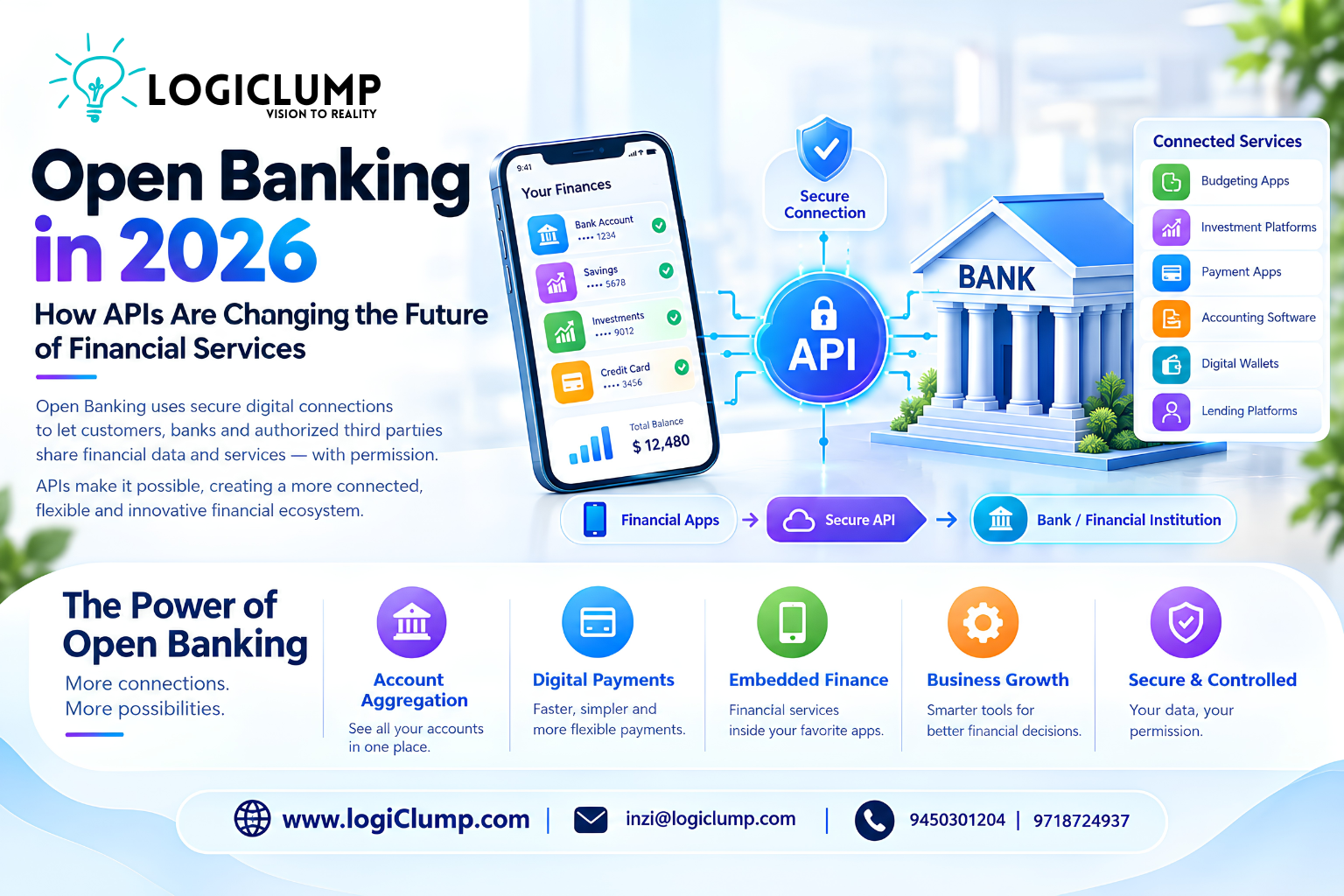
Open Banking in 2026: The Future of Connected Finance
Banking is no longer limited to visiting a branch or opening a bank's own application.
Today, people can manage finances through budgeting apps, payment platforms, investment applications, accounting software, digital wallets, and other connected services. Businesses are also connecting their financial systems with software that helps them manage payments, transactions, accounting, and cash flow.
A major technology behind this connected financial ecosystem is the API.
Open Banking uses secure digital connections to allow customers, banks, and authorized third-party providers to exchange financial information or initiate supported services with appropriate permission.
In 2026, the concept is expanding beyond simple account-data access. It is becoming part of a larger movement toward connected finance, embedded financial services, automated payments, and intelligent FinTech applications.
What Does Open Banking Mean?
Open Banking is a financial technology model that enables customers to authorize approved third-party services to access certain banking information or services.
Instead of keeping all financial activity inside one banking application, users can choose to connect their accounts with other services.
For example, a person may connect several bank accounts to one financial-management application. The application can then display authorized information in one place.
Depending on the market and available infrastructure, Open Banking can support capabilities such as:
- Account information access
- Balance information
- Transaction data
- Payment initiation
- Financial management
- Account aggregation
The customer's permission and the applicable regulatory framework remain central to the process.
Why APIs Matter So Much
An API acts as a communication mechanism between different software systems.
In an Open Banking environment, an API can allow an authorized application to communicate with a bank or financial institution without requiring the third-party application to directly access the bank's internal systems.
A simplified example looks like this:
Customer → Financial App → Secure API → Bank → Authorized Information
This model allows different services to communicate while keeping access controlled.
For software developers, APIs also make it easier to build financial applications around existing banking infrastructure rather than recreating every banking function from the ground up.
The Shift From Traditional Banking to Connected Finance
Traditional banking generally revolved around individual institutions.
The modern financial ecosystem is much more distributed.
A customer might use:
- One bank for daily transactions
- Another service for investments
- A budgeting application for expense tracking
- A payment application for purchases
- A lending platform for financing
Open Banking helps create connections between these different services.
The result is a financial environment where customers can access specialized services without necessarily managing everything through one institution.
Account Aggregation and Financial Visibility
One practical application of Open Banking is account aggregation.
Instead of checking multiple accounts separately, customers can authorize a financial application to bring information together.
This can make it easier to understand:
- Current balances
- Recent transactions
- Monthly expenses
- Recurring payments
- Income patterns
- Overall financial activity
For consumers, this can make financial management more convenient.
For software companies, it creates opportunities to build applications around financial planning, budgeting, analytics, and personalized recommendations.
Open Banking and Digital Payments
Open Banking can also play an important role in payment innovation.
Where supported by the relevant financial infrastructure, APIs can enable applications to initiate account-to-account payments or create alternative payment experiences.
Potential use cases include:
- Digital checkout
- Direct account payments
- Subscription payments
- Automated business payments
- Payment reconciliation
- Financial workflow automation
This can give businesses additional ways to design payment experiences around their own applications.
Open Banking Is Fueling Embedded Finance
Financial services are increasingly being integrated into software that was not traditionally considered financial software.
This is known as embedded finance.
A business platform might provide payment capabilities.
An e-commerce application might offer financing.
An accounting system might connect directly with a bank.
A marketplace might integrate financial services for its sellers.
Instead of forcing customers to leave an application to access a financial service, businesses can incorporate selected financial capabilities directly into their digital products.
Open Banking infrastructure can contribute to this shift by enabling controlled connections between financial institutions and software platforms.
How Businesses Can Benefit From Open Banking
Open Banking can provide opportunities beyond consumer banking.
Businesses can connect financial information with internal systems to improve operational visibility.
For example, financial data can potentially be incorporated into:
- Accounting platforms
- Expense management systems
- Cash-flow dashboards
- Invoicing applications
- Enterprise software
- Business analytics tools
This can reduce repetitive manual processes and give businesses more current information about their finances.
Open Banking and Accounting Automation
Finance teams often spend significant time moving transaction information between systems.
Manual imports and spreadsheet-based processes can create unnecessary work and increase the possibility of mistakes.
With suitable API integrations, authorized banking information can potentially flow into accounting software automatically.
This can support processes such as:
- Transaction matching
- Account reconciliation
- Expense categorization
- Financial reporting
- Payment tracking
Automation does not remove the need for financial professionals. Instead, it can allow teams to spend less time on repetitive data handling.
Open Banking and Lending
Financial data can also support modern lending workflows.
Traditional lending applications may require customers to provide multiple documents to demonstrate their financial situation.
Where regulations and customer permissions allow, authorized banking information can provide additional insight into income, expenses, and cash flow.
This could help support:
- Faster application processing
- Automated financial analysis
- Cash-flow assessment
- Risk evaluation
- Personalized lending experiences
However, financial data should never be treated as a simple shortcut to automated approval. Responsible lending, privacy, fairness, security, and regulatory requirements remain important.
The Role of AI in Open Banking
Artificial intelligence is creating new possibilities for financial applications.
Once customers have authorized access to relevant financial information, AI can potentially help turn raw transaction data into useful insights.
For example, an AI-powered financial application could identify:
- Spending trends
- Recurring expenses
- Unusual changes
- Budget patterns
- Cash-flow issues
- Potential areas for savings
Financial institutions can also use AI for internal processes such as customer support, fraud analysis, financial analytics, and operational automation.
The effectiveness of these systems depends on the quality, accuracy, authorization, and security of the underlying data.
Open Banking and Fraud Detection
Greater connectivity also means greater responsibility.
Financial APIs can become targets for attackers if they are not properly secured.
Potential threats include:
- Unauthorized account access
- Stolen credentials
- Malicious applications
- Excessive API requests
- Account takeover attempts
- Manipulated transactions
Businesses therefore need a layered approach to Open Banking security.
Important controls may include:
- Strong authentication
- Fine-grained authorization
- Encryption
- Secure token handling
- Rate limiting
- API monitoring
- Fraud detection
- Audit logging
Security should be designed into the architecture instead of being added after the financial application has been built.
Customer Consent Is Fundamental
Financial information belongs to the customer, making consent a critical part of Open Banking.
Users should be able to understand what they are authorizing before an application receives access.
A well-designed consent experience should clearly communicate:
- Which information is being requested
- Which service is requesting it
- Why the information is required
- What permissions are being granted
- How long access will remain active
- How access can be withdrawn
Making consent understandable can help build user confidence in financial data-sharing services.
Protecting Financial Data
Open Banking applications can handle extremely sensitive information.
Transaction records can reveal spending habits, financial relationships, subscriptions, business activities, and other private details.
Businesses should therefore consider security throughout the entire data lifecycle.
Important practices include:
Encryption
Protect sensitive information during transmission and storage.
Access Control
Limit financial data access to authorized users and systems.
Data Minimization
Avoid collecting information that the application does not actually require.
Secure API Design
Protect endpoints against unauthorized requests and abuse.
Audit Logging
Maintain useful records of important access and financial activities.
Retention Controls
Avoid keeping sensitive financial information longer than necessary.
Open Banking and API Security
The API layer is one of the most important parts of an Open Banking architecture.
An application may look secure from the customer's perspective while still having weaknesses in its backend APIs.
A secure implementation should consider:
Authentication
Who is making the request?
Authorization
What are they allowed to access?
Validation
Is the request legitimate and correctly formed?
Rate Limiting
Is the request volume reasonable?
Monitoring
Is the activity normal?
Logging
Can important actions be investigated later?
These controls help establish a stronger security boundary around financial integrations.
Open Banking for Small and Medium Businesses
Open Banking is not exclusively a technology for major banks or large enterprises.
Smaller businesses can also use connected financial services to improve everyday operations.
For example, a small company could connect its banking information with software used for:
- Accounting
- Invoicing
- Expense management
- Cash-flow tracking
- Financial reporting
This can provide better visibility without requiring employees to manually update multiple systems.
Open Banking and FinTech Startups
FinTech startups can benefit from the availability of financial APIs because they can focus on creating customer-facing products rather than building an entire banking infrastructure.
A startup might build:
- Budgeting software
- Financial dashboards
- Payment products
- Lending applications
- Expense-management tools
- Investment services
- Business-finance platforms
APIs provide the technical foundation for connecting these products with financial institutions and other services.
Open Banking vs Open Finance
Open Banking and Open Finance are related concepts but are not identical.
Open Banking generally focuses on banking accounts and associated financial services.
Open Finance expands the idea toward a wider range of financial products and information.
Depending on the market and regulatory framework, this broader ecosystem could include:
- Banking
- Investments
- Insurance
- Pensions
- Lending
- Payments
The move toward Open Finance could create even more opportunities for connected financial software.
Challenges Businesses Need to Consider
Open Banking provides opportunities, but implementation is not always simple.
Different APIs
Financial institutions may expose different API capabilities and technical requirements.
Availability
External services can experience downtime or temporary failures.
Security
Financial APIs require strong security controls.
Privacy
Financial information needs responsible handling.
Regulatory Requirements
Organizations must understand the laws and regulations applicable to their specific market and product.
Scalability
Financial applications need to remain reliable as users and transaction volumes increase.
Good architecture should account for these issues before the product reaches production.
Building an Open Banking Application
A reliable Open Banking product usually requires several interconnected components.
1. User Application
This could be a mobile application, web platform, or business dashboard.
2. Identity Layer
Users need secure authentication and account management.
3. Consent Management
The platform needs to track and enforce customer permissions.
4. API Integration Layer
This connects the application with banking and financial services.
5. Data Processing Layer
Authorized financial information needs to be transformed into useful application data.
6. Security Layer
Encryption, access controls, monitoring, and threat detection protect the system.
7. Business Logic
The application converts financial information into useful features such as reporting, payments, analytics, or automation.
Designing for Reliability
Financial applications cannot assume that external APIs will always respond successfully.
A bank API could become temporarily unavailable.
A request could time out.
A third-party service might return unexpected data.
A strong architecture should therefore include:
- Timeout handling
- Retry strategies
- Error handling
- Monitoring
- Alerting
- Secure fallback mechanisms
- Transaction reconciliation
Reliability is especially important when financial actions are involved.
What the Future of Open Banking Looks Like
Open Banking is likely to become increasingly connected with other areas of digital technology.
Future financial products may combine:
Open Banking + AI + Digital Identity + Embedded Finance + Automation
This combination could enable financial applications that are more personalized and responsive.
Customers may receive more intelligent financial insights.
Businesses may automate more financial operations.
Developers may be able to build specialized financial products on top of connected infrastructure.
The larger trend is clear: financial services are becoming increasingly integrated into the digital applications people already use.
How Businesses Can Prepare
Companies considering Open Banking should begin with the business problem rather than the technology.
Ask:
What financial process are we trying to improve?
Then determine:
- What data is actually needed?
- What permissions are required?
- Which financial providers need to be connected?
- How should the data be protected?
- What happens if an external API becomes unavailable?
- How will users control their permissions?
- How will suspicious activity be detected?
Starting with these questions can help prevent unnecessary complexity.
Why Software Architecture Matters
Open Banking is fundamentally a software-integration challenge.
A typical platform could involve:
Web/Mobile App
↓
Backend Services
↓
Identity & Consent Management
↓
Secure API Layer
↓
Financial Institution
↓
Financial Data
Every component needs to work reliably and securely.
Poor architecture can lead to security vulnerabilities, integration problems, performance issues, and difficult maintenance.
For this reason, Open Banking products should be designed with scalability, security, monitoring, and failure handling from the beginning.
Final Thoughts
Open Banking is changing the relationship between banks, software companies, and customers.
Secure APIs allow authorized applications to connect with financial services and create experiences that were difficult to build in traditional banking environments.
For consumers, this can mean better financial visibility and more convenient digital services.
For businesses, it can enable automation, accounting integration, payments, analytics, lending workflows, and new FinTech products.
But successful Open Banking implementation depends on more than API connectivity.
Security, consent, privacy, reliability, scalability, and responsible data handling are equally important.
As financial services continue moving into everyday digital experiences, APIs will remain a critical part of the infrastructure connecting the financial ecosystem.
Businesses that understand how to combine these technologies thoughtfully will be better positioned to build the next generation of connected financial products.
How LogiClump Can Help
Creating a modern financial platform requires more than connecting an API. It requires secure architecture, reliable integrations, scalable backend systems, and a clear understanding of how different services should communicate.
LogiClump Technologies can help businesses build custom digital solutions involving FinTech platforms, APIs, web applications, mobile apps, AI integrations, automation systems, and scalable business software.
Whether you are planning an Open Banking product, financial dashboard, payment solution, or another connected FinTech application, a strong technical foundation can help your product grow securely.
Website: www.logiclump.com
Email: inzi@logiclump.com
Contact: 9450301204 | 9718724937
Build. Innovate. Empower
Discover how Open Banking APIs are transforming financial services in 2026 through secure data sharing, digital payments, FinTech, AI, embedded finance, and automation.
Tom Cruise