
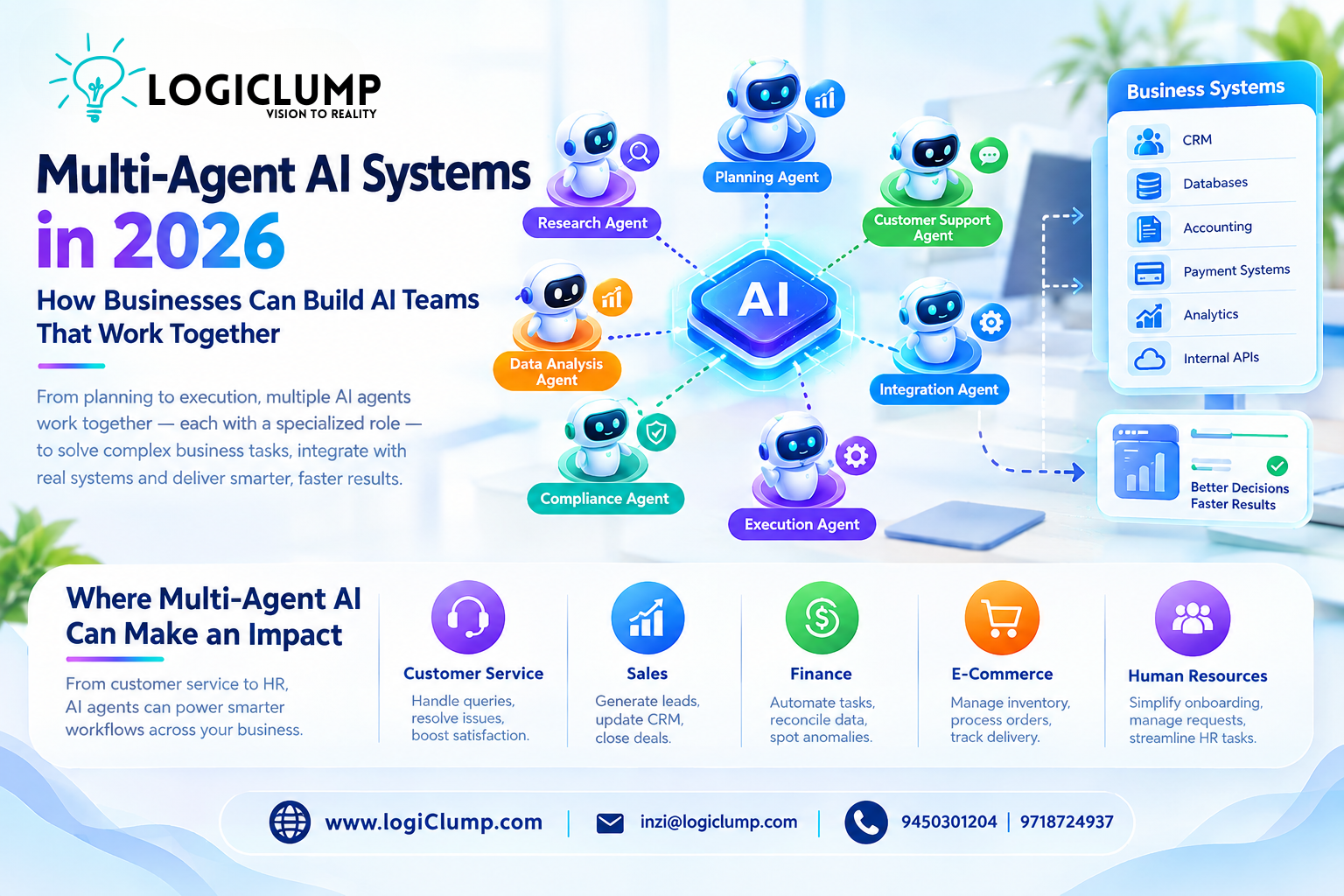
Multi-Agent AI Systems in 2026: Building Smarter AI Teams for Business
Artificial intelligence is entering a new phase. Businesses are no longer looking only for AI tools that answer questions or generate content. Increasingly, they want software that can understand a task, divide it into smaller steps, use business systems, and complete work with limited human intervention.
This is where multi-agent AI systems are becoming important.
Rather than depending on one AI agent for an entire workflow, companies can use several specialized agents. Each agent can focus on a particular responsibility while communicating with other agents to complete a larger business objective.
For organizations exploring intelligent automation in 2026, this approach could change how future business applications are designed.
What Is Multi-Agent AI?
Multi-agent AI refers to a system where multiple AI agents operate together to accomplish a broader objective.
Each agent can be designed for a particular function. For example, one agent might analyze customer information while another handles CRM updates and another prepares a report.
A typical workflow could look like:
Business Request → Planning Agent → Specialized Agents → Business Systems → Verification → Final Result
The agents do not necessarily have identical capabilities. Their roles, tools, data access, and permissions can be different.
This specialization can make complex automation easier to organize.
Why Businesses Are Looking at Multi-Agent Systems
Business processes often involve several applications and multiple decision points.
Consider a simple customer upgrade request. The process might require the system to:
- Identify the customer.
- Check the current subscription.
- Verify eligibility.
- Calculate the new price.
- Update the account.
- Record the transaction.
- Send a confirmation.
A conventional application can handle this through predefined code and workflows.
A multi-agent system can add an intelligent coordination layer where different agents manage parts of the process.
This does not mean traditional software becomes unnecessary. Instead, AI agents can work on top of existing business infrastructure.
How a Multi-Agent Architecture Works
A multi-agent system normally consists of several layers.
The Planning or Coordination Layer
A coordinator determines what needs to happen and which agents should participate.
It may convert a broad objective into smaller tasks.
For example:
"Prepare a monthly sales report."
could become:
- Collect sales data.
- Check data quality.
- Analyze performance.
- Compare previous periods.
- Generate a report.
- Send it to the appropriate team.
Different agents can then handle those responsibilities.
Specialized Agents
Each agent has a defined purpose.
Examples include:
- Research agent
- Customer support agent
- Sales agent
- Finance agent
- Data analysis agent
- Compliance agent
- Reporting agent
- IT operations agent
Keeping responsibilities separated can make permissions and testing easier to manage.
Tools and Integrations
Agents become useful when they can interact with real software.
They may need access to:
- Databases
- CRM platforms
- Payment services
- Accounting systems
- Inventory software
- Analytics platforms
- Internal APIs
These connections allow agents to move beyond generating text and actually participate in business workflows.
A Simple Example
Imagine an online retailer receives this request:
"Find customers who may be interested in our new product and prepare a campaign."
A multi-agent system could divide the work.
The Research Agent identifies relevant customer segments.
The Data Agent analyzes available customer information.
The Marketing Agent prepares campaign ideas.
The Compliance Agent checks whether the proposed communication follows company rules.
The CRM Agent prepares the relevant records.
A human employee can then review the final campaign before it is launched.
This is an example of how several smaller AI capabilities can combine into one larger workflow.
Where Multi-Agent AI Can Be Used
The technology has potential across many business functions.
Customer Service
A support system could use separate agents for understanding customer questions, searching internal knowledge, checking account information, and escalating complicated cases.
This can reduce the amount of repetitive work handled manually.
Sales
Sales teams can use agents to research prospects, qualify leads, update CRM records, prepare follow-ups, and summarize conversations.
Instead of spending time on administrative tasks, sales professionals can focus more heavily on customer relationships.
Finance
Finance workflows can involve multiple agents for invoice classification, transaction checking, reconciliation, reporting, and anomaly identification.
Sensitive financial operations should still use appropriate approval controls.
E-Commerce
E-commerce businesses can connect agents across product discovery, customer support, inventory monitoring, order processing, and delivery workflows.
For example, an inventory agent could identify a potential shortage and notify another system responsible for procurement.
Human Resources
HR software could use agents for tasks such as:
- Employee queries
- Document processing
- Interview scheduling
- Policy searches
- Onboarding workflows
- Internal reporting
Sensitive employee information should be protected with strict access controls.
IT Operations
IT agents can monitor applications, analyze system events, summarize incidents, and suggest possible solutions.
A separate approval mechanism can prevent an AI agent from making risky infrastructure changes without authorization.
Multi-Agent AI and APIs
APIs are particularly important in an agent-based environment.
An AI agent may need to retrieve information from one system and send the result to another. APIs provide the communication layer that makes these interactions possible.
For example:
AI Agent → CRM API → Customer Data
or:
AI Agent → Payment API → Transaction Service
or:
AI Agent → Inventory API → Stock Management
However, APIs should not expose unlimited capabilities to AI agents.
A secure implementation should define:
- Which agent can access an API
- Which operations it can perform
- What information it can retrieve
- How requests are authenticated
- How frequently requests are allowed
- Which actions require approval
This makes API security a fundamental part of multi-agent application development.
Security Becomes More Important With More Agents
Adding multiple autonomous components also increases the number of security boundaries.
Businesses need to know exactly what every agent is allowed to do.
Give Each Agent an Identity
Agents should have identifiable service identities so actions can be traced back to the responsible component.
Follow Least-Privilege Access
An agent should receive only the permissions required for its job.
For example, a reporting agent may need to read sales data but should not be allowed to delete customer records.
Protect Credentials
API keys, tokens, and service credentials should not be exposed through prompts, logs, or application interfaces.
Treat External Information Carefully
Agents may process emails, documents, websites, or user-generated content. These sources should be treated as potentially untrusted.
Protect Against Prompt Injection
An external document might contain instructions intended to manipulate an AI agent.
Systems should therefore separate data being analyzed from instructions the agent is authorized to follow.
Human Approval Still Matters
Autonomous does not have to mean uncontrolled.
Businesses should determine which actions an AI agent can perform automatically and which actions require human confirmation.
For example, automatic execution might be acceptable for:
- Creating a draft
- Categorizing information
- Generating an internal summary
- Updating low-risk records
Human approval may be more appropriate for:
- Large payments
- Account deletion
- Legal decisions
- Sensitive data changes
- Permission changes
- Irreversible operations
This creates a balance between automation and accountability.
Monitoring Multi-Agent Workflows
When several agents participate in one task, simply knowing the final result is not enough.
Businesses should be able to answer questions such as:
- Which agent started the workflow?
- What tasks were created?
- Which tools were accessed?
- What APIs were called?
- What data was retrieved?
- Which agent produced a particular result?
- Where did an error occur?
- Was human approval obtained?
Centralized logging and observability can help teams understand the complete workflow.
Testing Is Different With Multiple Agents
Testing a single AI feature is already challenging.
Testing a group of cooperating agents adds another layer of complexity.
Companies should test:
Individual agent behavior
Does each agent perform its assigned task correctly?
Agent-to-agent communication
Can agents exchange information without losing important context?
Permission boundaries
Can an agent access something outside its intended scope?
Failure handling
What happens when one agent becomes unavailable or produces an incorrect result?
Unexpected instructions
How does the system react to malicious or misleading input?
A multi-agent system should be tested as both individual components and as a complete workflow.
More Agents Do Not Always Mean Better AI
One common mistake is assuming that adding more agents automatically improves an application.
It does not.
Every additional agent can introduce:
- More model calls
- More latency
- More infrastructure
- More communication
- More opportunities for failure
- More security considerations
The objective should be to use the smallest practical number of agents needed to solve the business problem.
Sometimes one well-designed agent is enough.
Other workflows may genuinely benefit from several specialized agents.
Multi-Agent AI and Existing Business Software
Companies do not necessarily need to replace their existing software to adopt agentic systems.
Instead, AI agents can be connected to existing applications through APIs and controlled integrations.
A company might already have:
- CRM software
- ERP systems
- Accounting tools
- Customer databases
- Mobile applications
- Web applications
- Analytics platforms
AI agents can potentially become an intelligent coordination layer between these systems.
This is one reason software architecture matters so much in the development of agent-based applications.
How Businesses Can Start
A practical adoption strategy is to begin with a well-defined workflow.
Step 1: Select One Business Process
Choose a process that is repetitive, measurable, and suitable for automation.
Step 2: Map the Workflow
Identify every step, decision, application, and human approval point.
Step 3: Decide Where AI Adds Value
Not every step needs an AI agent. Some tasks are better handled by conventional software.
Step 4: Define Agent Responsibilities
Give every agent a clear role instead of creating vague responsibilities.
Step 5: Build Secure Integrations
Connect agents to business systems through properly authenticated and authorized APIs.
Step 6: Add Guardrails
Set limits around sensitive data and high-impact actions.
Step 7: Monitor Results
Measure accuracy, reliability, cost, latency, and business outcomes.
Step 8: Expand Carefully
Once the first workflow works reliably, additional use cases can be introduced.
The Future of Multi-Agent Business Software
The long-term potential of multi-agent AI goes beyond automating individual tasks.
Business applications may increasingly become systems where AI agents coordinate activities across departments.
A customer request could trigger a chain of actions across sales, CRM, billing, support, and analytics.
A supply-chain issue could involve agents monitoring inventory, analyzing demand, contacting suppliers, and preparing recommendations.
A software development workflow could involve agents for coding, testing, documentation, security analysis, and deployment preparation.
The key will be creating these systems with strong technical controls rather than treating AI agents as unrestricted autonomous workers.
What Businesses Should Focus On in 2026
Companies considering multi-agent AI should focus on practical outcomes rather than simply the number of agents deployed.
Important questions include:
- Does the system solve a genuine business problem?
- Can employees understand what the agents are doing?
- Are sensitive actions controlled?
- Can every important action be traced?
- Are APIs and integrations secure?
- Can the workflow recover from errors?
- Is human intervention available when necessary?
- Does the automation produce measurable value?
These questions are often more important than the AI model itself.
How LogiClump Can Help
Multi-agent software requires a combination of AI engineering and conventional software development.
Businesses may need custom APIs, web or mobile applications, databases, authentication systems, third-party integrations, workflow engines, monitoring, and cloud infrastructure alongside their AI agents.
LogiClump can help businesses design and develop custom digital solutions that combine AI, secure APIs, automation, integrations, and scalable application architecture.
The objective is to create AI-powered software that fits the company's actual workflow and business requirements.
Conclusion
Multi-agent AI systems are changing the way businesses can think about intelligent automation.
Instead of expecting one AI system to perform every task, organizations can divide complex workflows among specialized agents and connect them with existing software through controlled integrations.
The strongest implementations will not simply focus on autonomy. They will combine specialized agents, secure APIs, clear permissions, monitoring, testing, and human oversight.
As businesses move toward more intelligent software in 2026 and beyond, multi-agent architecture could become an important building block for applications that do more than respond—they can coordinate, act, and help complete meaningful business work.
Talk to Our Team
Looking to build multi-agent AI software, intelligent automation, secure APIs, or connected business applications?
LogiClump Technologies can help turn your technology requirements into practical and scalable software solutions.
🌐 Website: www.logiclump.com
📧 Email: inzi@logiclump.com
📞 Contact: 9450301204 | 9718724937
Build. Innovate. Empower.
Multi-Agent AI Systems in 2026: How Businesses Can Make AI Agents Work Together
Tom Cruise