
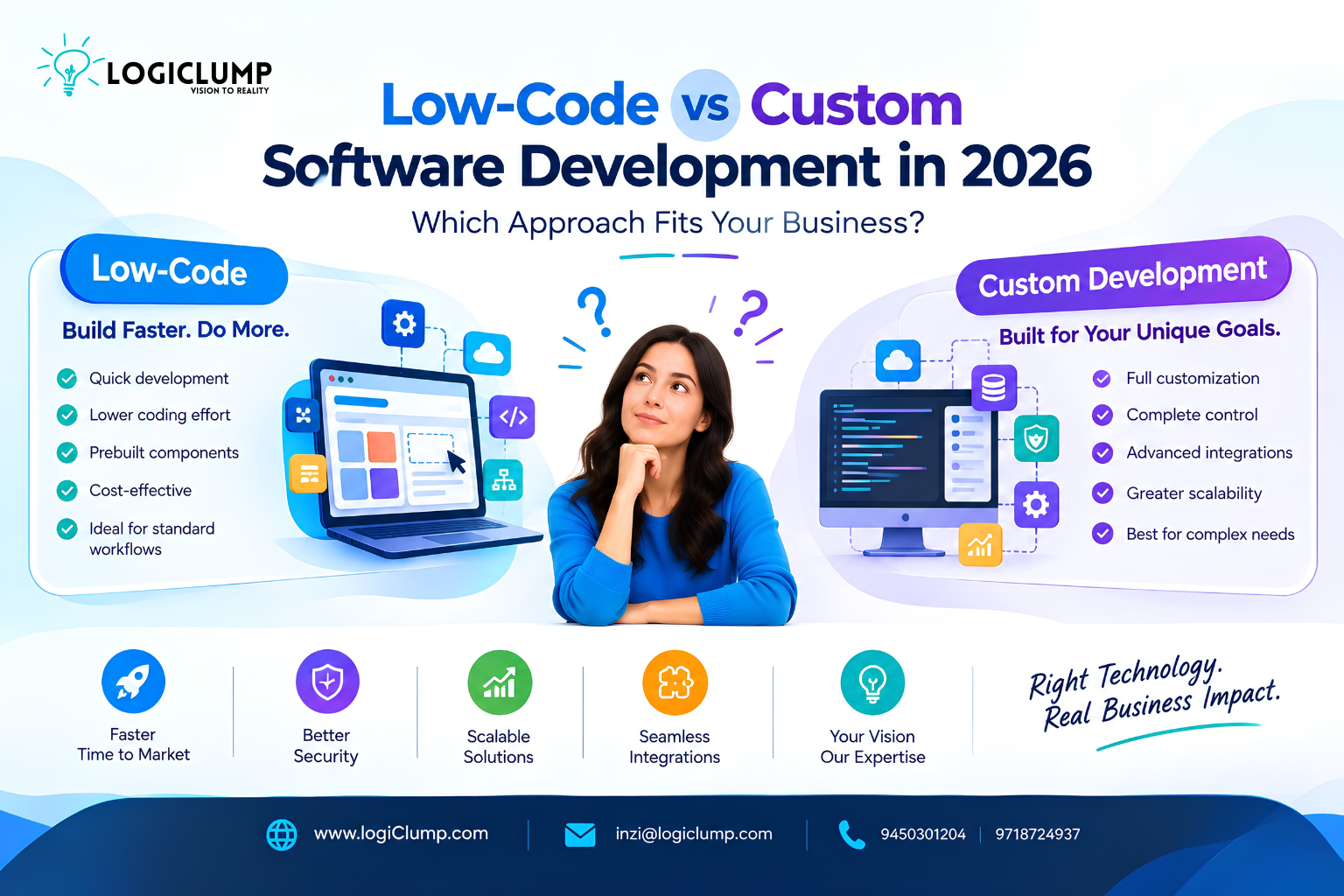
Low-Code vs Custom Software Development in 2026
Software has become part of almost every modern business. Companies use digital systems to manage customers, automate operations, process information, communicate with employees, and deliver services to users.
But when a business decides to build a new application, one important question comes up:
Should we use a low-code platform, or should we build the software specifically for our business?
In 2026, businesses have more choices than ever. Low-code platforms can help teams turn ideas into working applications quickly, while custom software development provides greater control over functionality, architecture, integrations, and future expansion.
Neither approach is automatically suitable for every project.
The better decision comes from understanding the business problem, technical requirements, budget, users, security needs, and long-term plans.
Understanding Low-Code Development
Low-code development uses visual tools and prebuilt components to simplify application creation.
Instead of writing every part of an application manually, developers can use interfaces, workflow builders, reusable modules, database connectors, and automation tools to assemble much of the solution.
Depending on the platform, developers may also add custom programming when the built-in functionality isn't enough.
Low-code is commonly considered for applications such as:
- Internal business dashboards
- Approval workflows
- Employee portals
- Basic customer management systems
- Data collection tools
- Reporting applications
- Workflow automation
- Internal administrative software
- Early-stage product prototypes
The biggest attraction is the ability to move from concept to usable software in less time.
Understanding Custom Software Development
Custom development takes a different route.
Instead of starting with a predefined application platform, developers create the software according to the organization's specific requirements.
The development team can determine:
- Application architecture
- Database structure
- User interface
- Backend services
- APIs
- Authentication
- Authorization
- Integrations
- Hosting environment
- Security controls
- Deployment strategy
This approach requires more engineering effort, but it gives the organization significantly more control over the final product.
Custom software can be particularly useful when the application itself becomes an important part of the company's competitive advantage.
The Difference Is More Than Coding
It is tempting to think of the decision as:
Less coding vs more coding
But that is only part of the story.
The real difference concerns control and constraints.
A low-code platform provides an existing environment within which the application is developed. This can dramatically accelerate common tasks, but the business may have to work within the platform's capabilities.
Custom development starts with fewer predefined limitations.
That gives developers more freedom, but it also means they are responsible for designing, building, securing, testing, and maintaining more of the system.
A Simple Comparison
| Area | Low-Code | Custom Software |
|---|---|---|
| Development approach | Visual tools and reusable components | Software built around specific requirements |
| Time to prototype | Often shorter | Usually requires more planning |
| Customization | Depends on platform capabilities | Extensive |
| Architecture control | Platform-dependent | High |
| Integrations | Often uses available connectors | APIs and integrations can be built specifically |
| Performance control | Depends on platform | Greater engineering control |
| Platform dependency | Potentially higher | Generally lower |
| Complex business logic | May require workarounds | Can be designed specifically |
| Long-term flexibility | Depends on platform | High |
| Engineering involvement | Lower for standard functionality | Higher |
These are general characteristics. Actual results depend on the platform, development team, application design, and project requirements.
Where Low-Code Can Be Useful
Imagine a company needs an internal employee request system.
Employees submit requests through a form. Managers receive notifications, approve or reject requests, and administrators can view reports.
If the workflow is straightforward, building every component from scratch may not provide enough additional value to justify the engineering effort.
A low-code platform may already provide:
- Forms
- User management
- Notifications
- Workflow automation
- Database connectivity
- Reporting components
The development team can configure these pieces and concentrate on the parts that actually require customization.
This is where low-code can be particularly effective.
Speed Can Be a Strategic Advantage
Time matters in software development.
A business may need to test a new idea quickly, automate an inefficient internal process, or provide employees with a new tool without waiting for a long development cycle.
Low-code can shorten the path between:
Idea → Prototype → Testing → Working Application
This can be valuable for businesses experimenting with new workflows or validating an early product concept.
However, speed during development should not come at the expense of security, reliability, or future requirements.
Custom Development Starts With the Business
Custom software is particularly useful when the business process doesn't fit neatly into an existing platform.
Consider a company with a specialized operational model involving:
- Complex pricing
- Multiple customer categories
- Unique approval rules
- Real-time processing
- Several external APIs
- Advanced reporting
- Custom permissions
- Specialized calculations
Instead of changing the business process to match a software platform, a custom development team can design the system around the business process.
That distinction can become increasingly important as the application grows.
When Flexibility Becomes Important
A small application may begin with a handful of requirements.
Over time, the business may ask for:
- New user types
- Additional workflows
- More integrations
- New dashboards
- Mobile access
- AI functionality
- Advanced analytics
- Regional expansion
- Higher transaction volumes
A custom architecture can be designed with these future requirements in mind.
A low-code platform may also support significant expansion, but businesses should understand its limits before making it the foundation of a critical system.
Integrations Can Be a Major Factor
Modern software rarely operates alone.
A business application may need to communicate with:
CRM → Payment Gateway → Accounting → ERP → Analytics → Mobile App → AI Services
Low-code platforms often provide ready-made connectors for popular services.
This can save considerable development time.
However, problems can appear when a business needs an uncommon integration or precise control over how information moves between systems.
Custom API development can provide control over:
- Authentication
- Data transformation
- Validation
- Error handling
- Rate limiting
- Logging
- Business rules
- Data synchronization
For integration-heavy projects, these details can become critical.
Security Should Be Considered From Day One
Technology selection should never be based only on development speed.
The application may eventually handle:
- Customer information
- Employee data
- Financial records
- Business documents
- Authentication credentials
- Payment information
- Proprietary data
Security requirements should therefore be evaluated before development begins.
Important considerations include:
- Identity management
- Role-based access
- API protection
- Encryption
- Secure data storage
- Input validation
- Audit logs
- Secrets management
- Dependency security
- Vulnerability testing
- Secure deployment
A low-code platform can provide security capabilities, but businesses need to understand how those capabilities work and what remains their responsibility.
Custom development offers more control over the security architecture, but that also means the development team must implement and maintain those controls correctly.
Think About the Total Cost
The cheapest way to build software isn't always the cheapest way to operate it.
With low-code, the initial development effort may be smaller, but the overall cost can include:
- Platform subscriptions
- User-based licensing
- Usage charges
- Premium connectors
- Storage costs
- Support
- Migration expenses
Custom development can require greater initial investment, including:
- Developers
- Designers
- Infrastructure
- Testing
- Security
- Maintenance
Businesses should therefore compare the total cost of ownership rather than looking only at the first development invoice.
Vendor Dependency
Low-code platforms can create another consideration: dependence on the provider.
If an application becomes deeply connected to a particular platform's:
- Database
- Workflow engine
- APIs
- Authentication system
- Hosting environment
- Proprietary components
moving the application elsewhere may require substantial work.
This does not make low-code a poor choice.
It simply means that businesses should understand how portable their data, workflows, and application logic will be before committing to a platform.
Custom Software and Ownership
For strategically important software, ownership can become a major consideration.
A custom-built application can provide greater control over:
- Source code
- Database design
- Infrastructure
- APIs
- Deployment
- Security architecture
- Product roadmap
This can be useful when the software is expected to become a long-term business asset rather than simply an internal utility.
Low-Code for MVPs
Startups and new product teams often face uncertainty.
Before investing heavily in a complete platform, they may want to determine whether customers actually need the proposed product.
A low-code solution can sometimes help create an initial version quickly.
The team can use that version to learn:
- What customers actually use
- Which features matter
- Which workflows need improvement
- Where the product needs customization
If the product gains traction, the organization can then evaluate whether parts of the system should be rebuilt or expanded using custom development.
The important thing is to consider future migration before the prototype becomes deeply dependent on a particular platform.
The Hybrid Model
Businesses don't always need to select one approach for everything.
A hybrid architecture can combine both.
For example:
Custom Core System + APIs + Low-Code Administration
The core application could contain custom business logic, databases, security controls, and APIs.
A low-code platform could then be used for simpler internal workflows or administrative interfaces.
This allows businesses to reserve custom engineering for the areas where it provides the most value.
AI Is Changing Both Approaches
Artificial intelligence is becoming part of modern development environments.
AI-assisted tools can help developers:
- Generate code
- Create database queries
- Explain existing software
- Produce test cases
- Identify potential bugs
- Generate documentation
- Create interface components
- Assist with API development
At the same time, low-code platforms are incorporating AI-based tools that allow users to describe applications or workflows using natural language.
This means software development is becoming more accessible without making engineering expertise irrelevant.
AI-generated output still needs testing, validation, security review, and human oversight.
Low-Code Doesn't Mean Developer-Free
Another common misconception is that low-code removes the need for professional developers.
In simple applications, business teams may be able to build substantial portions of the software themselves.
But complex systems still require technical expertise.
Developers may need to handle:
- Architecture
- Database design
- Security
- APIs
- Performance
- Custom logic
- Integrations
- Testing
- Deployment
- Monitoring
Low-code changes the development process. It does not remove the need for engineering judgment.
Questions to Ask Before Choosing
Before committing to a development approach, businesses should examine the project carefully.
Is the software central to the business?
If the application is mission-critical, long-term control and flexibility may carry greater importance.
How complicated are the business rules?
Simple workflows may fit low-code environments well. Highly specialized logic may require custom engineering.
How many systems need to connect?
Standard integrations can work well with low-code connectors. Complex integrations may require custom APIs.
How quickly does the application need to launch?
A short timeline may make low-code attractive, particularly for straightforward applications.
How large could the application become?
Consider future users, transactions, data volumes, features, and geographic expansion.
How important is platform independence?
If the company wants extensive control over its technology stack, custom development may provide more flexibility.
A Practical Way to Choose
Instead of asking:
“Which technology is better?”
businesses should ask:
“Which approach fits this particular application?”
Low-Code May Fit When:
- The workflow is relatively standard
- Rapid development is important
- Existing platform components meet most requirements
- The application is not highly differentiated
- Standard integrations are sufficient
- Platform limitations are acceptable
Custom Development May Fit When:
- The software is strategically important
- Business rules are highly specialized
- The application needs extensive customization
- Advanced integrations are required
- Performance is critical
- Security requirements are complex
- Long-term control is important
A Hybrid Strategy May Fit When:
- Core functionality needs custom engineering
- Some supporting workflows are straightforward
- The organization wants to accelerate internal tools
- Different application components have different requirements
What Software Development Looks Like in 2026
The modern development environment is becoming increasingly diverse.
A single business may use:
Custom Code + Low-Code + AI + APIs + Cloud + Automation
There is no requirement that every component of a technology ecosystem be created in exactly the same way.
The strongest architecture is usually the one that balances:
- Business requirements
- User experience
- Security
- Performance
- Scalability
- Development speed
- Maintenance
- Long-term cost
Technology should support the business rather than dictate how the business operates.
How LogiClump Can Help
At LogiClump, software solutions can be designed around the specific requirements of a business.
Our development capabilities include:
- Custom software development
- Web application development
- Mobile app development
- API development
- AI-powered applications
- SaaS platforms
- Business automation
- Cloud solutions
- Secure enterprise applications
Whether a project needs a completely custom platform, low-code-assisted workflows, or a combination of technologies, the development strategy can be selected according to the application's functionality, users, integrations, security requirements, and growth plans.
Conclusion
Low-code and custom development solve different types of software problems.
Low-code can help businesses create applications and automate workflows quickly when their requirements align with the capabilities of an existing platform.
Custom software development offers greater freedom when the application requires specialized functionality, complex integrations, advanced security, or extensive control over its architecture.
And in many real-world projects, the answer doesn't have to be one or the other.
A combination of custom engineering, low-code tools, APIs, cloud services, and AI-assisted development can provide a flexible way to build modern business software.
The goal isn't simply to develop software faster.
The goal is to build software that continues to deliver value as the business grows.
Choose the technology around the business problem—not the other way around.
Contact LogiClump
🌐 Website: www.logiclump.com
📧 Email: inzi@logiclump.com
📞 Contact: 9450301204 | 9718724937
Build. Innovate. Empower.
Explore low-code and custom software development in 2026, their differences, costs, flexibility, security, scalability, integrations, and practical use cases.
Tom Cruise