
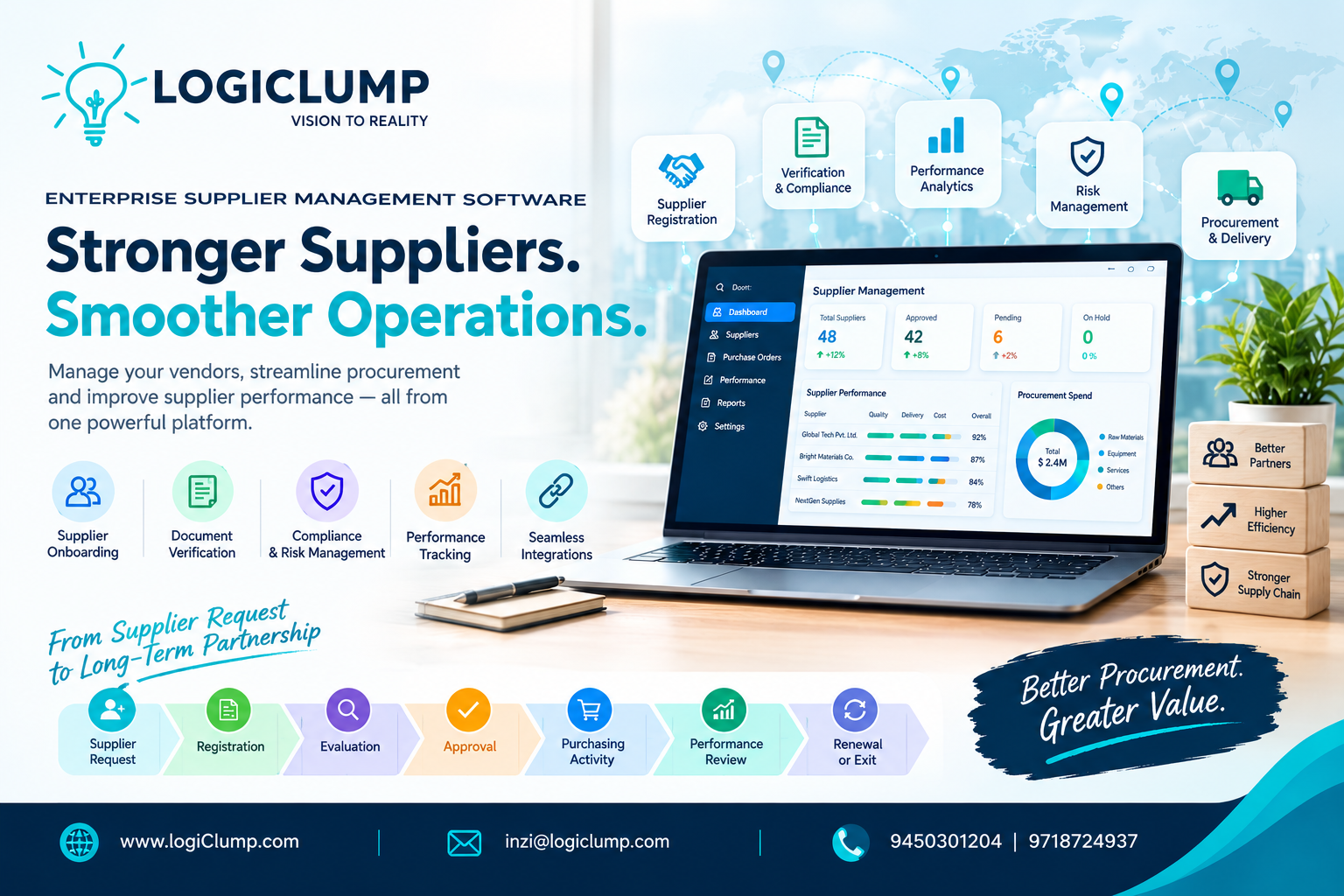
Stronger Suppliers. Smarter Operations.
Suppliers play a major role in how modern businesses operate. From sourcing raw materials and purchasing equipment to outsourcing professional services and managing technology partners, organizations depend on external vendors to keep their operations running smoothly.
As a company expands, managing these relationships becomes more complicated. Procurement teams must evaluate new suppliers, collect documentation, coordinate internal approvals, review performance, and ensure that purchasing decisions follow company policies.
When this information is spread across spreadsheets, emails, and separate business applications, maintaining control becomes difficult. Employees may work with outdated vendor records, managers may lack reliable performance information, and procurement decisions may take longer than necessary.
Enterprise supplier management software helps organizations bring these activities into one coordinated system.
For businesses looking to strengthen procurement operations in 2026, the right software can improve supplier visibility, simplify administrative processes, and support more informed purchasing decisions.
What Is Enterprise Supplier Management Software?
Enterprise supplier management software is a digital platform that helps organizations manage their relationships with vendors throughout the purchasing lifecycle.
It provides a structured environment for maintaining supplier information, evaluating qualifications, managing approvals, reviewing performance, and coordinating activities across departments.
Depending on the company's needs, the platform may support:
-
Supplier registration and onboarding
-
Vendor profiles and business records
-
Document collection and verification
-
Supplier evaluation and approval
-
Performance monitoring
-
Purchasing and expenditure reporting
-
Risk and compliance tracking
-
Vendor communication records
-
Issue resolution and corrective actions
-
Review reminders
-
Procurement dashboards
-
Integration with accounting and ERP applications
The purpose is to replace fragmented supplier administration with a more consistent, transparent, and manageable process.
Rather than relying on individual employees to maintain separate records, businesses can establish a shared source of supplier information with controlled access and clearly defined responsibilities.
Why Supplier Management Needs a Structured Approach
Managing five suppliers is very different from coordinating hundreds of vendors across multiple departments.
As procurement operations grow, informal processes can create problems that affect both efficiency and business continuity.
Inconsistent Supplier Records
Different teams may maintain their own vendor lists, leading to duplicate profiles, outdated contact details, and conflicting information.
A centralized platform helps employees work with more consistent records and reduces the effort required to locate important supplier details.
Delayed Supplier Onboarding
Before a vendor can begin working with a business, several activities may need to be completed, including information collection, document checks, internal evaluation, and approval.
When these steps depend on manual follow-ups, onboarding can become unnecessarily slow.
A digital workflow can show which requirements have been completed and which actions remain outstanding.
Difficulty Comparing Vendor Performance
The lowest-priced supplier is not always the most suitable choice.
Delivery reliability, product quality, responsiveness, service consistency, and issue resolution can all affect the total value a vendor provides.
Without organized performance records, businesses may struggle to compare suppliers objectively.
Limited Purchasing Visibility
When different departments purchase from different vendors, management may find it difficult to understand total expenditure or identify overlapping supplier relationships.
Connected purchasing records and reporting can provide a clearer picture of vendor-related spending.
Unclear Accountability
Procurement, finance, operations, and other departments may share responsibility for supplier relationships.
If responsibilities are not clearly assigned, approvals can be delayed and important reviews may be missed.
Supplier management software can help establish ownership and make pending actions visible.
How an Enterprise Supplier Management Platform Works
A supplier management platform organizes the process from initial vendor selection through ongoing performance evaluation.
A typical workflow may follow this sequence:
Supplier Request → Registration → Evaluation → Approval → Purchasing Activity → Performance Review → Renewal or Exit
Each stage can have its own requirements, assigned employees, supporting documents, and approval conditions.
For example, an operations team may identify a need for a new supplier. The vendor submits company information, procurement evaluates the offering, finance completes relevant checks, and an authorized manager approves the relationship.
Once approved, the supplier's details become available to the appropriate business systems and employees.
The platform can then maintain performance records, track outstanding documentation, and support periodic reviews.
The exact process should reflect the organization's purchasing policies rather than forcing every vendor through an identical workflow.
Core Features That Make Supplier Management More Effective
1. A Complete Supplier Information Hub
A reliable supplier profile gives employees a consolidated view of the business relationship.
Depending on the vendor category, the profile may include:
-
Business identity and contact information
-
Products or services provided
-
Assigned procurement owner
-
Approved supplier status
-
Relevant certifications
-
Supporting documentation
-
Purchasing history
-
Performance evaluations
-
Outstanding issues
-
Upcoming review dates
This makes supplier information easier to maintain and retrieve.
For enterprises with multiple offices or subsidiaries, the system can also distinguish between organization-wide supplier records and information specific to individual business units.
2. Digital Supplier Registration
A structured registration process helps businesses collect consistent information from prospective vendors.
Instead of exchanging multiple emails, organizations can provide a defined process for submitting required details and documents.
The platform can display incomplete submissions, route information to the appropriate reviewers, and maintain a record of onboarding progress.
This can reduce repetitive administration while helping the business apply its supplier requirements consistently.
3. Supplier Evaluation and Selection
Vendor selection should consider the needs of the purchasing organization.
A supplier evaluation process may examine pricing, product specifications, service capability, delivery capacity, experience, documentation, and other relevant criteria.
The platform can organize evaluation results and record the reasons behind approval or rejection decisions.
Different vendor categories can have different assessment requirements. A supplier providing office materials may need a simpler review than a company handling sensitive business information or critical infrastructure.
4. Performance Monitoring and Supplier Scorecards
A supplier's performance should be assessed throughout the relationship, not only during onboarding.
A scorecard can help procurement teams review measurable indicators such as:
-
Delivery reliability
-
Product or service quality
-
Responsiveness to requests
-
Resolution of reported issues
-
Compliance with agreed requirements
-
Price consistency
-
Service-level performance
These records can support supplier reviews and help management identify relationships that require improvement.
Scorecards should use meaningful criteria and reliable information. A complicated scoring system is not useful if the underlying measurements are incomplete or inconsistent.
5. Supplier Risk and Document Tracking
Some vendors require periodic checks or updated documentation.
Depending on the industry and relationship, these may include insurance certificates, business registrations, security assessments, quality certifications, or regulatory documents.
A supplier management platform can maintain the relevant records, assign review responsibilities, and flag approaching expiry dates.
This helps organizations keep documentation organized and identify outstanding requirements before they become operational problems.
The platform supports the process; it does not replace professional compliance, legal, or security assessments.
6. Procurement and Spending Analysis
Supplier information becomes more valuable when connected to actual purchasing activity.
By integrating with procurement and finance systems, a business can develop a consolidated view of its vendor-related expenditure.
Reports may help answer questions such as:
-
Which vendors receive the highest purchasing volume?
-
How does spending vary across departments?
-
Which supplier costs have increased?
-
Are several teams purchasing similar products from different vendors?
-
How dependent is the business on a particular supplier?
These insights can support budgeting, supplier negotiations, and purchasing decisions.
Reliable analysis requires accurate transaction records and clear rules for categorizing expenditure.
7. Supplier Issue and Corrective-Action Tracking
Supplier-related problems can affect production schedules, customer commitments, and internal operations.
A management platform can record an issue, assign an owner, document the expected resolution, and track progress until closure.
For example, repeated late deliveries may trigger a performance review and a corrective-action plan.
A consistent record helps the business understand whether a problem has been resolved and whether similar issues continue to occur.
8. Review Scheduling and Notifications
Supplier relationships need ongoing attention.
Organizations may schedule periodic evaluations, document reviews, commercial discussions, and service-performance assessments.
The platform can assign these activities to responsible employees and send reminders before their due dates.
This encourages proactive supplier management rather than relying on someone to remember every important task.
How Different Departments Benefit
Supplier management connects several parts of an enterprise. A shared platform can improve coordination while preserving the responsibilities of each team.
Procurement teams can manage supplier registration, evaluations, purchasing relationships, and performance reviews.
Finance teams can access relevant vendor information, coordinate financial checks, and analyze supplier-related expenditure.
Operations teams can review delivery reliability, availability, and service quality.
IT and security teams can maintain visibility into technology suppliers and external providers with access to company systems.
Legal and compliance teams can review relevant documents and monitor outstanding requirements.
Business leaders can use consolidated reports to understand supplier concentration, performance trends, and purchasing activity.
Each department should receive only the information and permissions required for its responsibilities.
Why Custom Enterprise Supplier Management Software May Be Necessary
Commercial supplier management platforms can work well when their features and workflows align with the organization's needs.
However, enterprises may have complex purchasing structures, multiple subsidiaries, specialized approval policies, or established applications that require deeper integration.
For example, a company may centralize supplier qualification while allowing individual branches to manage day-to-day purchasing. Its software may need to support both approaches without creating inconsistent records.
Custom enterprise software can be designed to accommodate requirements such as:
-
Different supplier categories and evaluation rules
-
Multi-level approval processes
-
Regional and department-specific access
-
Custom performance measurements
-
Organization-wide supplier reporting
-
Integration with existing ERP and finance systems
-
Specialized purchasing workflows
-
Business-specific dashboards
Custom development is most appropriate when standard products cannot meet important operational requirements without excessive workarounds.
Before choosing an approach, businesses should compare implementation costs, licensing, integration effort, maintenance responsibilities, and the flexibility needed for future growth.
Connecting Supplier Management With Enterprise Applications
A supplier management system should not operate as an isolated database.
In many organizations, vendor information is already used by procurement, finance, inventory, and enterprise resource planning applications.
A connected environment might link:
Supplier Management → Procurement → ERP and Finance → Inventory → Reporting
For example, approved supplier information can be shared with the purchasing system, while transaction records from finance can support spending analysis.
Inventory information may help operations teams assess whether a supplier's deliveries are meeting business requirements.
Successful integration depends on defining which system owns each record, how updates are synchronized, and how errors are handled.
Businesses should also protect sensitive actions, including changes to supplier banking details, approval status, and purchasing permissions, with appropriate verification and authorization procedures.
Security Requirements for Enterprise Supplier Platforms
Supplier records can contain commercially sensitive information, pricing details, financial information, confidential documents, and details about external service providers.
A secure platform should be designed with appropriate controls.
Access Management
Permissions should reflect each employee's responsibilities and the confidentiality of the information.
Authentication
Only authorized users and services should be able to access the platform.
Data Protection
Sensitive information should be protected during storage and transmission.
Activity Records
Important changes, approvals, and administrative actions should be recorded so they can be reviewed when necessary.
Verification of Sensitive Changes
Updates to payment details or other critical supplier information should follow a controlled verification process.
Backup and Recovery
Organizations should maintain suitable procedures for recovering essential records after accidental deletion or system failure.
Integration Security
Connections with procurement, finance, and other applications should use appropriate authentication, authorization, and monitoring.
These controls help businesses protect supplier information while maintaining accountability across procurement operations.
Mistakes to Avoid When Implementing Supplier Management Software
Treating the Platform as a Vendor Directory
Storing names and contact information is only the starting point. The platform should support the evaluations, approvals, reviews, and reporting required by the business.
Applying the Same Checks to Every Supplier
A vendor providing low-risk office supplies may not require the same level of scrutiny as a provider handling sensitive information or a critical business service.
Controls should be proportionate to the relationship and its potential impact.
Migrating Inaccurate Data
Duplicate records, outdated documents, and inconsistent supplier categories can reduce confidence in the new system.
Data cleanup should be included in the implementation plan.
Making Approvals Unnecessarily Complicated
Excessive approval steps can slow purchasing without adding meaningful control.
Organizations should review their existing process and retain the checks that genuinely matter.
Overlooking System Integration
A new platform may create more administrative work if employees still need to enter the same information into several separate applications.
Integration requirements should be defined before development or implementation begins.
Ignoring Employee Adoption
The platform must work for the people who use it every day. Procurement employees, department managers, and other stakeholders should be involved in testing and feedback.
A Practical Implementation Plan
A phased approach helps businesses introduce supplier management software without disrupting existing operations.
Step 1: Review Current Supplier Processes
Document how vendors are selected, registered, approved, monitored, and reviewed.
Step 2: Identify Operational Gaps
Determine which problems have the greatest impact, such as incomplete records, slow approvals, or limited performance visibility.
Step 3: Define Supplier Categories
Establish which information, documents, and evaluations are required for different types of vendors.
Step 4: Set Roles and Responsibilities
Decide who can register suppliers, approve relationships, update records, and view reports.
Step 5: Prepare Existing Records
Identify duplicates, correct outdated information, and establish consistent supplier categories before migration.
Step 6: Plan Enterprise Integrations
Determine which systems need supplier information and how updates should be handled.
Step 7: Start With a Pilot
Introduce the platform to a representative department or vendor category and gather practical feedback.
Step 8: Train Employees
Explain the workflows, responsibilities, and benefits to the people who will use the system.
Step 9: Measure and Improve
Review the results, resolve usability issues, and expand the platform as operational needs evolve.
How to Measure Business Results
The value of supplier management software should be assessed through measurable improvements.
Organizations can monitor:
-
Time required to onboard a supplier
-
Average duration of approval processes
-
Completeness of supplier records
-
Supplier delivery performance
-
Number of unresolved vendor issues
-
Time spent on manual administrative tasks
-
Completion of scheduled supplier reviews
-
Visibility into purchasing expenditure
-
Employee adoption
-
Changes in supplier performance over time
The appropriate metrics depend on the company's purchasing model and business priorities.
Recording baseline results before implementation makes it easier to understand whether the software is producing meaningful operational improvements.
The Future of Enterprise Supplier Management
Supplier management is becoming more closely connected with broader procurement planning and business performance.
Organizations may increasingly use integrated reporting to identify spending patterns, compare supplier performance, highlight incomplete records, and prepare for upcoming reviews.
Some platforms may also introduce analytical capabilities that help employees identify unusual changes or prioritize suppliers requiring attention.
These features are most useful when supported by accurate records, clearly defined criteria, and accountable decision-makers.
The long-term goal is to make supplier management an ongoing business process rather than a collection of disconnected administrative tasks.
How LogiClump Can Help
Effective supplier management requires software that connects business records, purchasing workflows, approval processes, reporting, and existing enterprise applications.
LogiClump Technologies develops custom enterprise software solutions designed around the practical needs of businesses.
Our services can support projects involving:
-
Enterprise supplier management platforms
-
Custom procurement applications
-
Business workflow automation
-
ERP and finance integrations
-
Secure API development
-
Vendor performance dashboards
-
Web and mobile applications
-
Role-based access management
-
Scalable backend systems
Whether your business needs a dedicated supplier management platform or wants to connect existing applications, the solution should reflect your operational processes, organizational structure, and long-term objectives.
The focus is on building software that solves genuine business problems and can adapt as the organization grows.
Conclusion
Supplier relationships influence purchasing costs, product quality, operational reliability, and business continuity.
When vendor information is fragmented and responsibilities are unclear, organizations can struggle to evaluate suppliers consistently and make informed procurement decisions.
Enterprise supplier management software brings vendor records, onboarding, evaluation, performance monitoring, and reporting into a coordinated business environment.
With suitable integrations, security controls, and clearly defined workflows, businesses can improve supplier visibility, reduce unnecessary administrative effort, and manage procurement relationships more effectively.
The best solution is not simply a database containing supplier details. It is a platform that helps the organization make informed decisions, maintain accountability, and build stronger relationships with the vendors it depends on.
Develop Custom Enterprise Software With LogiClump
Looking to build supplier management software, procurement applications, enterprise dashboards, or integrated business systems?
LogiClump Technologies can help turn your business requirements into practical and scalable software solutions.
🌐 Website: www.logiclump.com
📧 Email: inzi@logiclump.com
📞 Contact: 9450301204 | 9718724937
Build. Innovate. Empower.
Learn how enterprise supplier management software helps businesses organize vendors, streamline onboarding, evaluate performance, and improve procurement visibility.
Tom Cruise