Enterprise Contract Lifecycle Management Software in 2026
Every growing business depends on contracts.
From customer agreements and supplier arrangements to employment documents, service-level agreements, licensing terms, and partnership deals, contracts shape how organizations operate and fulfill their commitments.
But managing these agreements can become difficult when documents are scattered across email inboxes, shared folders, spreadsheets, and disconnected business applications.
Employees may struggle to locate the latest version of an agreement. Approvals can remain pending for days. Important renewal dates may be overlooked, and teams may find it difficult to determine which obligations have already been fulfilled.
These challenges can create unnecessary administrative work and expose businesses to avoidable operational risks.
Enterprise contract lifecycle management software provides a structured way to manage agreements throughout their lifecycle—from initial creation and negotiation to approval, signing, monitoring, renewal, and closure.
For organizations managing hundreds or thousands of agreements, a well-designed contract management system can become an important part of their enterprise software infrastructure.
What Is Contract Lifecycle Management Software?
Contract lifecycle management (CLM) software helps businesses manage the stages involved in creating, reviewing, approving, storing, tracking, and renewing contracts.
Instead of treating each agreement as an isolated document, a CLM platform manages the contract as part of a larger business process.
Depending on the organization's requirements, the platform may include:
-
Centralized contract storage
-
Contract creation and templates
-
Document version tracking
-
Internal review and approval workflows
-
Electronic signature integration
-
Contract search and classification
-
Renewal and expiry reminders
-
Obligation tracking
-
Access permissions
-
Audit trails
-
Management dashboards
-
Integration with CRM, ERP, and finance systems
The objective is to make contracts easier to manage, monitor, and retrieve while establishing clearer responsibility for each stage of the process.
Why Traditional Contract Management Becomes Difficult
Many organizations begin with simple tools for managing agreements.
Contracts are created in document editors, reviewed through email, approved by managers, signed, and saved in shared folders.
This approach may work for a small team with a limited number of agreements.
However, as the business expands, several problems can emerge.
Contracts Become Difficult to Find
When documents are distributed across multiple folders, departments, and employee accounts, finding the correct agreement can take unnecessary time.
Employees may also struggle to identify the latest approved version.
Approvals Lack Visibility
A contract may need review from sales, finance, procurement, legal, or senior management.
Without a coordinated workflow, employees may not know who currently has the document or what is preventing approval.
Important Dates Are Overlooked
Contracts frequently include renewal windows, expiry dates, notice periods, payment milestones, and other deadlines.
Relying on manual reminders can increase the risk of missed dates and rushed decisions.
Contract Information Is Difficult to Analyze
A business may know where its documents are stored but lack a consolidated view of the information inside them.
For example, management may need to determine which supplier agreements are expiring soon or which customer contracts contain specific service commitments.
Without structured records, answering these questions can require significant manual effort.
How Enterprise CLM Software Works
A contract management platform creates a consistent process for handling agreements.
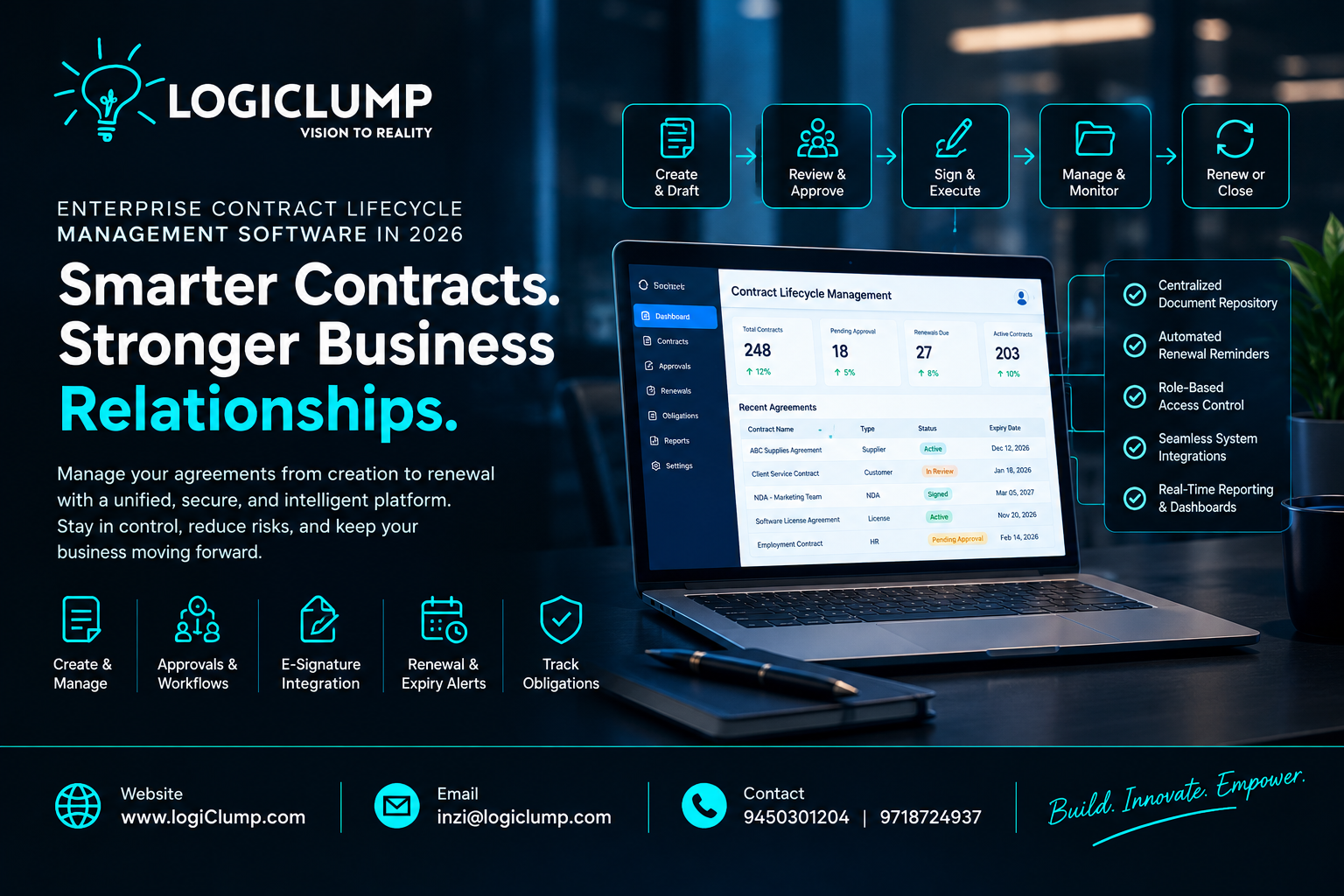
A typical lifecycle looks like this:
Request → Draft → Review → Approval → Signature → Active Management → Renewal or Closure
Each stage has defined responsibilities, status information, and supporting records.
For example, when a department requests a new supplier agreement, the system can create a contract record, assign the relevant reviewers, track approval progress, and store the signed agreement in the appropriate repository.
After signing, the platform can monitor important dates and obligations so that the contract remains visible throughout its active period.
The exact workflow depends on the organization's approval policies, contract types, and operational requirements.
Essential Features of Enterprise Contract Management Software
1. Centralized Contract Repository
A centralized repository provides one organized location for approved contracts and related documents.
Employees with the appropriate permissions can search for agreements using information such as:
-
Contract title
-
Customer or supplier name
-
Agreement type
-
Department
-
Contract owner
-
Effective date
-
Expiry date
-
Status
This reduces dependence on individual employees' inboxes and personal file collections.
A well-designed repository should also preserve document versions and distinguish draft agreements from approved and executed contracts.
2. Contract Templates and Document Creation
Many businesses repeatedly create similar agreements.
Examples include supplier contracts, service agreements, non-disclosure agreements, purchase agreements, and customer contracts.
A CLM platform can provide approved templates and standardized fields to help employees prepare documents consistently.
Depending on the workflow, employees may be able to select a contract type, enter the required business information, and generate a draft for review.
Legal and authorized business teams should remain responsible for approving templates and determining which terms can be modified.
3. Approval Workflow Management
Contracts often require several approvals before they can be signed.
A workflow engine can route agreements to the appropriate reviewers according to business rules.
For example, a contract exceeding a defined value may require finance approval, while an agreement involving non-standard terms may need additional legal review.
The platform can display:
-
Current approval stage
-
Assigned reviewer
-
Pending actions
-
Review history
-
Rejection reasons
-
Outstanding requirements
This helps employees understand the status of each agreement and reduces uncertainty during the approval process.
4. Document Version Control
Contract negotiations can produce multiple revisions.
Without proper version control, employees may accidentally review an outdated document or send an incorrect version for signature.
A contract management system can preserve document versions and maintain a record of important changes.
Authorized users can review the history, identify the current approved draft, and understand which version was executed.
This becomes especially important when agreements involve multiple parties and several rounds of negotiation.
5. Electronic Signature Integration
Electronic signatures can help businesses complete agreements without relying entirely on printing, scanning, and physical delivery.
A CLM platform can integrate with an appropriate electronic signature provider to coordinate signing and update the contract record when the process is completed.
The selected signature process should meet the organization's legal, regulatory, and evidentiary requirements.
Keeping the signed agreement connected to its approval history also makes later retrieval easier.
6. Renewal and Expiry Management
A contract's responsibilities do not end when it is signed.
Some agreements renew automatically unless notice is provided within a defined period. Others require renegotiation, price reviews, or updated approvals.
CLM software can track key dates and notify the responsible employees before important deadlines.
For example, a supplier agreement approaching renewal could trigger a review task for procurement and finance.
This gives the business time to evaluate the relationship rather than responding only after a deadline has passed.
7. Obligation Tracking
Contracts often contain commitments that must be fulfilled over time.
These may include service delivery requirements, payment schedules, reporting obligations, maintenance responsibilities, or performance milestones.
A contract management platform can record relevant obligations, assign ownership, and track completion.
For complex agreements, the system may also connect obligations with project management, finance, procurement, or service operations software.
The objective is to turn contractual commitments into visible, manageable business activities.
8. Contract Reporting and Dashboards
Managers need more than a list of documents.
They may want to understand how many contracts are awaiting approval, which agreements are approaching expiry, which departments have the highest contract volume, and where delays occur.
A management dashboard can bring these indicators together.
Useful views may include:
-
Contracts by status
-
Pending approvals
-
Upcoming renewals
-
Expired agreements
-
Contract value by category
-
Average approval time
-
Agreements by department
-
Overdue obligations
These reports can help management identify bottlenecks and allocate responsibility more effectively.
Who Benefits From Enterprise Contract Management?
Contract management is relevant across several departments, although each department has different needs.
Legal Teams
Legal professionals can manage reviews, approved templates, negotiation history, document versions, and contractual obligations.
Procurement Teams
Procurement can organize supplier agreements, renewal schedules, purchasing terms, and vendor commitments.
Sales Teams
Sales teams can track customer agreements, monitor approval progress, and reduce delays between commercial discussions and contract execution.
Finance Teams
Finance can review payment terms, contract values, billing milestones, and obligations that affect financial planning.
Human Resources
HR departments can manage employment agreements, policy acknowledgments, and other workforce-related documents with appropriate access restrictions.
Executive Management
Leadership can gain a consolidated view of contract activity, upcoming decisions, and operational bottlenecks.
A shared platform improves coordination while allowing each department to maintain its own permissions and approval responsibilities.
Why Enterprises May Need Custom CLM Software
Ready-made contract management products can be suitable for businesses with standard requirements.
However, some organizations operate with complex approval structures, specialized contract types, regional policies, or legacy business systems that require deeper integration.
A company may need its contract platform to work with:
-
Customer relationship management software
-
Enterprise resource planning systems
-
Procurement platforms
-
Finance and accounting applications
-
Employee management systems
-
Electronic signature services
-
Document repositories
-
Business reporting tools
A custom enterprise solution can be designed around these existing systems and the organization's actual contract workflows.
Potential benefits include tailored approval rules, organization-specific dashboards, controlled access, integration with internal records, and the flexibility to evolve the platform over time.
Custom development should be considered alongside implementation cost, maintenance requirements, available commercial products, and the complexity of the business process.
Connecting CLM With Other Enterprise Applications
Integration is one of the most important considerations when developing a contract management platform.
Consider a business that manages customer agreements through its sales team but tracks billing through a separate finance system.
A connected workflow might look like:
CRM → Contract Management → E-Signature Service → Finance System → Reporting Dashboard
When an agreement is approved and signed, relevant information can be made available to the appropriate downstream systems.
For example, customer and commercial details may be transferred from the CRM, signed contract information may be recorded in the repository, and approved billing terms may be shared with finance.
The integration must preserve data consistency and apply appropriate permissions at every stage.
A signed contract should not automatically trigger every possible business action. Sensitive changes, financial commitments, and exceptional cases may still require additional verification or approval.
Security and Access Control
Contracts can contain confidential pricing, customer information, supplier terms, intellectual property, employment details, and commercially sensitive commitments.
Security should therefore be a core part of the platform's architecture.
Important controls include:
Role-based access: Users should only see or modify contracts relevant to their responsibilities.
Authentication: Access should be restricted to authorized users and services.
Encryption: Contract documents and related information should be protected during storage and transmission.
Audit trails: Important activities should be recorded, including document changes, approvals, downloads, and signature events where appropriate.
Version integrity: The system should preserve the relationship between approved drafts and executed agreements.
Backup and recovery: Organizations should have procedures for restoring critical contract records after accidental deletion or system failure.
Retention policies: Documents should be retained or disposed of according to applicable business and legal requirements.
These controls help protect confidential information and support more accountable contract administration.
Common Mistakes in CLM Implementation
Treating It as a Document Storage Project
A repository is useful, but it does not solve approval delays, renewal tracking, or obligation management by itself.
The project should address the entire contract lifecycle.
Recreating Every Existing Process
Some current processes may be unnecessarily complicated.
Before translating them into software, review which steps are essential and which can be simplified.
Ignoring Existing Systems
A contract platform that remains disconnected from CRM, finance, and procurement may create additional data-entry work.
Integration requirements should be identified early.
Migrating Poor-Quality Records
Duplicate files, missing dates, inconsistent naming, and incomplete contract metadata can reduce the value of a new system.
Contract records should be reviewed and organized before migration.
Giving Everyone the Same Access
Not every employee should be able to view every agreement.
Permissions should reflect confidentiality, job responsibilities, and organizational policies.
Launching Without Employee Training
Employees need to understand how to submit requests, review agreements, find documents, and manage assigned obligations.
A usable interface and clear training can improve adoption.
A Practical Roadmap for Implementing Contract Management Software
A structured implementation can reduce disruption and help the organization focus on the most valuable capabilities first.
Step 1: Assess the Existing Process
Document how contracts are requested, created, reviewed, signed, stored, and renewed.
Step 2: Identify the Main Problems
Determine whether the biggest challenges involve document retrieval, approval delays, renewal risks, or fragmented records.
Step 3: Define the Contract Categories
Identify the agreement types, departments, and workflows the platform must support.
Step 4: Establish Access and Approval Rules
Define who can create, review, approve, sign, and manage different categories of contracts.
Step 5: Plan Integrations
Identify the systems that need to exchange contract-related information.
Step 6: Organize Existing Records
Clean up document collections and establish consistent metadata before migration.
Step 7: Pilot the Platform
Start with a manageable contract category or department and gather feedback.
Step 8: Measure Results
Track approval time, search efficiency, renewal visibility, adoption, and the number of manual steps reduced.
Step 9: Expand Gradually
Introduce additional contract categories and integrations as the platform becomes established.
How to Measure the Success of a CLM Platform
A contract management project should be evaluated against operational outcomes rather than the number of features delivered.
Businesses can track indicators such as:
-
Average contract approval time
-
Time required to retrieve an agreement
-
Percentage of contracts with complete metadata
-
Number of overdue approvals
-
Percentage of renewals reviewed before deadlines
-
Obligation completion rate
-
Manual data-entry effort
-
Employee adoption
-
Contract-related administrative costs
Establishing baseline measurements before implementation makes it easier to assess whether the platform is delivering meaningful improvements.
The Future of Contract Management
Contract management is likely to become more connected with broader enterprise workflows.
Businesses may increasingly connect agreements with procurement, customer onboarding, financial planning, project delivery, and vendor performance management.
Some platforms may also introduce document classification, clause extraction, contract summarization, and risk-review assistance.
Such capabilities can help employees locate information and prepare reviews more efficiently, but their outputs should be checked against the actual agreement and approved business policies.
The long-term objective is to make contracts easier to manage as active business records rather than documents that are stored and forgotten after signing.
How LogiClump Can Help
Enterprise contract management requires a combination of document handling, workflow design, business logic, secure data management, and system integration.
LogiClump Technologies develops custom enterprise software designed around the operational requirements of businesses.
Our services can support projects involving:
-
Custom enterprise applications
-
Contract and document management platforms
-
Business workflow automation
-
Secure API development and integration
-
Role-based access management
-
Reporting dashboards
-
CRM, ERP, and finance system integration
-
Web and mobile application development
-
Scalable backend systems
Whether your organization needs a contract management platform from the ground up or wants to connect existing systems, the solution should reflect how your teams work and how your business manages agreements.
Conclusion
Contracts influence revenue, supplier relationships, service delivery, compliance, and everyday business decisions.
When agreements are scattered across disconnected tools, organizations can lose visibility into approvals, deadlines, obligations, and document history.
Enterprise contract lifecycle management software brings these activities into a structured process.
By combining centralized records, approval workflows, version control, renewal tracking, reporting, and enterprise integrations, businesses can improve how agreements are managed throughout their lifecycle.
The best solution is not simply a place to store signed documents. It is a system that helps the organization understand its commitments, coordinate responsibilities, and act on important contract information at the right time.
For enterprises with complex agreement workflows, a well-designed contract management platform can become a valuable foundation for more organized and accountable business operations.
Build Smarter Enterprise Software With LogiClump
Looking to develop custom contract management software, enterprise workflow systems, secure integrations, or business applications tailored to your operations?
LogiClump Technologies can help turn your business requirements into practical and scalable software solutions.
🌐 Website: www.logiclump.com
📧 Email: inzi@logiclump.com
📞 Contact: 9450301204 | 9718724937
Build. Innovate. Empower.
Learn how enterprise contract lifecycle management software helps businesses manage approvals, agreements, renewals, obligations, and connected workflows.
Tom Cruise