
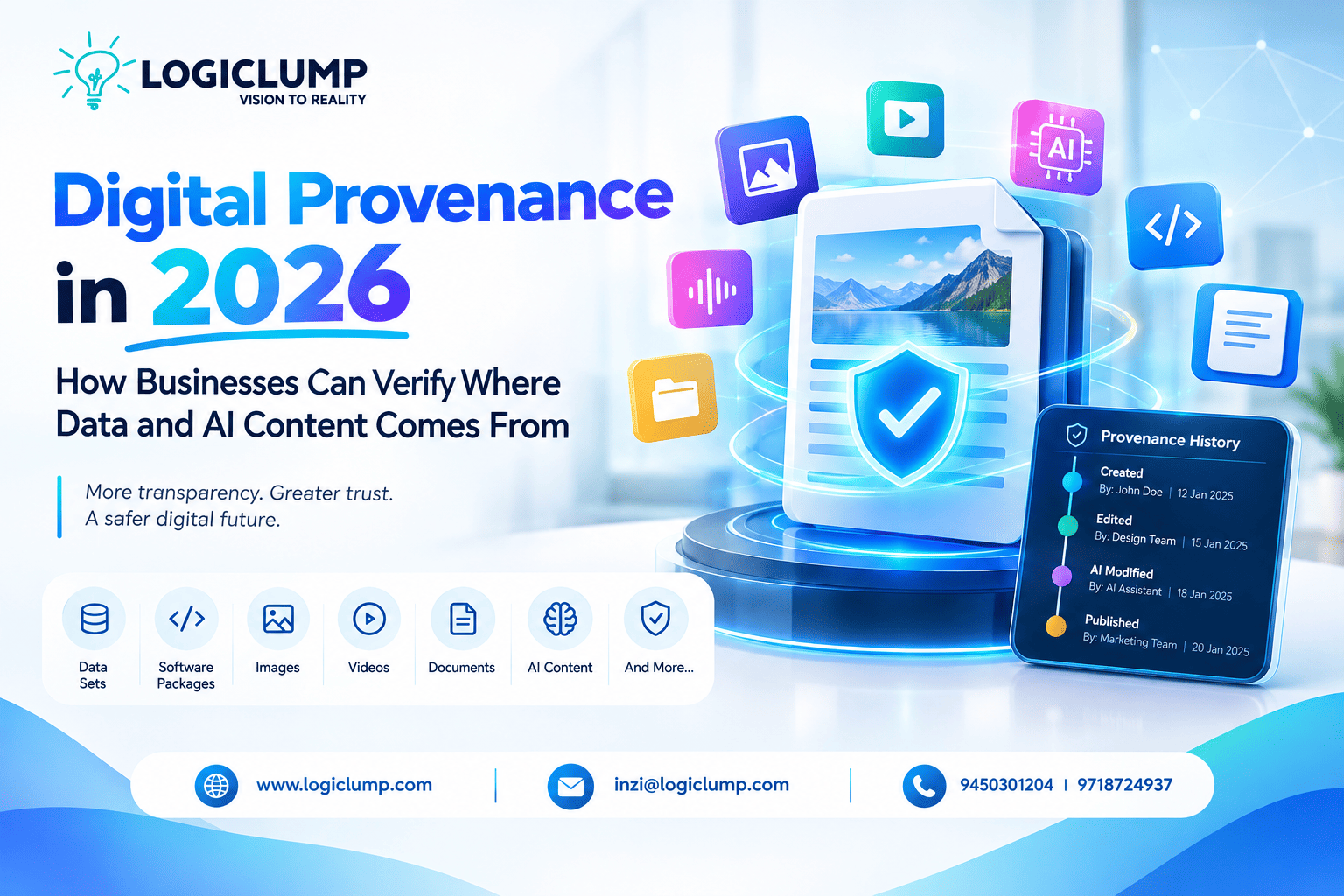
Digital Provenance in 2026
Businesses are producing and consuming more digital information than ever before.
Customer records, software code, documents, images, videos, reports, datasets, AI-generated text, and machine-generated media can move through dozens of systems before reaching their final destination.
That creates an important question:
Can a business determine where a digital asset came from, who created it, what happened to it, and whether it has been changed?
This is where digital provenance becomes important.
Digital provenance is the ability to establish and track the origin, history, ownership, processing, and changes associated with a digital asset.
In 2026, this concept is becoming increasingly relevant as organizations depend on third-party data, cloud platforms, open-source software, generative AI, automated workflows, and AI-generated content.
For businesses, provenance is not simply about knowing where a file came from.
It is about creating a reliable history that helps people and systems determine whether digital information can be trusted.
What Is Digital Provenance?
Digital provenance refers to the recorded history of a digital asset.
An asset could be:
- A dataset
- A software package
- A source-code file
- An image
- A video
- An audio recording
- A business document
- An AI-generated report
- A financial record
- A machine-learning dataset
- A digital product
Provenance can answer questions such as:
- Who created the asset?
- When was it created?
- Which system produced it?
- What tools were used?
- Where did the underlying data come from?
- Who modified it?
- What changes were made?
- Was AI involved?
- Which version is the original?
- Can the history be verified?
The objective is to create a trustworthy chain of information around a digital asset.
Why Digital Provenance Matters in 2026
Digital content has become increasingly difficult to evaluate simply by looking at it.
A document can be automatically generated.
An image can be produced by AI.
A video can be synthetically created.
A dataset can contain information from multiple sources.
Software can depend on hundreds of third-party packages.
An AI system can generate an answer using information collected from multiple sources.
Without reliable provenance, businesses may struggle to determine which information is authentic, modified, authorized, or suitable for a particular purpose.
This can create problems involving:
- Security
- Compliance
- Intellectual property
- Fraud
- Reputation
- Data quality
- Software supply chains
- AI governance
Digital provenance provides a way to add context and traceability.
Digital Provenance and AI-Generated Content
Generative AI has made content creation dramatically faster.
Businesses can now generate:
- Marketing copy
- Product images
- Presentations
- Reports
- Videos
- Audio
- Software code
- Customer communications
But faster creation also creates a transparency challenge.
A company may need to know whether a piece of content was:
Created entirely by a person
Generated by AI
Edited using AI
Created by a person and later modified by AI
Combined from multiple sources
This information can matter for internal governance, customer transparency, intellectual-property management, and regulatory requirements.
Provenance systems can attach information about how content was created or modified without necessarily changing the visible content itself.
What Are Content Credentials?
One approach to digital content provenance is the use of machine-readable credentials.
The Coalition for Content Provenance and Authenticity (C2PA) has developed an open technical standard for communicating information about the origin and editing history of digital content.
Systems based on this approach can attach signed provenance information to assets.
For example, a content record could indicate:
Created → Edited → AI Modified → Published
Instead of relying only on what a file looks like, users can inspect additional information about its history.
This is particularly useful for images, videos, audio, documents, and other digital media.
Digital Provenance Is More Than Watermarking
Digital provenance is sometimes confused with visible watermarks.
They are not the same thing.
A visible watermark changes how an asset looks.
Provenance information provides additional information about an asset's history.
For example:
Visible watermark:
"AI Generated"
Provenance information:
- Created using a particular application
- AI generation was involved
- Edited by a specific workflow
- Credential issued at a particular time
- Subsequent modifications recorded
A business may use both approaches depending on its requirements.
Provenance for Business Data
Digital provenance is not limited to media.
Businesses also need to understand the history of their data.
Consider a sales dashboard.
The final revenue number may come from:
CRM → Payment System → Data Warehouse → Analytics Platform → Dashboard
If the number looks incorrect, someone needs to determine where the problem occurred.
Was the CRM record incorrect?
Was a transaction duplicated?
Did an integration fail?
Was the data transformed incorrectly?
Did an analytics process use an outdated dataset?
Data provenance can help organizations trace information through these stages.
Data Lineage and Digital Provenance
Digital provenance is closely connected to data lineage.
Data lineage focuses on understanding how data moves and changes across systems.
For example:
Customer Order
↓
Order Database
↓
Data Pipeline
↓
Data Warehouse
↓
Analytics Model
↓
Business Dashboard
A lineage system can show how the final information was produced.
This becomes especially important when businesses use AI systems that depend on large amounts of enterprise data.
Provenance for AI Training Data
AI systems depend heavily on data.
If an organization uses internal or external datasets to train, fine-tune, evaluate, or augment an AI system, it can be useful to know:
- Where the data came from
- Who supplied it
- When it was collected
- What permissions apply
- How it was processed
- Whether it contains sensitive information
- Whether it was modified
- Which AI system used it
A strong provenance process can help organizations maintain better control over their AI data pipelines.
Why Unverified Data Is a Growing Problem
AI systems can generate enormous quantities of information.
This creates a new challenge.
What happens when AI-generated information becomes part of the data used by another AI system?
For example:
AI System A → Generates Content
↓
Content Added to Dataset
↓
AI System B → Uses Dataset
↓
New Content Generated
↓
AI System C → Uses New Data
If the origin of the information is unknown, organizations may have difficulty determining its reliability.
Provenance can provide additional context about where information originated and how it moved through the organization.
Provenance in Software Development
Software has its own provenance problem.
Modern applications rarely depend only on code written by the internal development team.
They may use:
- Open-source libraries
- Third-party packages
- Cloud services
- External APIs
- AI-generated code
- Container images
- Development frameworks
A software application can therefore contain components originating from many different sources.
Businesses need ways to understand those dependencies.
Software Supply Chain Provenance
Consider a simple application:
Business Application
↓
Framework
↓
Third-Party Libraries
↓
Open-Source Packages
↓
External Dependencies
Each component can introduce security, licensing, or maintenance considerations.
Software provenance can help organizations answer:
- Where did this component come from?
- Which version are we using?
- Who produced it?
- Has it been modified?
- Does it contain known vulnerabilities?
- What other components depend on it?
This can improve software supply-chain visibility.
AI-Generated Code Needs Provenance Too
AI coding tools can generate substantial amounts of software.
That creates another provenance question:
Where did this code come from?
Organizations may want to track:
- Which AI tool was used
- Which developer initiated the task
- Which repository was involved
- What changes were generated
- Who reviewed the changes
- Which tests were performed
- When the code entered production
This does not mean every line of AI-generated code needs a visible label.
Instead, internal development systems can maintain an audit trail around important AI-assisted workflows.
Provenance in Financial Services
Financial organizations handle sensitive information and transactions where traceability is critical.
Digital provenance can help establish the history of:
- Financial records
- Transactions
- Reports
- Customer information
- Risk models
- Automated decisions
- Regulatory documents
For example, if an automated financial report contains an unexpected number, an organization may need to trace the value back through the systems that produced it.
Reliable lineage can make this investigation easier.
Provenance in E-Commerce
E-commerce businesses also generate large amounts of digital information.
Product information can pass through:
Supplier → Inventory System → E-Commerce Platform → Marketplace → Customer
Images and descriptions may also be created or modified by employees, agencies, software tools, or AI systems.
Provenance can help businesses understand the source of product information and identify unauthorized changes.
Provenance in Marketing
Marketing teams increasingly use AI to create content.
A single campaign may involve:
- Human copywriters
- AI writing tools
- Image-generation systems
- Video editors
- Design software
- External agencies
- Social-media platforms
Keeping track of how marketing assets were produced can help organizations maintain transparency and consistent brand governance.
This can be particularly useful for regulated industries where content claims require additional review.
Provenance and Cybersecurity
Digital provenance can also support security investigations.
Suppose an important file suddenly changes.
Security teams may want to know:
- Who changed it?
- Which system performed the change?
- When did it happen?
- Was the change authorized?
- What version existed previously?
- Which account was involved?
A strong provenance system can provide valuable evidence during incident investigations.
Digital Signatures and Cryptographic Verification
Provenance becomes more useful when the information can be verified.
Digital signatures and cryptographic techniques can help establish whether provenance information has been altered.
Instead of simply storing:
Created by Company X
a system can attach verifiable information associated with the organization or system that issued the record.
This can make provenance harder to manipulate without detection.
Blockchain and Digital Provenance
Blockchain is another technology sometimes associated with provenance.
A blockchain can provide a distributed record of transactions or events.
This can be useful when multiple parties need a shared history.
For example:
Manufacturer → Distributor → Retailer → Customer
could potentially use a shared ledger to record important supply-chain events.
However, blockchain is not automatically required for every provenance solution.
Traditional databases, cryptographic signatures, audit logs, metadata systems, and secure APIs may be more appropriate depending on the use case.
The technology should match the business requirement.
Provenance Through APIs
APIs are important because digital assets frequently move between systems through APIs.
For example:
CRM API → Data Platform
Data Platform → AI Service
AI Service → Business Application
A provenance-aware API architecture can record important events during these exchanges.
Useful information may include:
- Source system
- Destination system
- Timestamp
- Asset identifier
- Version
- Processing operation
- User or service identity
- Authorization status
This creates a more traceable digital workflow.
Provenance and AI Governance
AI governance requires organizations to understand how AI systems operate.
Provenance can support this by providing information about:
- AI-generated content
- Training datasets
- Model versions
- Data sources
- Human approvals
- Automated processing
- Model outputs
- Subsequent modifications
This can help organizations create stronger internal controls around AI.
Digital Provenance and Compliance
Regulatory requirements increasingly place greater emphasis on transparency, accountability, data handling, and AI-related disclosures.
The exact obligations vary by industry and jurisdiction.
Businesses should therefore determine:
- Which assets require traceability
- What information needs to be recorded
- How long records should be retained
- Who can access provenance information
- How provenance records should be protected
- Which regulations apply to the organization
Digital provenance can become part of a broader compliance architecture rather than a standalone feature.
Challenges of Digital Provenance
Digital provenance offers significant benefits, but implementation is not always simple.
Data Volume
Large organizations can generate millions of events and assets.
Interoperability
Different platforms may store provenance information in different formats.
Privacy
Provenance records may contain information about people or organizations.
Metadata Loss
Some workflows may remove metadata when files are converted, compressed, copied, or uploaded to another platform.
Adoption
A provenance system is most useful when multiple systems participate in the workflow.
Cost
Collecting, storing, securing, and processing provenance information requires infrastructure.
False Confidence
Provenance can provide useful evidence, but organizations still need to evaluate whether the underlying source is trustworthy.
A record showing where information came from does not automatically prove that the information itself is correct.
How Businesses Can Start Using Digital Provenance
Organizations do not need to implement provenance across every system immediately.
A practical approach can begin with high-value assets.
Step 1: Identify Critical Digital Assets
Determine which data, software, documents, and media require strong traceability.
Step 2: Map the Data Flow
Document where those assets originate and which systems process them.
Step 3: Define Important Events
Decide which activities need to be recorded.
Examples include:
- Creation
- Modification
- Approval
- Transfer
- Publication
- AI processing
- Deletion
Step 4: Assign Digital Identities
Identify the users, applications, services, and AI systems participating in the workflow.
Step 5: Secure the Records
Use appropriate access controls, encryption, audit logs, and integrity protections.
Step 6: Standardize Where Possible
Use interoperable approaches when digital assets need to move between organizations or platforms.
Step 7: Connect Provenance to Business Workflows
Provenance becomes more useful when it is integrated with applications, APIs, data platforms, content systems, and security tools.
What a Provenance Architecture Can Look Like
A modern business could create a provenance architecture consisting of several layers.
Source Layer
Where the asset originates.
Identity Layer
Identifies users, organizations, applications, and AI systems.
Processing Layer
Records how the asset is transformed.
Metadata Layer
Stores information about the asset and its history.
Verification Layer
Provides mechanisms for validating provenance information.
Storage Layer
Maintains secure provenance records.
Application Layer
Makes provenance information available to authorized users and systems.
This architecture can be adapted to different industries.
The Future of Digital Provenance
Digital provenance is likely to become increasingly connected with AI governance, cybersecurity, data management, software supply-chain security, and digital identity.
As AI-generated content becomes more common, organizations may increasingly need to distinguish between:
What was created
Who created it
How it was created
What was changed
Which systems were involved
Whether the information can be verified
The long-term objective is not to make every digital asset complicated.
It is to make important digital information more traceable, transparent, and verifiable.
Digital Provenance Is Becoming Part of Digital Trust
Businesses depend on digital information for decisions, operations, customer experiences, and automated systems.
When information moves between multiple platforms, trust cannot rely entirely on appearance or assumptions.
Organizations need evidence.
Digital provenance can provide that evidence by connecting digital assets with their history.
For AI-powered businesses, this becomes particularly important because software can now create, transform, analyze, and distribute information at a very large scale.
How LogiClump Can Help
Businesses looking to implement digital provenance may need more than a metadata solution.
They may require:
- Custom software
- Secure APIs
- Data pipelines
- Audit systems
- Digital identity
- AI integrations
- Cloud infrastructure
- Database architecture
- Workflow automation
- Security monitoring
- Enterprise dashboards
LogiClump can help businesses develop custom digital solutions that connect applications, APIs, databases, AI systems, and business workflows.
A provenance-focused solution can be designed around the organization's specific data flows and requirements, helping create better visibility into where important digital information comes from and how it changes.
Conclusion
Digital information is becoming more valuable—and more difficult to verify.
AI-generated content, third-party software, cloud services, automated workflows, and interconnected data systems have created increasingly complex digital supply chains.
Digital provenance provides a way to record and verify the history of important digital assets.
For businesses, this can support:
- Data transparency
- AI governance
- Software supply-chain visibility
- Security investigations
- Content authenticity
- Compliance
- Accountability
- Digital trust
The goal is not simply to know where a file came from.
It is to understand the complete journey of important digital information.
As businesses become increasingly dependent on AI and interconnected software, provenance can become an important foundation for knowing what digital information can be trusted, how it was produced, and how it reached its current state.
Talk to Our Team
Looking to build secure data systems, AI-powered applications, API integrations, audit trails, or custom business software?
LogiClump Technologies can help turn your technology requirements into practical and scalable software solutions.
🌐 Website: www.logiclump.com
📧 Email: inzi@logiclump.com
📞 Contact: 9450301204 | 9718724937
Build. Innovate. Empower.
Learn how digital provenance helps businesses verify the origin, history, ownership, and integrity of data, software, and AI-generated content in 2026.
Tom Cruise