
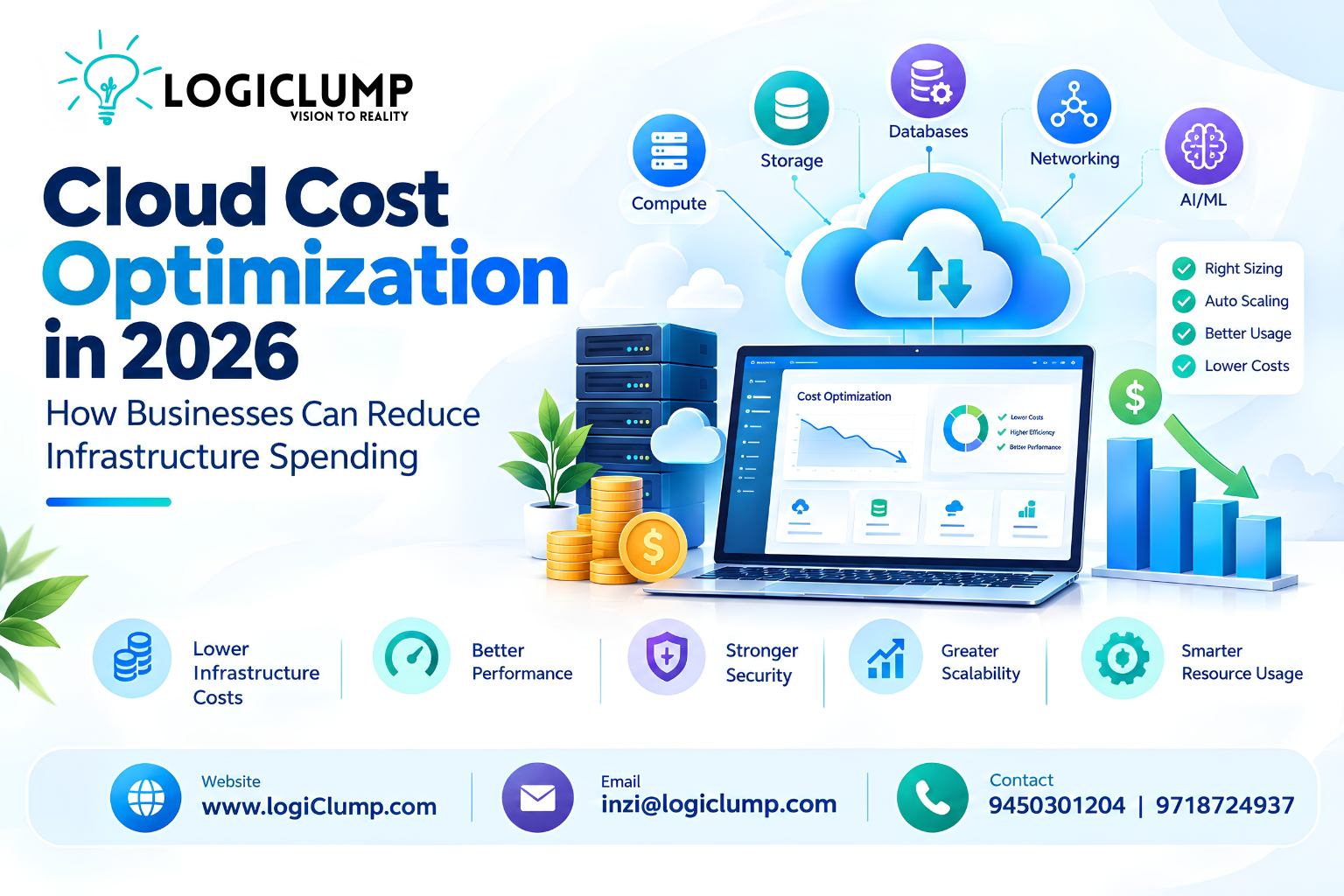
Cloud Cost Optimization in 2026
Cloud computing has become an essential part of modern software infrastructure. Businesses use cloud platforms to host applications, store data, run databases, manage APIs, process analytics, and support AI-powered workloads.
However, as cloud environments become larger and more complex, infrastructure spending can grow quickly.
In 2026, cloud cost optimization is no longer simply about reducing the monthly cloud bill. It is about understanding how infrastructure is being used, matching resources to actual business requirements, improving efficiency, and creating a sustainable approach to cloud spending.
Businesses can reduce unnecessary costs while maintaining the performance, reliability, and scalability their applications require.
What Is Cloud Cost Optimization?
Cloud cost optimization is the process of managing cloud infrastructure and services so that businesses get the required performance and capabilities without paying for unnecessary resources.
A typical cloud environment may include:
- Virtual machines
- Containers
- Databases
- Object storage
- Content delivery networks
- Serverless functions
- Networking services
- Monitoring tools
- Backup systems
- AI and machine-learning services
Each service can contribute to overall infrastructure spending.
The goal is not to use the cheapest possible resources. Instead, businesses should aim for the right balance between cost, performance, reliability, security, and scalability.
Why Cloud Costs Can Increase So Quickly
Cloud platforms make it easy to create resources whenever they are needed.
This flexibility is useful, but it can also create unexpected expenses.
For example, a development team might create a temporary server for testing and forget to remove it after the project is completed.
Similarly, a database may be provisioned with more capacity than the application actually requires.
Common causes of unnecessary cloud spending include:
- Idle servers
- Oversized virtual machines
- Unused storage
- Excessive database capacity
- Unoptimized data transfers
- Unused IP addresses or resources
- Duplicate environments
- Excessive logging
- Unnecessary backups
- Poorly managed development environments
- Inefficient AI workloads
Without regular monitoring, these small expenses can accumulate into significant monthly costs.
Understanding Where Cloud Money Is Going
The first step toward optimization is visibility.
Businesses need to understand which applications, teams, services, and environments are generating cloud expenses.
Cloud spending can be categorized into areas such as:
Compute → Storage → Database → Network → Monitoring → Backup → AI Services
Breaking costs into these categories makes it easier to identify areas where optimization may be possible.
For example, if compute represents a large portion of the infrastructure bill, the organization can investigate whether machines are properly sized and whether workloads can scale dynamically.
Right-Sizing Cloud Resources
One of the most common cloud optimization techniques is right-sizing.
Right-sizing means selecting infrastructure resources that match the actual workload.
A business may initially choose a powerful server because future traffic is uncertain. However, if the application consistently uses only a small portion of that capacity, the organization may be paying for resources it does not need.
Teams can analyze:
- CPU utilization
- Memory usage
- Network traffic
- Storage requirements
- Request volume
- Application performance
Based on this information, infrastructure can potentially be adjusted.
The objective is not simply to reduce server size. Performance requirements should always be considered before making infrastructure changes.
Use Auto Scaling for Variable Workloads
Not every application experiences the same level of traffic throughout the day.
An e-commerce platform might receive significantly more traffic during a sale, while an internal business application may experience high usage only during working hours.
Keeping maximum infrastructure running continuously can result in unnecessary costs.
Auto-scaling allows infrastructure capacity to increase or decrease according to workload requirements.
A simplified model looks like:
Low Traffic → Fewer Resources
High Traffic → More Resources
Traffic Falls → Resources Scale Down
This approach can help businesses avoid maintaining peak capacity during periods of low demand.
Shut Down Idle Development Resources
Development and testing environments are another common source of unnecessary cloud spending.
Teams may create:
- Development servers
- Testing databases
- Temporary environments
- Demo applications
- Staging infrastructure
These resources may not need to run 24 hours a day.
For example, a development environment used only during business hours could potentially be stopped overnight and restarted when developers need it.
Automated schedules can help manage these environments.
This can be particularly useful for organizations running multiple development environments.
Optimize Cloud Storage
Cloud storage can become expensive as applications accumulate data over time.
Businesses may store:
- Application files
- Database backups
- Images
- Videos
- Logs
- Reports
- User-generated content
- Archived information
Not all data needs the same level of accessibility.
A practical storage strategy can classify information based on how frequently it is accessed.
For example:
Frequently Used Data → High-Performance Storage
Occasionally Used Data → Lower-Cost Storage
Long-Term Archives → Archive Storage
Businesses should also regularly identify and remove unnecessary duplicate or obsolete data where appropriate.
Review Database Costs
Databases can represent a significant portion of cloud infrastructure spending.
A database may become unnecessarily expensive because of:
- Oversized instances
- Excessive storage
- Inefficient queries
- Unused replicas
- Unnecessary high availability configurations
- Poor indexing
- Excessive backup retention
Database optimization should therefore involve both infrastructure and application-level improvements.
Improving a slow query may reduce the need for additional database capacity.
In other words:
Better Queries → Less Resource Usage → Potentially Lower Infrastructure Costs
Optimize Data Transfer and Networking
Cloud costs are not limited to compute and storage.
Data transfer between different services, regions, networks, or external systems can also contribute to infrastructure spending.
For example, an architecture with multiple services constantly transferring large amounts of data may create unnecessary network costs.
Businesses can evaluate:
- Data transfer volume
- Service locations
- Region selection
- API communication
- Content delivery
- Data processing locations
Keeping frequently communicating components appropriately positioned and reducing unnecessary data movement can improve both performance and cost efficiency.
Use Caching to Reduce Infrastructure Load
Caching can improve application performance while potentially reducing the amount of work performed by backend systems.
Frequently requested information can be temporarily stored so that the application does not need to repeatedly perform the same expensive operation.
Caching can be applied to:
- API responses
- Database queries
- Product information
- Static assets
- Frequently accessed content
For example:
User Request → Cache → Response
instead of:
User Request → Application → Database → Response
When implemented correctly, caching can reduce database load and improve response times.
Consider Serverless for Suitable Workloads
Serverless computing can be useful for workloads that do not require continuously running servers.
Instead of maintaining infrastructure around the clock, businesses can run functions or services in response to events.
Potential use cases include:
- File processing
- Scheduled tasks
- API operations
- Notifications
- Data processing
- Background jobs
Serverless is not automatically cheaper for every workload.
Costs depend on execution frequency, duration, memory requirements, architecture, and other factors.
Therefore, businesses should evaluate serverless based on actual workload characteristics.
Optimize Containers and Kubernetes Environments
Containerized applications provide flexibility, but poorly managed container environments can also waste resources.
Businesses using container platforms should monitor:
- CPU requests
- Memory requests
- Resource limits
- Node utilization
- Number of running workloads
- Idle containers
- Scaling behavior
If workloads request significantly more resources than they actually use, infrastructure may remain underutilized.
Automated scaling and workload scheduling can help improve resource utilization.
Manage Cloud Commitments Carefully
Many cloud providers offer pricing models that can reduce costs when businesses commit to using certain resources for longer periods.
These may include reserved or committed-use pricing arrangements.
Such models can be useful for predictable workloads.
However, businesses should analyze usage patterns before making long-term commitments.
A resource that may be discontinued or significantly changed in the future should not automatically be locked into a long-term commitment.
Improve Cloud Cost Visibility With Tagging
As infrastructure grows, identifying ownership becomes increasingly important.
Cloud resources can be organized using tags or labels such as:
- Department
- Project
- Application
- Environment
- Customer
- Team
- Cost center
For example:
Project: E-Commerce
Environment: Production
Team: Engineering
This makes it easier to understand where cloud spending is coming from.
It can also help teams take responsibility for the infrastructure they create and operate.
Establish Cloud Budgets and Alerts
Cloud optimization should not depend entirely on monthly bill reviews.
Businesses can establish budgets and alerts to identify unexpected increases in spending.
For example, a team could configure alerts when:
- Monthly spending exceeds a threshold
- A project experiences unusual cost growth
- A new service generates unexpected usage
- Resource consumption increases significantly
Early warnings can help organizations investigate problems before they become major expenses.
Monitor Cloud Costs Continuously
Cloud optimization is an ongoing process.
A system that is optimized today may become inefficient later because:
- Traffic increases
- Applications change
- New services are introduced
- Data grows
- Architecture evolves
- Teams create new infrastructure
Businesses should therefore monitor both infrastructure performance and cost trends.
Useful metrics can include:
- Cost per application
- Cost per customer
- Cost per transaction
- Cost per environment
- Resource utilization
- Monthly cloud spending
- Cost growth rate
These measurements provide a better understanding of whether infrastructure is becoming more efficient.
Optimize Cloud Logging and Monitoring
Logging and monitoring are essential for security, troubleshooting, and operational visibility.
However, collecting every log indefinitely can create unnecessary storage costs.
Businesses can review:
- Log retention periods
- Log volume
- Duplicate logs
- Debug logging in production
- Archive policies
- Monitoring frequency
Important logs should be retained according to operational, security, and regulatory requirements.
The goal is not to eliminate logging but to make logging useful, controlled, and appropriately retained.
Use Infrastructure as Code
Infrastructure as Code (IaC) allows teams to define cloud infrastructure through configuration files and automation.
This can help organizations:
- Standardize environments
- Reduce configuration errors
- Recreate infrastructure consistently
- Track infrastructure changes
- Remove unnecessary resources
- Automate deployment
Consistent infrastructure management can also make it easier to identify differences between development, staging, and production environments.
Optimize AI and Machine-Learning Workloads
AI has become an increasingly important part of modern software, but AI workloads can introduce significant infrastructure costs.
Businesses may need to manage:
- Model inference
- GPU usage
- Training workloads
- API consumption
- Data processing
- Vector databases
- Storage
- Model monitoring
Not every AI workload requires expensive infrastructure.
Businesses can evaluate whether a smaller model, optimized prompt, caching strategy, batch processing, or appropriate API configuration can deliver the required result at lower cost.
For high-volume AI applications, even small efficiency improvements can have a meaningful impact on total spending.
FinOps Is Becoming More Important
Cloud cost management increasingly involves collaboration between different teams.
This approach is often associated with FinOps, where engineering, finance, and business teams work together to understand and manage cloud spending.
A successful FinOps process can involve:
Engineering + Finance + Operations + Business
Engineering teams understand infrastructure.
Finance teams understand budgets and financial reporting.
Business teams understand product priorities.
Combining these perspectives can help organizations make more informed infrastructure decisions.
Cloud Cost Optimization Is Not Just About Cutting Costs
Reducing infrastructure spending should not come at the expense of application quality.
For example, reducing database capacity too aggressively could cause performance problems.
Similarly, removing backup resources simply to save money could increase operational risk.
Cloud optimization should therefore consider multiple dimensions:
Cost + Performance + Reliability + Security + Scalability
A successful optimization strategy balances all five.
Common Cloud Cost Optimization Mistakes
Businesses can make several mistakes when trying to reduce cloud spending.
Cutting Resources Without Monitoring
Removing infrastructure without understanding workload requirements can create performance problems.
Ignoring Architecture
Sometimes the biggest savings come from redesigning inefficient workflows rather than simply changing server sizes.
Focusing Only on Compute
Storage, networking, databases, backups, and AI services can also contribute significantly to cloud costs.
Failing to Review Costs Regularly
Cloud environments change continuously. A one-time optimization is rarely enough.
Overcommitting to Discounts
Long-term commitments should be based on reliable usage patterns.
Ignoring Developer Behavior
Teams can unintentionally create expensive resources. Clear policies, tagging, budgets, and automation can help prevent this.
Building a Practical Cloud Cost Optimization Strategy
Businesses can approach optimization through a structured process.
Step 1: Discover
Identify all cloud resources and services currently being used.
Step 2: Measure
Analyze utilization, performance, and spending.
Step 3: Identify Waste
Look for idle, oversized, duplicated, or unnecessary resources.
Step 4: Optimize
Right-size infrastructure, improve architecture, automate scaling, and optimize storage and databases.
Step 5: Automate
Use policies, schedules, alerts, and Infrastructure as Code to prevent unnecessary spending.
Step 6: Monitor
Track costs and resource usage continuously.
Step 7: Improve
Review the environment regularly as applications and business requirements change.
The Future of Cloud Cost Optimization in 2026
Cloud environments are becoming increasingly automated and intelligent.
Businesses may increasingly use AI-assisted tools to identify:
- Unused resources
- Resource inefficiencies
- Cost anomalies
- Scaling opportunities
- Infrastructure patterns
- Optimization recommendations
Automation can also help organizations respond to changing workloads more efficiently.
The future of cloud cost management is likely to involve a combination of:
AI + Automation + FinOps + Observability + Intelligent Infrastructure
However, automated recommendations should still be reviewed against business requirements, security considerations, and application performance.
How LogiClump Can Help With Cloud-Ready Software
Cloud optimization begins with good software architecture.
Applications that are designed with scalability, efficient database usage, caching, API optimization, monitoring, and appropriate infrastructure planning can be easier to operate efficiently as they grow.
LogiClump can help businesses develop and improve custom software solutions with considerations such as:
- Cloud-ready architecture
- Scalable backend systems
- Database optimization
- API development
- Performance optimization
- Automation
- Secure integrations
- Monitoring
- Infrastructure planning
The objective is to build software that can support business growth without creating unnecessary technical complexity or infrastructure overhead.
Final Thoughts
Cloud computing gives businesses flexibility, scalability, and access to powerful infrastructure.
But flexibility can also lead to unnecessary spending when resources are not properly monitored and managed.
In 2026, effective cloud cost optimization is becoming a continuous discipline rather than a one-time cost-cutting exercise.
Businesses can improve cloud efficiency by combining right-sizing, auto-scaling, storage optimization, database improvements, intelligent architecture, automation, monitoring, and FinOps practices.
The goal is not simply to spend less.
The goal is to ensure that every infrastructure resource provides meaningful value to the business while maintaining the performance, reliability, security, and scalability that modern digital products require.
Smart cloud management is ultimately about building infrastructure that grows with the business—not expenses that grow faster than it.
Contact LogiClump
🌐 Website: www.logiclump.com
📧 Email: inzi@logiclump.com
📞 Contact: 9450301204 | 9718724937
Build. Innovate. Empower.
Discover practical cloud cost optimization strategies for 2026 to reduce infrastructure spending through automation, right-sizing, monitoring, and smarter cloud management.
Tom Cruise