
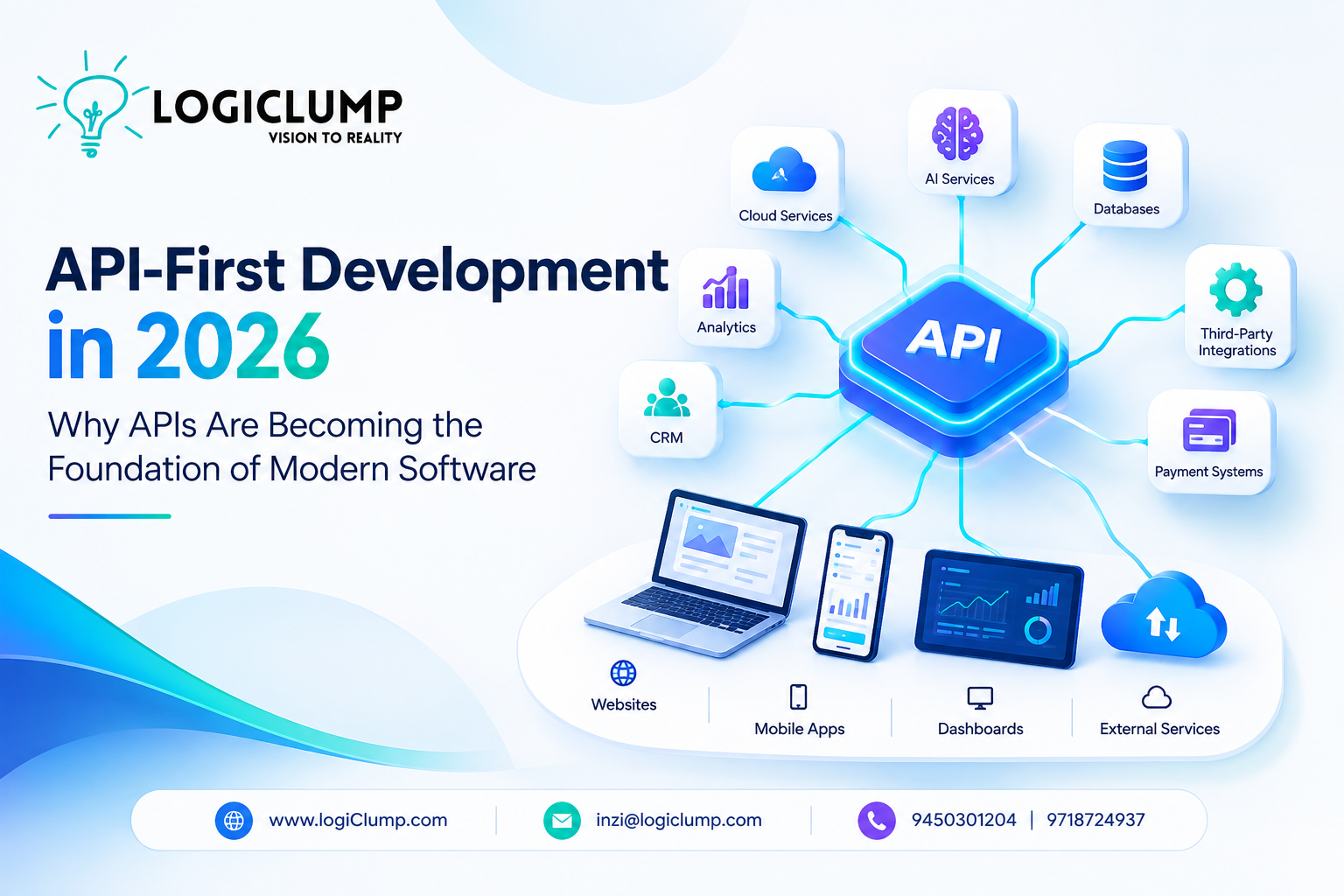
API-First Development in 2026
Software development is moving toward a more connected and modular future.
A modern digital product rarely works in isolation. A single business may operate a website, mobile applications, cloud services, internal dashboards, payment systems, CRM platforms, analytics tools, AI services, and third-party integrations at the same time.
These different systems need a reliable way to communicate.
That is where APIs come in.
An API, or Application Programming Interface, provides a structured way for software systems to exchange information and request actions from one another. In 2026, APIs are becoming more than a communication mechanism between a frontend and backend. They are increasingly being treated as an architectural foundation for connected digital products.
This approach is commonly known as API-first development.
Instead of building an application first and adding APIs afterward, development teams can design the API structure around the product's business requirements from the beginning.
The result can be a software ecosystem where websites, mobile applications, AI tools, dashboards, and external services can work through a common technical foundation.
What Does API-First Development Mean?
API-first development is an approach in which APIs are considered and designed before the applications that will consume them.
In a conventional development process, a team might create a web application, build its backend, and later expose selected functionality through APIs.
With an API-first strategy, the API contract becomes an early part of the development process.
A simplified model is:
Business Requirements → API Design → Backend Services → Applications → Integrations
The API defines how different systems communicate.
For example, an e-commerce platform might have separate APIs for:
- Customer accounts
- Products
- Shopping carts
- Orders
- Payments
- Inventory
- Shipping
- Notifications
A website and mobile application can then consume the same services instead of implementing completely separate versions of the underlying business logic.
Why API-First Development Is Gaining Importance in 2026
Businesses are increasingly operating across multiple digital platforms.
A customer might interact with the same company through a mobile application, website, chatbot, customer portal, or connected service.
Behind these interfaces, numerous systems may need to exchange information.
Common integrations include:
- Payment providers
- CRM platforms
- Cloud infrastructure
- Authentication services
- Analytics systems
- AI platforms
- ERP software
- Communication tools
- Databases
- Business applications
- Partner platforms
Without a structured integration strategy, these connections can become difficult to maintain.
A well-designed API layer provides a consistent communication mechanism between these systems.
This makes APIs an important part of modern software architecture.
API-First Development vs. Traditional Development
The main difference is not simply whether an application has APIs.
It is when APIs become part of the design process.
Traditional Development
A typical sequence may look like:
Frontend → Backend → API Added Later
The API can become heavily influenced by the requirements of the first application that uses it.
API-First Development
An API-first process may look like:
Business Capability → API Contract → Backend Implementation → Multiple Applications
The API is designed with multiple potential consumers in mind.
This can make it easier to support new platforms without rebuilding the underlying business functionality.
APIs as the Connecting Layer
Imagine a company operating:
- A public website
- Android and iOS applications
- An employee dashboard
- A customer portal
- A partner platform
Each of these applications may require access to the same customer, order, payment, or account information.
Instead of creating separate backend implementations for every platform, the organization can create shared services.
A simplified architecture might be:
Web Application
Mobile Application
Partner Portal
↓
API Layer
↓
Business Services
↓
Database & External Systems
This structure separates the user interface from the underlying business capabilities.
API-First Architecture and Headless Software
API-first development also supports the growing use of headless architectures.
In a tightly coupled application, the frontend and backend are often designed as one system.
A headless architecture separates the presentation layer from the underlying services.
For example:
Content / Business Services
↓
APIs
↓
Website | Mobile App | Dashboard | Partner Portal | Other Interfaces
This allows the same backend capabilities to support different digital experiences.
A company can potentially redesign its website without completely rebuilding the services used by its mobile application.
APIs and Mobile Applications
Mobile applications depend heavily on APIs for communication with backend services.
An application may use APIs to:
- Sign users in
- Retrieve account information
- Load products
- Submit orders
- Upload files
- Send messages
- Retrieve notifications
- Update profiles
- Process authorized transactions
For example:
Mobile Application
↓
Authentication API
↓
Identity Service
Similarly:
Mobile Application
↓
Product API
↓
Product Service
The mobile application does not need direct access to the database.
The API acts as an intermediary and can enforce authentication, authorization, validation, and business rules.
APIs and Modern Web Applications
APIs are equally important for many web applications.
Interactive websites and SaaS platforms can request information from backend services as users perform different actions.
A simplified flow could be:
Browser → API → Application Services → Database
This architecture can support products such as:
- CRM platforms
- SaaS applications
- E-commerce websites
- Trading dashboards
- Business management portals
- Analytics platforms
- Customer portals
Instead of loading all information through a single page request, the application can communicate with specific backend services as required.
APIs and Artificial Intelligence
Artificial intelligence is creating new reasons for businesses to invest in API architecture.
AI applications frequently need access to information or external capabilities.
An AI-powered business assistant, for example, might need to:
- Understand a user's request.
- Retrieve permitted information.
- Apply business rules.
- Perform an authorized operation.
- Return the result.
The interaction could look like:
User Request
↓
AI System
↓
Tool or API
↓
Business Application
↓
Result
The API provides a controlled connection between the AI system and the business software.
This is particularly important because an AI model should not automatically receive unrestricted access to internal systems.
APIs and AI Agents
The development of AI agents is making APIs even more significant.
An AI agent can potentially interact with multiple software tools to accomplish a broader objective.
Consider a request such as:
“Prepare a sales summary using this month's data.”
A connected AI agent could potentially:
- Request sales data through an API
- Retrieve relevant records
- Process the information
- Generate a summary
- Send the completed report through an authorized service
The AI interprets the request, while APIs provide access to specific capabilities.
This creates a separation between:
Understanding the request
and
Executing the permitted operation
That separation can be important for security and system control.
APIs and Cloud Services
Cloud platforms are heavily API-driven.
Applications can communicate with cloud services to manage resources such as:
- Storage
- Databases
- Computing
- Authentication
- Messaging
- Monitoring
- AI services
- Networking
A business application can combine several cloud services through APIs to create a larger platform.
API-first architecture therefore fits naturally with cloud-based and distributed software environments.
Reusable Business Capabilities
One of the key ideas behind API-first development is that business functionality can become reusable.
Suppose a company creates a customer-management service.
That service could potentially be consumed by:
- Website
- Mobile application
- Employee dashboard
- Partner portal
- Customer support platform
- AI assistant
Instead of recreating customer-management functionality for every application, the organization can provide a shared service through APIs.
This can reduce duplication and make future integrations easier.
APIs Improve Software Integration
Most businesses already use multiple software products.
A company might have separate systems for:
- Accounting
- CRM
- Inventory
- Payments
- Customer support
- Marketing
- Human resources
- Analytics
APIs allow these systems to exchange information.
For example:
Online Order
↓
Order API
↓
Inventory Service
↓
Payment Service
↓
Shipping Service
↓
Customer Notification
The customer may experience this as one seamless process, even though several independent systems are communicating in the background.
API Security Must Be Designed From the Start
As APIs become gateways to business systems, security becomes increasingly important.
An exposed API may provide access to customer records, financial information, administrative functions, or other sensitive resources.
Security measures may include:
- Authentication
- Authorization
- Access tokens
- API keys
- Role-based permissions
- Input validation
- Encryption
- Rate limiting
- Logging
- Monitoring
- Threat detection
Authentication determines who is making a request.
Authorization determines what that identity is permitted to access or change.
Both need to be handled carefully.
Protecting APIs With Multiple Security Layers
An API should not rely entirely on the frontend application to enforce security.
A stronger architecture can place controls at the API and service layers.
A request might pass through:
Identity Verification
↓
Permission Check
↓
Input Validation
↓
Business Rules
↓
Authorized Operation
This makes the backend responsible for enforcing important security decisions.
If an application is compromised, properly designed backend controls can help prevent unauthorized operations.
Rate Limiting and API Protection
APIs can receive large numbers of requests.
Rate limiting allows organizations to control how frequently an application, user, or client can make requests.
For example, an API could establish a limit based on:
- Requests per minute
- Requests per hour
- Requests per account
- Requests per IP address
- Requests per application
The appropriate approach depends on the system.
Rate limiting can help protect services from accidental traffic spikes, excessive consumption, and certain forms of automated abuse.
API Documentation Is Part of API Design
A technically functional API can still be difficult to use if developers do not understand it.
Good documentation should explain:
- Available endpoints
- Required parameters
- Request formats
- Response structures
- Authentication requirements
- Error messages
- Examples
- Rate limits
- Version information
Standards such as OpenAPI can also help teams describe APIs in a consistent and machine-readable format.
Clear documentation becomes particularly valuable when APIs are used by multiple development teams or external partners.
API Versioning and Long-Term Compatibility
APIs rarely remain unchanged forever.
Businesses may introduce new functionality, modify data structures, or change internal services.
At the same time, existing applications may still depend on previous behavior.
Versioning can help manage these changes.
For example:
API v1
and
API v2
can represent different versions of a service.
The exact versioning strategy should depend on the product architecture and compatibility requirements.
The goal is to allow APIs to evolve without unexpectedly disrupting applications that already depend on them.
Monitoring and API Observability
Developing an API is only the beginning.
Once an API is running in production, teams need visibility into its behavior.
Useful metrics can include:
- Request volume
- Response time
- Error rate
- Availability
- Authentication failures
- Traffic patterns
- Dependency failures
- Resource consumption
Suppose an API suddenly starts producing a high number of failed requests.
Monitoring tools can help identify whether the issue originates from the API itself, a database, an external service, or another dependency.
Observability is especially important when APIs support critical business operations.
API-First Development and Microservices
API-first development is often associated with microservices.
A large software platform can be divided into individual services such as:
User Service
Order Service
Payment Service
Notification Service
Analytics Service
Each service can expose specific capabilities through APIs.
However, API-first development does not require microservices.
A well-structured monolithic application can also follow an API-first approach.
The architecture should be selected according to the business requirements, team structure, complexity, performance needs, and long-term maintenance goals.
APIs and Event-Driven Architecture
Modern systems do not always communicate through direct request-and-response interactions.
Some workflows can be driven by events.
For example:
Order Created
↓
Inventory Event
↓
Inventory Updated
↓
Payment Event
↓
Notification Triggered
In an event-driven architecture, services respond to events rather than waiting for every operation to happen synchronously.
APIs and event-driven systems can coexist and serve different purposes within the same software ecosystem.
API-First Development in FinTech
Financial technology relies heavily on secure communication between software systems.
APIs can support functions such as:
- Account information
- Payment services
- Transaction data
- Identity verification
- Financial reporting
- Customer support
- Investment-related services
Because financial information is sensitive, API design must include appropriate identity, authorization, validation, and transaction controls.
For example, viewing a transaction history and initiating a financial transfer should not necessarily have the same security requirements.
Sensitive operations may require additional verification and confirmation.
APIs in E-Commerce
An online store may depend on numerous systems working together.
A simplified workflow could be:
Customer
↓
Product Service
↓
Cart Service
↓
Order Service
↓
Payment Service
↓
Shipping Service
The APIs connecting these services allow each component to perform its specific role.
Businesses can also use APIs to connect with:
- Marketplaces
- Logistics providers
- Payment gateways
- Recommendation engines
- Analytics platforms
- Customer-support systems
This creates an interconnected commerce environment.
APIs and the Internet of Things
Connected devices create another important API use case.
Sensors and IoT devices continuously generate information that applications may need to access.
APIs can allow software to:
- Read device data
- Monitor sensors
- Send commands
- Store measurements
- Trigger workflows
- Connect devices to business systems
A simplified IoT architecture could look like:
Connected Device
↓
API / Gateway
↓
Cloud Platform
↓
Business Application
↓
Analytics Dashboard
This connects physical devices with digital services.
API Governance for Growing Organizations
As an organization creates more APIs, consistency becomes increasingly important.
API governance can establish standards for:
- Naming conventions
- Authentication
- Authorization
- Documentation
- Versioning
- Error handling
- Security
- Data formats
- Lifecycle management
Without common standards, APIs created by different teams can become inconsistent and difficult to manage.
Governance helps create a more predictable API ecosystem.
Challenges of API-First Development
API-first architecture can provide significant flexibility, but it also introduces its own challenges.
Poor API Design
An API that is confusing or inconsistent can create problems for every application that depends on it.
Security Vulnerabilities
Weak authentication, authorization, or input validation can expose important systems.
Inadequate Documentation
Poor documentation increases the time required for developers to understand and integrate APIs.
Breaking Changes
Changing an API without considering existing consumers can cause application failures.
Performance Issues
High traffic or inefficient backend operations can affect API response times.
Lack of Governance
Different teams may follow different approaches, creating an inconsistent ecosystem.
Unnecessary Complexity
Not every project requires dozens of services or an elaborate API architecture.
The architecture should remain appropriate to the actual needs of the business.
API-First Development Best Practices
Organizations can follow several practices when developing API-first products.
Start With the Business Requirement
Determine what business capabilities need to be exposed before designing individual endpoints.
Design the API Contract Early
Define expected requests, responses, permissions, and errors before implementation.
Build Security Into the Architecture
Security should not be treated as an afterthought.
Maintain Consistent Standards
Use predictable naming, structures, authentication patterns, and error responses.
Document APIs Clearly
Provide developers with practical examples and complete technical references.
Plan for Future Changes
Consider versioning and backward compatibility from the beginning.
Monitor Production Usage
Track performance, availability, failures, and unusual activity.
Use Appropriate Permissions
Give each user, application, or service only the access it actually requires.
Test APIs Thoroughly
Testing should cover functionality, security, performance, validation, and failure scenarios.
What Is Next for API-First Development?
The role of APIs is likely to expand as software becomes increasingly connected.
Several areas are contributing to this change:
- Artificial intelligence
- AI agents
- Cloud computing
- SaaS platforms
- Mobile applications
- IoT systems
- Digital payments
- Business automation
- Real-time data services
- Headless applications
- Multimodal software
As these technologies become interconnected, APIs can provide the communication layer that allows them to work together.
APIs as the Foundation of Intelligent Software
The future of software may involve many systems working together behind a single user experience.
Imagine a business assistant that receives a request from an employee.
The architecture could look like:
User
↓
AI Assistant
↓
API Gateway
↓
Business Services
↓
CRM + Database + Analytics + Communication + Other Tools
The employee may interact with one interface while several services operate in the background.
APIs make this type of architecture possible by defining how each system can communicate and what actions are permitted.
How Businesses Can Prepare for API-First Development
Companies considering an API-first approach should begin by understanding their own software ecosystem.
Important questions include:
Which systems need to communicate?
Identify internal applications, third-party platforms, and future integration requirements.
Which business functions should be reusable?
Identify services that could support multiple applications.
Who will use the APIs?
Consider employees, customers, mobile applications, websites, partners, and AI systems.
Which information is sensitive?
Classify customer, financial, operational, and business-critical data.
Which actions require additional authorization?
Different operations may need different permission levels.
How will API activity be monitored?
Define logging, metrics, alerts, and incident-management processes.
How will the APIs evolve?
Create a versioning and lifecycle strategy before the ecosystem becomes difficult to manage.
Building an API-First Digital Product
A production-ready API ecosystem involves much more than creating endpoints.
Depending on the project, development may include:
- API architecture
- API design
- Backend engineering
- Database development
- Authentication
- Authorization
- Security controls
- API documentation
- Third-party integrations
- Cloud infrastructure
- Monitoring
- Analytics
- Mobile development
- Web development
- AI integration
- Business automation
The most useful APIs are designed around business capabilities rather than simply exposing database tables.
The goal is to provide dependable services that different applications can consume safely.
How LogiClump Can Help
At LogiClump, we build custom websites, mobile applications, business software, APIs, AI-powered solutions, and connected digital platforms.
Our development capabilities can include:
- Custom API development
- Backend development
- Secure API architecture
- Web application development
- Mobile application development
- Third-party API integration
- AI and automation integration
- Authentication and authorization
- Database integration
- Business process automation
- API documentation
- Cloud-ready application architecture
- Scalable software development
Whether a business requires a mobile application, customer portal, internal dashboard, business platform, or interconnected digital ecosystem, a well-planned API architecture can provide a strong foundation for connecting its different components.
The objective is not simply to create endpoints.
It is to create a software foundation that can support the business as its products, users, integrations, and technology requirements grow.
Conclusion
API-first development is becoming an increasingly important approach to building modern software.
Websites, mobile applications, cloud services, AI systems, IoT devices, payment platforms, and business applications all need reliable ways to exchange information and perform authorized operations.
APIs provide that connection.
In 2026, an API can be much more than a bridge between a frontend and a backend. It can serve as a reusable foundation for applications, integrations, automation, and intelligent software.
The modern digital ecosystem can be represented as:
Web + Mobile + Cloud + AI + APIs + Automation + Integrations
When these components are designed to work together, businesses can create digital products that are easier to extend and integrate.
The future of software is increasingly connected.
And APIs are becoming one of the core building blocks behind that connected future.
Build. Innovate. Empower.
Contact LogiClump
🌐 Website: www.logiclump.com
📧 Email: inzi@logiclump.com
📞 Contact: 9450301204 | 9718724937
Discover why API-first development is shaping modern software in 2026. Learn how APIs power AI, mobile apps, cloud platforms, integrations, automation, and scalable digital products.
Tom Cruise