
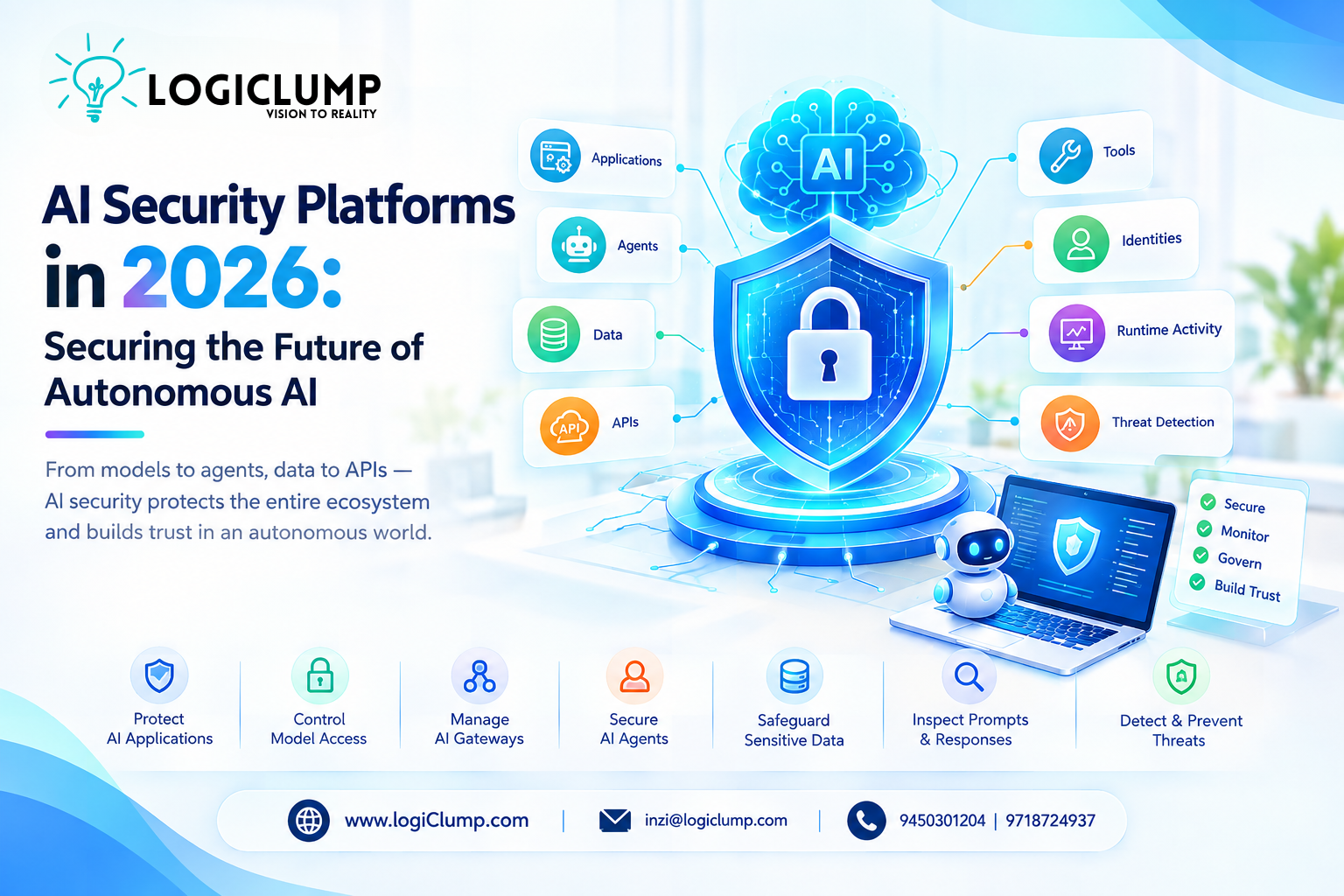
AI Security Platforms in 2026: Securing the Future of Autonomous AI
Artificial intelligence is becoming an important part of modern business software. Companies are using AI for customer support, data analysis, software development, financial operations, content generation, workflow automation, and many other tasks.
But as AI becomes more capable, security requirements are also changing.
Modern AI systems can interact with applications, access information, use external tools, communicate with APIs, and perform tasks with limited human involvement. This creates new security challenges that traditional application security alone may not fully address.
Businesses therefore need to think beyond protecting an AI model.
They also need to protect the applications, agents, APIs, data, tools, identities, and workflows connected to AI.
This is where AI security platforms are becoming increasingly important in 2026.
What Is an AI Security Platform?
An AI security platform is a collection of security technologies designed to protect applications and systems that use artificial intelligence.
Depending on the solution, an AI security platform may provide features such as:
- AI application security
- AI model protection
- AI gateway management
- Agent identity management
- Access control
- Sensitive-data protection
- Prompt security
- Runtime monitoring
- Threat detection
- Security testing
- AI governance
- Audit and compliance support
These capabilities are designed to work alongside traditional cybersecurity.
AI-powered applications still require authentication, authorization, encryption, secure coding, API protection, vulnerability management, and network security.
The difference is that AI security adds controls for risks created by AI-specific behavior.
Why AI Applications Need Additional Security
Traditional software generally follows predefined rules.
AI applications can interpret natural-language instructions, analyze information, generate responses, and make decisions based on context.
An AI agent can go even further by interacting with external tools and systems.
For example, an AI agent connected to a CRM might:
- Receive a customer request.
- Search the CRM.
- Retrieve account information.
- Analyze the customer's situation.
- Update a record.
- Send a response.
Every additional capability introduces another security consideration.
The question is no longer only:
"Is the application secure?"
Businesses must also ask:
"What can the AI access, and what actions is it allowed to perform?"
From AI Assistants to Autonomous AI Agents
Earlier AI applications were commonly used for answering questions, generating text, summarizing information, or assisting employees.
AI agents can perform broader workflows.
Depending on their design, an agent may be able to:
- Understand a business objective
- Break a task into multiple steps
- Retrieve information
- Select appropriate tools
- Call APIs
- Update business records
- Evaluate results
- Continue working toward a goal
This creates new opportunities for automation.
It also increases the importance of security.
An AI system with no access to external resources has limited ability to affect business systems.
An AI agent connected to databases, payment systems, cloud infrastructure, or customer applications requires much stronger controls.
Give Every AI Agent a Clear Identity
Identity is one of the foundations of secure autonomous software.
Businesses should be able to identify which AI agent performed an action.
For example:
Customer Support Agent → CRM → Read Customer Record
is different from:
Finance Agent → Payment API → Process Transaction
Each agent should have a defined identity, role, and permission set.
This makes it easier to:
- Track activity
- Investigate incidents
- Control access
- Apply security policies
- Audit AI actions
AI agents should not simply inherit unlimited permissions from the application or user who started the workflow.
Use Least-Privilege Access
The principle of least privilege is especially important for AI agents.
An agent should receive only the permissions required to complete its assigned task.
For example, a reporting agent may need permission to read selected sales data.
It probably does not need permission to:
- Delete customer records
- Change account permissions
- Modify security settings
- Process payments
Similarly, a customer-support agent may need access to customer information without receiving administrative access to the entire CRM.
Restricting permissions helps reduce the impact of accidental or unauthorized actions.
Protect Against Prompt Injection
Prompt injection is one of the important security concerns associated with AI applications.
AI systems can process information from many sources, including:
- Websites
- Emails
- Documents
- PDFs
- Customer messages
- Search results
- Code repositories
Some of this information may contain instructions intended to manipulate the AI.
For example, an attacker could place hidden instructions inside a document that an AI agent is asked to analyze.
If the agent incorrectly treats those instructions as authorized commands, it could potentially perform an unintended action.
This is why applications should clearly separate:
Data that the AI is allowed to analyze
from
Instructions that the AI is authorized to follow.
External information should be treated as potentially untrusted.
Control What AI Agents Can Do
Protecting AI inputs is only part of the security process.
Businesses must also control the actions available to an AI agent.
For example, an agent may be allowed to:
- Search a database
- Generate a report
- Create a draft
- Open a support ticket
- Retrieve approved information
But sensitive operations may require additional authorization.
These could include:
- Processing payments
- Deleting accounts
- Changing permissions
- Modifying financial records
- Removing production resources
- Accessing highly sensitive information
A secure AI architecture should therefore define clear boundaries around every tool and action.
AI Gateways as a Security Layer
Organizations are increasingly using multiple AI models, applications, and services.
Managing these connections individually can make security more difficult.
An AI gateway can provide a centralized layer between applications and AI services.
Depending on the implementation, it can help manage:
- Authentication
- Model access
- Usage policies
- Request monitoring
- Data inspection
- Rate limiting
- Access control
- Logging
A gateway can be especially useful for organizations using multiple AI providers or AI-powered applications.
Instead of allowing every application to connect directly to every model, businesses can introduce a controlled security layer.
Protecting Sensitive Business Data
AI systems may have access to valuable and confidential business information.
This can include:
- Customer records
- Financial information
- Employee data
- Internal documents
- Source code
- Business plans
- Transaction details
- Product information
Businesses should understand what information their AI applications can access and how that information is processed.
Important security measures include:
Data Classification
Identify which information is public, internal, confidential, or highly sensitive.
Access Restrictions
Allow AI systems to access only the information necessary for their tasks.
Encryption
Protect sensitive information during storage and transmission.
Data-Loss Prevention
Detect and restrict unauthorized movement of sensitive information.
Retention Policies
Define how long AI-related information, logs, and records should be stored.
AI Security and API Protection
APIs are often the connection between AI agents and business applications.
An AI agent may use APIs to:
- Retrieve customer information
- Update CRM records
- Check inventory
- Process transactions
- Create support tickets
- Access internal services
- Send notifications
This makes API security a critical part of AI security.
Secure APIs should use appropriate:
- Authentication
- Authorization
- Input validation
- Rate limiting
- Credential protection
- Logging
- Monitoring
AI agents should also have access only to the API operations they actually need.
For example, an agent that only needs to retrieve customer information should not automatically have access to account-deletion functions.
Runtime Security for AI Applications
Security should continue after an AI application is deployed.
Runtime monitoring can help organizations identify unusual behavior while the system is operating.
Security teams can monitor for:
- Unexpected tool usage
- Unusual API requests
- Repeated failed operations
- Unauthorized data access
- Suspicious agent behavior
- Unexpected data transfers
- Attempts to bypass security controls
This creates an additional layer of protection for AI applications operating in production.
Why AI Activity Logging Matters
AI workflows can involve many steps and multiple systems.
An agent may retrieve information from one service, process it, call another API, and then update a third system.
A detailed audit trail can help businesses understand:
- Who initiated the workflow
- Which AI agent handled the request
- Which tools were used
- Which APIs were called
- What information was accessed
- What actions were performed
- Which actions were blocked
- Whether human approval was obtained
- Where an error occurred
Without adequate logging, investigating an AI-related security incident can become much more difficult.
AI Security Testing
AI applications require security testing beyond conventional vulnerability assessments.
Businesses should test how their systems behave when exposed to malicious or unexpected inputs.
Testing can include:
- Prompt injection
- Unauthorized tool requests
- Data extraction attempts
- Malicious documents
- Manipulated web content
- Privilege escalation
- Unsafe API requests
- Unexpected instructions
AI red-team exercises can also help security teams discover weaknesses before attackers exploit them.
AI Governance and Security
Technology alone cannot solve every AI security problem.
Organizations also need clear policies around AI usage.
These policies can define:
- Which AI services are approved
- What data can be submitted to AI systems
- Which agents can access business applications
- Which actions require human approval
- How AI activity should be monitored
- How security incidents should be handled
- Who owns each AI system
- How long AI data should be retained
Good governance creates accountability around AI deployment.
Human Oversight Still Matters
Autonomous AI does not necessarily mean that every decision should be made without human involvement.
Human review can be particularly valuable when an action involves:
- Large financial transactions
- Confidential information
- Legal matters
- Security settings
- Irreversible operations
- Important customer decisions
Businesses can create different levels of autonomy.
Low-risk activities can potentially be automated.
Higher-risk activities can require human confirmation before execution.
This allows organizations to benefit from AI automation while maintaining appropriate control.
Building a Secure AI Application
Security should be included during the design and development stages rather than added after an AI application is completed.
A secure architecture can include several layers.
Identity Management
Identify users, applications, and AI agents.
Access Control
Define what each identity can access and modify.
Data Protection
Secure sensitive information throughout its lifecycle.
AI Model Security
Control access to AI models and services.
Tool Security
Restrict which tools each AI agent can use.
API Security
Protect communication between AI systems and other applications.
Runtime Monitoring
Monitor AI activity after deployment.
Governance
Define policies, responsibilities, and approval requirements.
Together, these controls create a stronger foundation for secure AI-powered software.
Common AI Security Mistakes
Businesses should be careful to avoid several common mistakes.
Giving AI Agents Excessive Permissions
An agent should not receive administrative access simply because it may need additional capabilities in the future.
Trusting External Content
Websites, emails, documents, and uploaded files may contain malicious instructions and should be treated carefully.
Protecting Only the AI Model
The model is only one part of an AI application. APIs, databases, tools, application logic, and infrastructure also require protection.
Ignoring Runtime Activity
Security teams need visibility into what AI systems actually do after deployment.
Automating High-Risk Actions Too Early
Businesses should validate AI workflows before allowing them to perform sensitive operations without approval.
How Businesses Can Prepare for AI Security in 2026
Organizations can take a structured approach to improving AI security.
Step 1: Identify AI Systems
Create an inventory of AI models, applications, agents, tools, and third-party services.
Step 2: Understand Data Access
Determine which types of information each AI system can access.
Step 3: Review Permissions
Check whether every AI agent has only the permissions it needs.
Step 4: Secure APIs
Apply strong authentication, authorization, validation, monitoring, and rate controls.
Step 5: Test AI Threats
Evaluate the system against prompt injection, data leakage, unauthorized actions, and other AI-specific risks.
Step 6: Monitor AI Activity
Track model requests, agent actions, tool usage, API calls, and security events.
Step 7: Define Approval Rules
Determine which actions can happen automatically and which require human confirmation.
Step 8: Review Security Regularly
AI applications change quickly. Security policies should therefore be updated as models, tools, integrations, and workflows evolve.
The Future of AI Security Platforms
AI security is likely to become increasingly connected with traditional cybersecurity.
Security platforms will need to understand not only networks, applications, and users but also AI agents and their behavior.
Organizations will need answers to questions such as:
Which agent is performing this action?
What is the agent trying to accomplish?
What information can it access?
Which tools can it use?
Is the requested action authorized?
Does its behavior match the expected workflow?
This represents a broader shift from simply securing AI infrastructure toward securing AI-driven behavior and actions.
AI Security Should Be Part of Software Architecture
AI security should not be treated as the responsibility of only one department.
Developers, software architects, DevOps teams, security professionals, and business leaders all have an important role.
A secure AI solution may require:
- Strong application architecture
- Secure APIs
- Identity management
- Authentication
- Authorization
- Data protection
- Cloud security
- Runtime monitoring
- AI governance
When these elements are planned together, businesses can create AI applications that are both useful and controlled.
How LogiClump Can Help
Developing a secure AI application requires more than integrating an AI model.
Businesses may need custom software, secure APIs, authentication systems, databases, AI integrations, workflow automation, monitoring, and scalable infrastructure.
LogiClump can help businesses develop custom digital solutions that combine AI capabilities with secure application architecture, API integrations, automation, web and mobile applications, and business workflows.
The focus is on creating practical AI solutions where security is considered alongside functionality and scalability.
Conclusion
AI is becoming increasingly autonomous and connected to real business systems.
This creates opportunities for powerful automation, but it also introduces security challenges that businesses cannot ignore.
AI security platforms can help organizations protect the wider AI environment, including models, applications, agents, data, APIs, tools, and runtime activity.
The goal should not simply be to make AI more autonomous.
The goal should be to make AI securely autonomous.
Strong identity management, least-privilege access, secure APIs, data protection, AI-specific testing, runtime monitoring, governance, and human oversight can help businesses maintain control as AI becomes more deeply integrated into their software.
As autonomous AI continues to evolve, security should be designed into the application from the beginning rather than treated as a final step.
Talk to Our Team
Looking to build secure AI applications, AI agents, intelligent automation, secure APIs, or custom business software?
LogiClump Technologies can help turn your technology requirements into practical and scalable software solutions.
🌐 Website: www.logiclump.com
📧 Email: inzi@logiclump.com
📞 Contact: 9450301204 | 9718724937
Build. Innovate. Empower
Learn how AI security platforms protect applications, autonomous AI agents, APIs, sensitive data, and intelligent workflows from emerging security threats in 2026.
Tom Cruise