
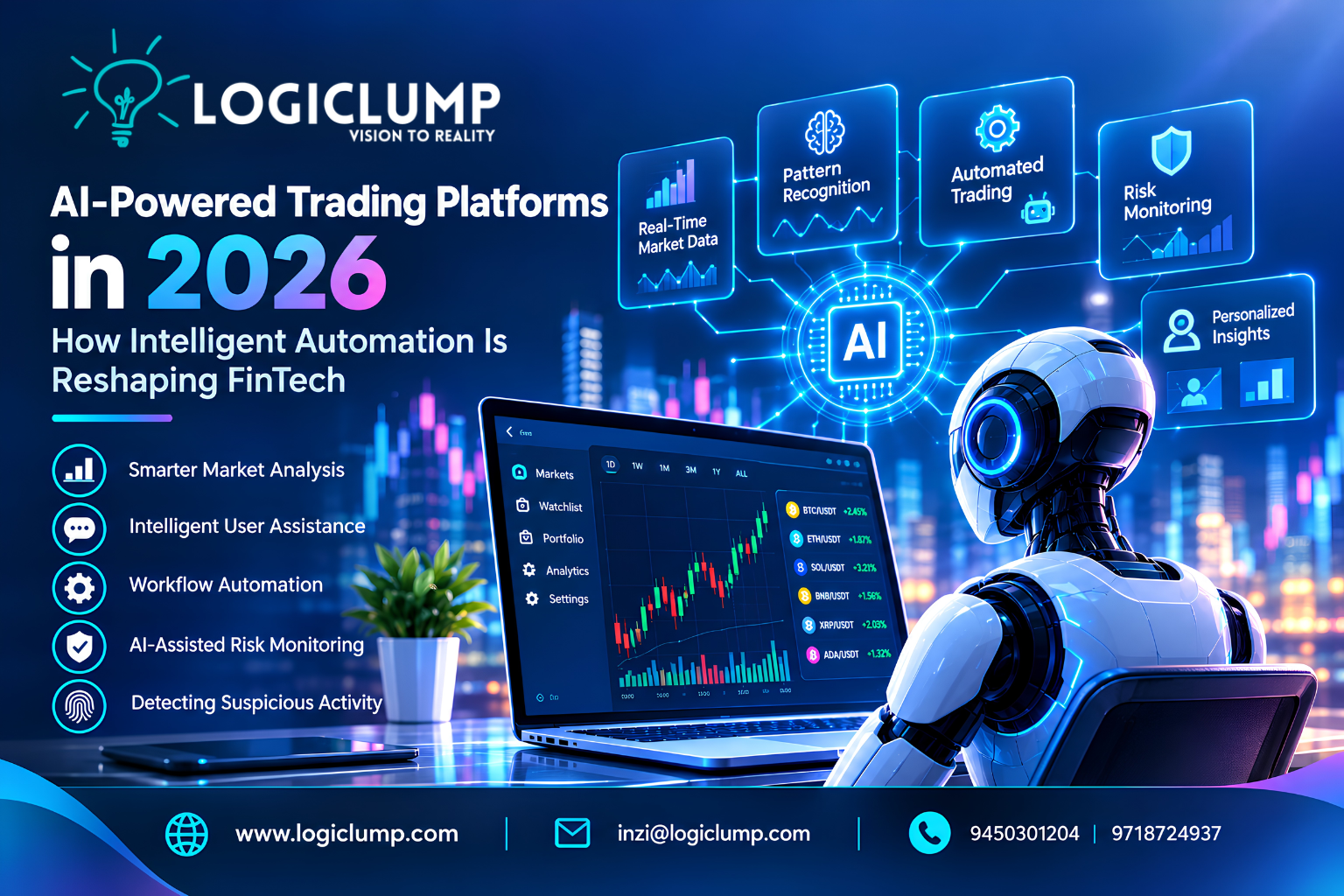
AI-Powered Trading Platforms in 2026: The Future of Intelligent FinTech
The financial technology industry is entering an increasingly intelligent era.
Trading software has traditionally focused on providing market prices, charts, order execution, account information, and portfolio tools. Today, artificial intelligence is adding another layer to these systems by helping platforms process information, identify patterns, automate repetitive operations, monitor risk, and provide more personalized assistance.
In 2026, the combination of AI, real-time data, automation, cloud computing, APIs, and advanced analytics is creating new possibilities for financial platforms.
The goal is not simply to make trading software more complicated. It is to make it more responsive, efficient, and capable of handling large amounts of information.
What Makes a Trading Platform AI-Powered?
An AI-powered trading platform incorporates artificial intelligence into one or more parts of its technology stack.
A conventional platform may show a trader a chart and allow them to decide what to do next. An intelligent platform can process additional information and help users interpret what they are seeing.
Depending on the system, AI can support:
- Market-data analysis
- Pattern identification
- Intelligent alerts
- Portfolio monitoring
- Risk analysis
- Sentiment analysis
- Fraud detection
- Automated operational tasks
- Personalized dashboards
- AI-based assistance
The role of AI can therefore range from simple analytical support to more sophisticated automated workflows.
Why Intelligent Automation Matters in FinTech
Financial markets produce information at an enormous scale.
Prices can change continuously, news can influence sentiment, economic events can affect market conditions, and trading systems may process large numbers of transactions simultaneously.
At the same time, financial businesses have operational responsibilities beyond trading. They may need to manage customers, accounts, compliance processes, risk controls, reporting, and multiple technology integrations.
Manually handling all these activities can become inefficient.
Intelligent automation can help software process information faster and reduce repetitive work.
However, AI should not be treated as a guaranteed market-prediction engine. Markets are unpredictable, and an AI model can make mistakes.
Its practical value often comes from processing information quickly, supporting decisions, and automating well-defined tasks.
Where AI Fits Into Trading Software
AI can influence several different components of a modern financial platform.
Smarter Market Analysis
AI systems can examine large volumes of market information and identify predefined patterns or unusual changes.
Instead of requiring users to manually examine every available data point, the platform can highlight information that may require attention.
This can make complex market dashboards easier to navigate.
Intelligent User Assistance
AI assistants can provide another way for users to interact with financial software.
For example, a user might ask:
- “Summarize today's market activity.”
- “Show unusual movement in my watchlist.”
- “Explain this alert.”
- “What is my current exposure?”
- “Give me a summary of my portfolio.”
A conversational interface can make complicated financial applications more accessible, particularly when the underlying platform contains many tools and screens.
Workflow Automation
AI can also be combined with predefined rules and automated workflows.
A possible process could look like:
Live Data → Analysis → Condition Detected → Alert → Review → Action
Depending on the platform's design, some steps may happen automatically while others require human confirmation.
For financial applications, this distinction is important because an automated error can have significant consequences.
AI-Assisted Risk Monitoring
Risk management is an area where intelligent software can provide considerable operational value.
A platform can continuously monitor selected account and market information to identify changes that may require attention.
Examples include:
- Increasing account exposure
- Unusual trading activity
- Concentrated positions
- Sudden changes in volatility
- Abnormal transaction behavior
When a predefined condition is detected, the system can notify a trader or risk-management team.
AI does not remove financial risk. Instead, it can help teams identify and investigate potential risks more efficiently.
Using AI to Detect Suspicious Activity
Security and fraud prevention are also becoming important areas for AI-enabled FinTech systems.
A financial platform may process a large number of transactions and user activities. Automated analysis can help identify behavior that differs from expected patterns.
For example, a system could flag:
- Unusual transaction sequences
- Unexpected account activity
- Suspicious login behavior
- Rapid changes in user behavior
- Potentially connected activities
The strongest implementations can combine automated detection with human investigation rather than allowing an AI system to make every security decision independently.
Personalized Financial Software
Not every user needs the same trading interface.
An experienced trader may require detailed market information, advanced charts, order-management tools, and deeper analytics.
A newer user may benefit from simpler dashboards, explanations, educational information, and carefully selected notifications.
AI can help personalize certain parts of the experience.
Possible applications include:
- Customized dashboards
- Relevant market notifications
- Personalized summaries
- Intelligent search
- Contextual explanations
- Educational assistance
Personalization must still be implemented with appropriate privacy and security controls.
Real-Time Data Is the Foundation
AI cannot provide useful analysis without reliable information.
For trading software, this makes the data pipeline a critical part of the overall architecture.
A simplified intelligent trading architecture might look like:
Market Data → Data Processing → AI & Analytics → Trading Services → User Interface
The quality, speed, consistency, and availability of data can directly affect the usefulness of the system.
This is why AI development and backend engineering need to work together rather than being treated as completely separate projects.
The Importance of Cloud Technology
Modern FinTech platforms often require scalable infrastructure.
Cloud technologies can provide computing resources, storage, deployment capabilities, monitoring, and infrastructure services that support large applications.
For AI-enabled trading platforms, cloud infrastructure can be used for:
- Data processing
- AI model deployment
- Analytics
- API services
- Application hosting
- Monitoring
- Storage
- Scaling
However, there is no single architecture suitable for every financial platform.
Latency requirements, security policies, regulatory obligations, data-location requirements, and business operations all need to be considered when selecting an infrastructure strategy.
APIs Connect the FinTech Ecosystem
A trading platform may need to communicate with many external and internal systems.
These can include:
- Market-data services
- Liquidity providers
- Broker infrastructure
- CRM platforms
- Payment services
- KYC providers
- Risk-management systems
- Mobile applications
- Reporting systems
APIs provide the communication layer between these technologies.
As a result, API design becomes an important part of building intelligent financial software.
Financial APIs should be designed with appropriate controls around authentication, authorization, encryption, validation, rate limiting, monitoring, and auditing.
The Growing Role of AI Agents
One of the more significant developments in AI is the evolution from simple assistants toward systems capable of completing multi-step tasks.
An AI agent connected to a financial application could potentially:
- Retrieve permitted information
- Analyze the available data
- Prepare a summary
- Check predefined conditions
- Generate a notification
- Request approval for a sensitive operation
This approach can reduce manual work across financial operations.
But agent-based systems require strong boundaries.
An AI agent should not automatically receive unrestricted access to trading accounts, databases, customer information, or financial operations.
Access permissions, approval mechanisms, monitoring, and activity logs become increasingly important as automation becomes more capable.
Why Human Control Still Matters
Greater automation does not mean removing humans from every financial workflow.
AI models can encounter unexpected conditions, inaccurate data, unusual market behavior, or situations outside their training and operating assumptions.
For high-impact operations, human review can provide an important safety layer.
A well-designed platform should clearly define:
What AI can do automatically
and
What requires human approval.
This distinction can help organizations gain the benefits of automation without giving an intelligent system unnecessary authority.
Security Challenges in AI-Based Trading Platforms
Adding AI to financial software also creates additional security considerations.
A platform may need to protect:
- Trading accounts
- User credentials
- API keys
- Financial records
- Transaction information
- AI services
- Internal databases
- Third-party integrations
Access should be based on clearly defined permissions.
Sensitive operations should also be monitored so that unusual activity can be detected and investigated.
Security should be included during architecture and development rather than treated as a final feature.
Compliance and Responsible AI
FinTech is a highly regulated industry, and the introduction of AI can create additional governance requirements.
Businesses may need to consider areas such as:
- Data privacy
- Audit trails
- Model governance
- Transparency
- Record retention
- Risk controls
- Automated decision-making
- User consent
The exact requirements depend on the market, country, financial activity, and regulatory framework.
Organizations should therefore involve appropriate compliance, legal, and financial professionals when introducing AI into regulated financial products.
What Does an AI-Ready Trading Platform Need?
Building an intelligent trading platform requires more than selecting an AI model.
A complete solution may include several technology layers.
User Experience
Web and mobile interfaces through which users monitor information and interact with the platform.
Trading Infrastructure
Services responsible for accounts, orders, trading workflows, and related operations.
Data Infrastructure
Systems that collect, process, store, and distribute financial data.
AI and Analytics
Models and services responsible for analysis, alerts, assistance, and automation.
API Infrastructure
Secure interfaces connecting internal components and external services.
Security
Identity management, permissions, encryption, monitoring, and audit mechanisms.
Cloud and DevOps
Infrastructure supporting deployment, availability, scaling, monitoring, and recovery.
A modular architecture can make it easier to introduce new AI capabilities without rebuilding the entire platform.
AI Is Not a Replacement for Good Software Architecture
One common mistake is to focus heavily on the AI model while overlooking the rest of the platform.
A powerful model cannot compensate for unreliable market data, insecure APIs, poor database design, weak access controls, or unstable infrastructure.
The AI layer is only one component of a larger technology ecosystem.
For this reason, successful AI FinTech projects require cooperation between AI engineering, backend development, security, cloud infrastructure, data engineering, and product design.
The Future of Intelligent Trading Software
The next generation of financial platforms is likely to combine traditional trading tools with increasingly intelligent interfaces.
Users may interact with their platforms through:
- Advanced dashboards
- Conversational assistants
- Automated alerts
- Intelligent analytics
- Personalized experiences
- AI agents
- Automated workflows
This could gradually shift trading software from being primarily a collection of tools to becoming a more intelligent operational environment.
However, technological capability alone will not determine success.
Financial platforms will also need to focus on security, reliability, transparency, responsible automation, and user control.
How Businesses Can Prepare
Companies planning to introduce AI into financial software can begin with a practical approach.
First, identify repetitive or information-heavy processes where automation could provide measurable value.
Next, evaluate the data required for those processes and determine whether it is reliable enough for AI-based analysis.
Then establish:
- Clear user permissions
- Secure APIs
- Data-protection controls
- Human approval workflows
- Monitoring systems
- Audit mechanisms
- Appropriate AI governance
Starting with controlled use cases can allow organizations to gain experience before expanding automation into more sensitive operations.
The Role of Custom FinTech Development
Every financial business has different workflows, users, integrations, and technology requirements.
A custom development approach can make it possible to design the platform around those specific needs rather than forcing the business into a generic software model.
This can include intelligent trading interfaces, financial dashboards, mobile applications, APIs, automation systems, AI assistants, analytics solutions, and scalable backend infrastructure.
For businesses entering AI-driven FinTech, the combination of software engineering and intelligent automation can create opportunities to build more flexible and efficient financial products.
Conclusion
AI is changing the possibilities for trading and financial software in 2026.
The biggest shift is not simply the addition of artificial intelligence to trading screens. It is the integration of AI, real-time data, automation, APIs, cloud infrastructure, analytics, and security into a single technology ecosystem.
AI can help platforms analyze information faster, automate repetitive processes, identify unusual activity, provide intelligent assistance, and create more personalized user experiences.
At the same time, financial applications require a high level of reliability and control.
The most successful AI-powered trading platforms will therefore be those that combine intelligent technology with strong architecture, secure infrastructure, responsible automation, and meaningful human oversight.
Talk to Our Team
If you are planning an AI-powered trading platform, FinTech application, financial dashboard, secure API, or custom software solution, the right technology architecture can make a significant difference.
LogiClump Technologies can help businesses transform their software ideas into scalable digital solutions.
🌐 Website: www.logiclump.com
📧 Email: inzi@logiclump.com
📞 Contact: 9450301204 | 9718724937
Build. Innovate. Empower.
Discover how AI-powered trading platforms are transforming FinTech in 2026 through automation, intelligent analytics, risk monitoring, AI agents, APIs, and cloud technology.
Tom Cruise