
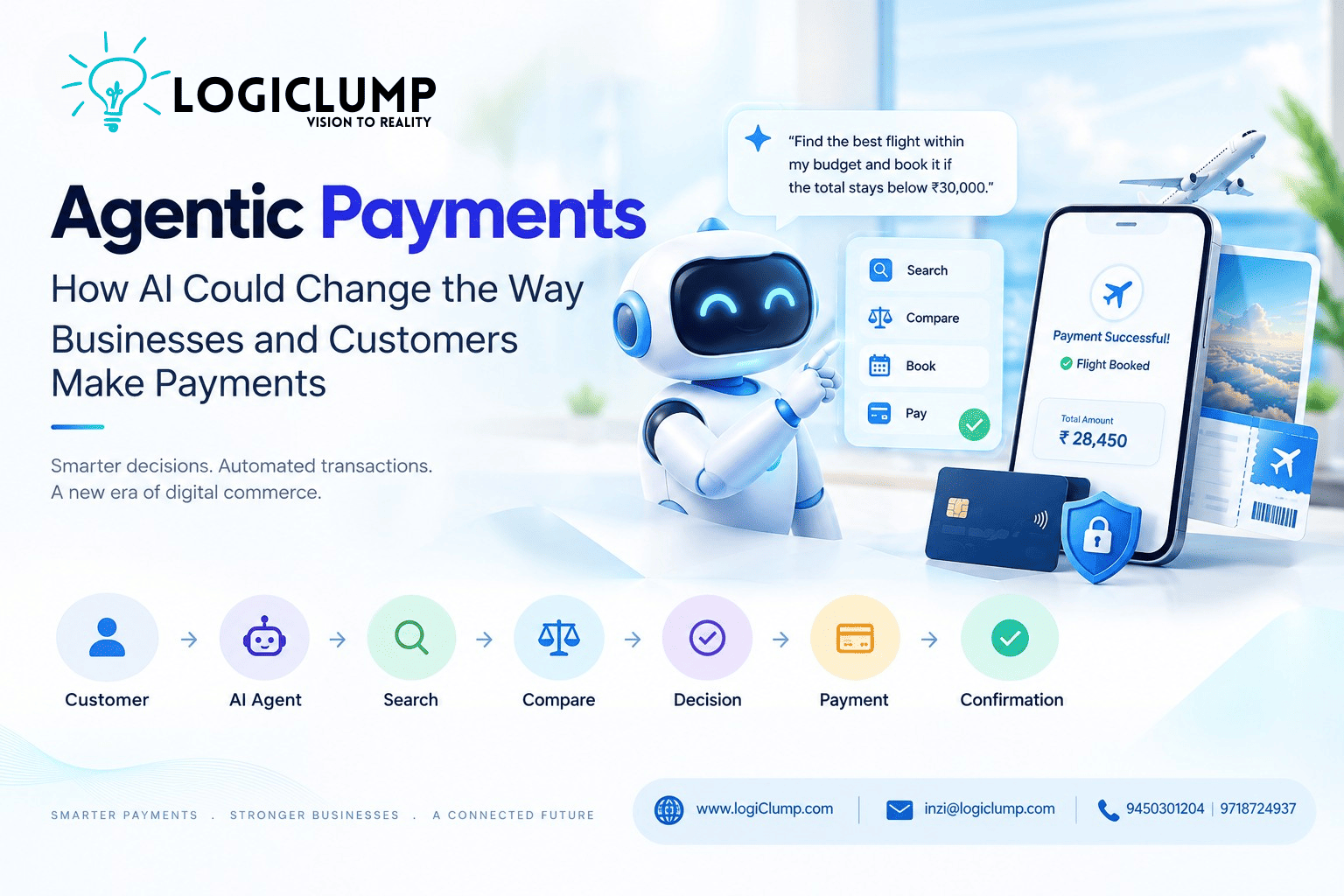
Agentic Payments: How AI Is Transforming Digital Commerce
Smartphones have already changed the way people communicate, shop, work, learn, travel, and manage money. Now artificial intelligence is changing the mobile applications running on those devices.
For years, most mobile apps depended on predefined menus, buttons, forms, and fixed rules. Users had to navigate the interface and tell the application exactly what to do.
AI is introducing a different approach.
Instead of simply responding to individual commands, modern applications can understand natural language, analyze images, recognize patterns, personalize experiences, and assist users with multi-step tasks.
This is creating a new generation of AI-powered mobile apps.
But adding an AI model to an application does not automatically make that application intelligent.
The real opportunity is to use AI where it can make a mobile experience more useful, faster, simpler, more personalized, and more accessible.
What Makes a Mobile App AI-Powered?
An AI-powered mobile application uses artificial intelligence or machine-learning technology to perform tasks that would traditionally require predefined rules or significant manual interaction.
A conventional application might follow this pattern:
Tap → Select → Enter Information → Process → Display Result
An AI-enabled application can introduce another layer:
User Intent → AI Understanding → Context Analysis → Action → Result
For example, instead of searching through several filters, a customer might simply tell an e-commerce app:
“Find a lightweight laptop for office work under ₹60,000.”
The application can interpret the request and use its available product information to produce relevant results.
AI can therefore change not only what an application does, but also how users interact with it.
Why AI Is Becoming Important for Mobile Applications
Modern smartphones already provide applications with access to powerful capabilities.
Depending on the device and user permissions, mobile apps can work with:
- Camera
- Microphone
- Location
- GPS
- Images
- Documents
- Sensors
- Notifications
- Device information
- Calendar data
- Local storage
AI can turn these capabilities into more intelligent experiences.
A camera can become a visual search tool.
A microphone can become a conversational interface.
A document scanner can become an intelligent information-extraction system.
A notification system can become a personalized assistant.
This combination is one of the reasons AI is becoming an important part of mobile application development.
On-Device AI Is Changing Mobile Intelligence
Not every AI operation needs to happen in the cloud.
Modern smartphones increasingly have hardware designed to handle AI workloads locally.
This allows selected AI functions to run directly on the device.
Potential advantages include:
- Faster responses
- Reduced network dependency
- Better offline experiences
- Lower latency
- Improved privacy for suitable workloads
- Reduced reliance on cloud inference
Android and Apple are both expanding developer capabilities around on-device AI and intelligent application experiences.
For developers, this creates an important architectural choice.
Some workloads may be suitable for local processing, while more complex tasks can use cloud-based models.
A practical architecture can therefore look like:
Mobile Device → On-Device AI → Secure Cloud AI → Business API
The right combination depends on the application's requirements.
Multimodal AI Will Make Apps More Aware
Mobile applications have traditionally focused heavily on text and touch.
AI is expanding that interaction model.
Multimodal systems can work with different forms of information, including:
- Text
- Images
- Voice
- Documents
- Video
- Visual information
Imagine taking a picture of a product and asking the application to find similar items.
Or uploading a document and asking the app to summarize its important points.
Or showing an application an image and asking what information it contains.
These experiences make mobile applications feel less like static software and more like intelligent interfaces.
Natural Language Could Become a New Way to Use Apps
Users have traditionally needed to understand how an application works.
They have to know where a particular setting is located or which menu contains a specific feature.
AI can reduce some of that complexity.
A user might say:
“Show my expenses from this month.”
Or:
“Find my last three orders.”
Or:
“Create a summary of today's sales.”
Instead of forcing users through several screens, an AI-enabled application can interpret the request and connect it with the appropriate application functionality.
Traditional graphical interfaces will still matter.
However, natural-language interaction can become another interface layer.
AI Agents Can Take Mobile Apps Beyond Chatbots
There is a major difference between an AI chatbot and an AI agent.
A chatbot generally responds to a user's message.
An AI agent can potentially understand a goal, determine the required steps, use approved tools, and complete part of a workflow.
For example, consider a business travel application.
A user might ask:
“Prepare my itinerary for next week's client meeting.”
An agent could potentially:
- Review authorized calendar information
- Find relevant travel details
- Organize the schedule
- Prepare an itinerary
- Create reminders
Sensitive or high-impact actions should still require appropriate authorization and, where necessary, human confirmation.
This is an important direction for mobile software: applications may increasingly become interfaces through which users delegate tasks to intelligent systems.
Personalization Will Become More Dynamic
Personalized experiences are not new.
Mobile applications already recommend products, videos, music, articles, and other content.
AI can make personalization more context-sensitive.
An application may consider several signals instead of relying on one preference.
For example, an online shopping app could consider:
- Previous purchases
- Search behavior
- Product preferences
- Price range
- Current activity
- Browsing history
A travel app could consider:
- Previous destinations
- Budget
- Dates
- Interests
- Travel style
The objective should be useful personalization—not unnecessary collection or use of personal information.
Privacy controls and responsible data handling need to remain part of the design.
AI-Powered Search Will Understand Intent
Traditional search often depends on keywords.
AI-powered search can interpret more detailed requests.
Instead of searching:
“Running shoes”
a user could ask:
“Show me comfortable running shoes for daily workouts under ₹5,000.”
The system can identify several requirements from the same request.
This approach can improve experiences across:
- E-commerce
- Banking
- Travel
- Education
- Business software
- Document management
- Customer support
The shift is from keyword matching toward intent understanding.
Smarter Customer Support Inside Apps
Mobile customer support can also benefit from AI.
Many applications still require users to search FAQs or navigate several support categories before reaching the right solution.
An AI-enabled support system can understand the user's problem and retrieve relevant information.
For example:
“The amount was deducted from my account, but my order still shows pending.”
With appropriate permissions and integrations, the system could check the relevant order and payment information and explain the current status.
For sensitive operations, the application should use authentication, authorization, business rules, and appropriate approval mechanisms.
AI should make support easier without becoming an uncontrolled access point to business systems.
Predictive Intelligence Can Help Users Before They Ask
AI does not always have to wait for a question.
It can also identify patterns and provide useful alerts or recommendations.
Examples include:
Banking
Detecting unusual transaction patterns.
E-Commerce
Suggesting products based on relevant customer behavior.
FinTech
Presenting analytical information based on market or portfolio data.
Business Applications
Highlighting unusual activity or operational trends.
Productivity Apps
Identifying upcoming tasks or potentially important information.
Predictions should be presented responsibly.
An AI-generated prediction is not the same as a guaranteed outcome.
Voice Interaction Will Become More Natural
Voice control has existed in mobile devices for years, but AI can make voice-based interactions more flexible.
Users may increasingly expect to speak naturally rather than memorize specific commands.
For example:
“Show today's appointments.”
“Summarize my notifications.”
“Find the nearest branch that's open.”
“Remind me about this tomorrow.”
The important development is not only speech recognition.
The larger opportunity comes from combining:
Voice + Context + AI + Application Functions
This can make mobile applications easier to operate, especially when users cannot comfortably interact with a screen.
The Camera Will Become an Intelligent Input
Smartphone cameras are becoming useful AI interfaces.
Instead of simply capturing photographs, applications can use visual intelligence to understand what is being shown.
Possible use cases include:
- OCR
- Document extraction
- Visual search
- Product identification
- Translation
- Object recognition
- Image classification
- Visual assistance
For example, an inventory application could allow employees to scan products instead of manually entering product information.
A shopping application could let users photograph an item and search for similar products.
A document application could extract important information from an uploaded image.
AI Can Improve Mobile Accessibility
AI also has the potential to make applications easier to use for people with different accessibility requirements.
Useful capabilities can include:
- Automatic transcription
- Voice interaction
- Text summarization
- Image descriptions
- Translation
- Speech assistance
- Simplified interactions
Accessibility should not be treated as an optional feature.
When AI is used thoughtfully, it can become part of the application's overall accessibility strategy.
Offline AI Will Matter for More Use Cases
Mobile applications cannot always rely on a continuous internet connection.
Field workers, travelers, delivery personnel, remote employees, and users in areas with poor connectivity may need applications to remain functional offline.
On-device AI can help support certain capabilities without sending every request to a remote server.
A hybrid approach can be particularly useful:
Offline Tasks → Device AI
Complex Processing → Cloud AI
Business Operations → Secure APIs
This allows developers to balance performance, connectivity, privacy, and computational requirements.
AI Will Transform Mobile Productivity
Business applications are another major area of opportunity.
Consider a mobile CRM application.
Instead of manually reviewing meeting notes and creating follow-up tasks, an authorized AI assistant could potentially:
- Summarize meetings
- Identify action items
- Draft follow-up messages
- Create tasks
- Retrieve relevant customer information
Similarly, an employee could ask an internal business application to summarize a report or locate information across authorized company systems.
This changes the role of mobile software.
The application becomes not only a place to view and enter information, but also a tool for getting work done.
AI-Powered Mobile Apps Need Strong Security
More intelligence can also mean more risk.
AI-enabled mobile applications may process sensitive information such as:
- Personal data
- Financial records
- Business documents
- Customer information
- Conversations
- Location information
- Account information
Security must therefore be designed alongside AI functionality.
Important controls can include:
- Authentication
- Authorization
- Encryption
- Secure APIs
- Data minimization
- Input validation
- Output validation
- Rate limiting
- Logging
- Monitoring
- Prompt-injection defenses
An AI system should only have access to the information and functions required for its job.
Privacy Will Influence Mobile AI Architecture
One of the biggest architectural questions is:
Where should AI processing happen?
Some information may be suitable for local processing.
Other workloads may require powerful cloud models.
A privacy-conscious architecture might therefore separate tasks:
Private, lightweight task → On-device processing
Complex reasoning → Secure cloud model
Business operation → Protected API
High-risk operation → User or human approval
This approach can provide a better balance between convenience, intelligence, security, and privacy.
AI Features Need Different Testing Methods
Traditional application testing remains necessary.
But AI-powered applications introduce additional testing requirements.
Developers may need to evaluate:
- Accuracy
- Relevance
- Hallucinations
- Safety
- Response consistency
- Prompt handling
- Tool selection
- Data leakage
- Failure behavior
An AI feature can technically function while still producing unreliable results.
Therefore, testing should examine both the software functionality and the quality of AI behavior.
AI-Native Mobile Architecture
Simply adding an AI API to an existing application may not be enough for more advanced use cases.
A scalable architecture can separate the mobile interface, AI layer, business logic, and backend services.
For example:
Mobile Application
↓
AI Interaction Layer
↓
Model / AI Services
↓
Business Logic
↓
Secure API Gateway
↓
Business Services
↓
Databases & External Systems
This separation can provide greater control over data access, permissions, business rules, and model changes.
It can also make it easier to replace or upgrade AI models in the future.
API-First Development Will Become More Important
AI-powered applications depend heavily on APIs.
An AI system cannot safely perform business tasks unless the application exposes controlled capabilities through well-designed services.
APIs may provide functions for:
- Searching records
- Checking account information
- Managing orders
- Creating reports
- Sending notifications
- Retrieving customer information
- Updating approved records
Each capability should have clearly defined permissions.
Business rules should remain outside the AI model wherever possible.
The AI can decide which approved capability to request, while the application determines whether that action is actually allowed.
Not Every App Needs AI Everywhere
There is an important lesson for businesses planning AI-powered applications.
More AI does not automatically mean a better product.
Adding a chatbot to every screen or generating AI responses for simple tasks can make an application more complicated.
Instead, businesses should identify areas where AI provides measurable value.
AI can be especially useful when it helps users:
- Save time
- Find information
- Understand complex data
- Automate repetitive work
- Make better-informed decisions
- Personalize their experience
- Interact more naturally
The best AI feature is often the one that solves a real user problem without creating unnecessary complexity.
How Businesses Can Prepare for AI-Powered Mobile Apps
Companies planning an intelligent mobile application can approach development in stages.
1. Find the Right Use Cases
Identify repetitive, time-consuming, or difficult tasks that AI could improve.
2. Define AI's Responsibilities
Decide whether AI should recommend, summarize, search, predict, generate, or execute approved actions.
3. Select the Right Architecture
Evaluate whether the workload should use:
- On-device AI
- Cloud AI
- Hybrid AI
4. Protect Sensitive Information
Determine what information the AI can access and how it should be protected.
5. Build Secure APIs
Expose only the business functions that the AI actually needs.
6. Keep Humans in Control
Require confirmation or human review for sensitive and high-impact operations.
7. Test AI Behavior
Evaluate the quality, reliability, security, and safety of AI-generated results.
8. Monitor the Application
Continue monitoring the system after launch and improve it based on real-world performance.
The Future of Mobile Apps Is Becoming More Conversational
The traditional mobile experience is based heavily on navigating screens.
The emerging experience is increasingly based on expressing intent.
A user might say:
“Help me organize my day.”
Instead of manually opening several applications, the intelligent system could potentially work with approved calendar, reminder, communication, and productivity functions.
The interface may still contain buttons and menus.
But users will have another option:
Tell the application what you want instead of figuring out where to click.
From Mobile Apps to Intelligent Experiences
The future of mobile software is not necessarily about eliminating traditional applications.
It is about combining different interaction methods.
A modern intelligent app could bring together:
Touch + Voice + Vision + Context + AI + Automation
This creates a much broader definition of a mobile application.
The app is no longer just a collection of screens.
It becomes an intelligent layer connecting users with information, services, and approved business capabilities.
How LogiClump Can Help
Creating an AI-powered mobile application requires more than connecting an AI model to a mobile interface.
A complete solution may involve:
- Mobile UI/UX
- AI integration
- On-device AI
- Cloud AI
- Backend development
- Secure APIs
- Database architecture
- Authentication
- Automation
- Analytics
- Testing
- Monitoring
LogiClump Technologies develops custom mobile applications and AI-powered software based on specific business requirements.
Whether the requirement involves an intelligent customer application, FinTech solution, e-commerce platform, business application, or AI-enabled workflow, the architecture can be designed around the actual users, data, security requirements, and business processes.
The goal is not simply to add AI.
The goal is to build a mobile product where AI provides genuine value.
Conclusion
AI is changing what mobile applications can do.
Apps are becoming better at understanding language, interpreting images, processing voice, identifying patterns, personalizing experiences, and assisting with complex tasks.
At the same time, on-device AI is creating new possibilities for faster and more private processing, while cloud-based AI provides access to more powerful capabilities.
But smarter software also requires smarter engineering.
Security, privacy, API design, testing, human oversight, and responsible data usage must be considered alongside AI functionality.
The future of mobile applications is therefore unlikely to be defined simply by how much AI a product contains.
It will be defined by how effectively that intelligence solves real user problems.
The evolution can be summarized simply:
Apps that respond → Apps that understand → Apps that assist → Apps that intelligently act
In 2026, the opportunity for businesses is to build mobile experiences that are not only feature-rich, but genuinely intelligent, useful, secure, and user-focused.
Talk to Our Team
Looking to build an AI-powered mobile application for your business?
LogiClump Technologies can help you design, develop, integrate, and scale intelligent mobile solutions.
🌐 Website: www.logiclump.com
📧 Email: inzi@logiclump.com
📞 Contact: 9450301204 | 9718724937
Build. Innovate. Empower
Discover how agentic payments could transform digital commerce through AI agents, automated transactions, secure APIs, spending controls, fraud prevention, and intelligent payment systems.
Tom Cruise